
Visa's Strategic Move into USDC Settlement and Its Impact on the Future of Digital Payments
The payments industry is undergoing a seismic shift, and Visa's recent integration of USDCUSDC-- (a dollar-backed stablecoin issued by Circle) into its settlement infrastructure marks a pivotal inflection point. By enabling U.S. financial institutions to settle transactions via blockchain-specifically SolanaSOL-- and, soon, Circle's Arc blockchain-Visa is not just adapting to the digital age; it's redefining the rules of institutional payment systems. This move signals a profound opportunity for investors to capitalize on the stablecoin-driven transformation of global finance, a trend that is accelerating faster than many realize.
Strategic Integration of USDC: A Game-Changer for Liquidity and Speed
Visa's adoption of USDC settlement allows banks and fintechs to move funds instantly, seven days a week, leveraging blockchain's inherent advantages over traditional systems. For context, the pilot program already achieved a $3.5 billion annualized run rate in stablecoin settlement volume by November 2025, a figure that underscores the immediate demand for faster, more efficient liquidity management. By using Solana-a high-performance blockchain known for its low latency and scalability-Visa is addressing critical pain points in legacy systems, such as delayed settlements and operational bottlenecks.
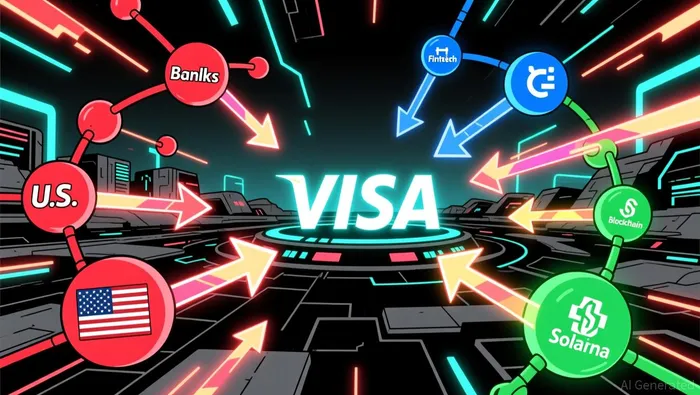
Moreover, Visa's collaboration with Circle extends beyond Solana. The company is a design partner for Arc, a new Layer 1 blockchain currently in public testnet, which is being engineered to support high-volume, real-time financial activity. VisaV-- plans to operate a validator node on Arc and use it for USDC settlements once it launches according to corporate announcements. This dual-track approach-leveraging existing blockchains while co-developing a custom solution-positions Visa to dominate the next generation of payment rails.
Institutional Adoption: Early Wins and Scalable Potential
The early adopters of Visa's USDC settlement program, including Cross River Bank and Lead Bank, are already demonstrating the tangible benefits of blockchain-based settlement. These institutions are using Solana to facilitate onchain transactions, reducing costs and improving cash flow efficiency. For example, Cross River Bank's integration of USDC has enabled real-time cross-border payments with minimal friction, a critical advantage in an era where speed and transparency are paramount.
Visa's new Stablecoins Advisory Practice, launched in late 2025, further amplifies its institutional reach. This service, delivered through Visa Consulting & Analytics, provides tailored guidance to banks, fintechs, and merchants on stablecoin strategy, implementation, and compliance. With over 130 stablecoin-linked card issuing programs already active across 40 countries, Visa is not just a participant in this shift-it's a catalyst according to investor reports.
Regulatory Tailwinds: The GENIUS Act and Institutional Confidence
The regulatory environment has also aligned to support this transformation. The passage of the GENIUS Act in 2025 established the first federal framework for stablecoins in the U.S., providing clarity and legitimacy to institutions hesitant to adopt blockchain-based solutions. This legislative milestone has accelerated institutional adoption, as seen in the rapid growth of USDC volume in markets like Africa and Latin America, where over 60% of stablecoin transactions are now processed through licensed providers.
Broader Implications: Challenging Legacy Systems
Visa's move is not just about incremental improvement-it's a direct challenge to legacy systems like SWIFT. As McKinsey's analysis highlights, stablecoins offer 24/7 availability, near-instant settlement, and transparent, auditable transaction records, all of which are critical for modern financial infrastructure. The ability to eliminate prefunding requirements and reduce reliance on correspondent banking systems is particularly transformative for cross-border payments, a $180 billion market ripe for disruption.
Future Outlook: A 2026 Rollout and Arc's Role
The broader rollout of USDC settlement in the U.S. is expected to continue through 2026 according to corporate updates, with Arc's launch likely to accelerate adoption. By operating a validator node on Arc, Visa will not only ensure its own operational resilience but also set a precedent for other financial institutions to follow. This strategic foresight-building infrastructure while the market is still nascent-positions Visa to capture significant market share as stablecoin adoption becomes mainstream.
Conclusion: A Must-Own Position in the New Payments Era
Visa's integration of USDC into its settlement infrastructure is more than a technological upgrade; it's a masterstroke in positioning the company as a leader in the stablecoin revolution. For investors, this represents a rare opportunity to align with a company that is not only adapting to change but actively shaping it. The numbers don't lie: a $3.5 billion annualized run rate in a pilot, regulatory tailwinds, and a clear roadmap for 2026 all point to a future where stablecoins are the backbone of institutional payments.
The question isn't whether this shift will happen-it's whether investors are ready to act before the next wave of disruption arrives.





Comentarios
Aún no hay comentarios