
Visa's Stablecoin Expansion and the Rise of Payment-Focused Altcoins: Identifying the Most Strategically Positioned Coin
Visa's Stablecoin Expansion and the Rise of Payment-Focused Altcoins: Identifying the Most Strategically Positioned Coin
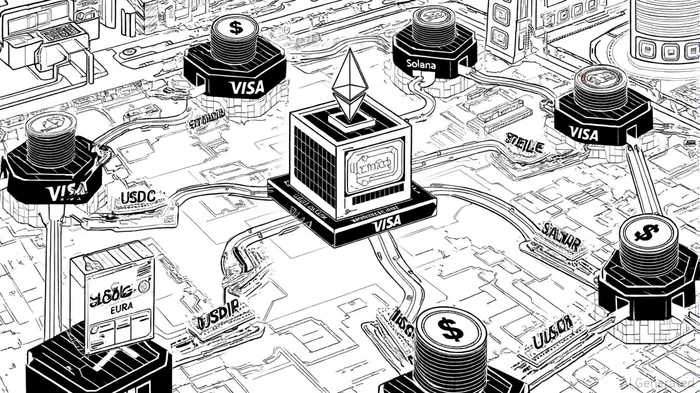
In 2025, VisaV-- has emerged as a pivotal force in bridging traditional finance and blockchain-based payment systems. By expanding its stablecoin settlement platform to support multiple blockchains and USD-backed stablecoins, the company is not only accelerating institutional adoption but also reshaping the real-world utility of digital assets. As global stablecoin transaction volumes surged to $27.6 trillion in Q1 2025-surpassing the combined transaction volumes of Visa and Mastercard, an Invezz report found-the question arises: Which altcoin is best positioned to benefit from this seismic shift?
Visa's Strategic Expansion: A Multi-Chain, Multi-Coin Infrastructure
Visa's stablecoin initiatives have evolved into a robust, multi-chain infrastructure. By supporting blockchains like EthereumETH--, SolanaSOL--, StellarXLM--, and Avalanche, alongside stablecoins such as USDG, PYUSD, and EURC, Visa expands stablecoin support and is creating a scalable framework for cross-border and on-chain transactions. This expansion is not merely technical; it reflects a strategic alignment with institutional demand for programmable money. For instance, Visa Direct now allows banks to pre-fund cross-border payments using stablecoins like USDCUSDC-- and EURC, treating them as cash equivalents to enable near-instant settlements, as a Visa pilot shows.
The real-world impact is evident in emerging markets. Visa's Yellow Card partnership to deploy stablecoin-powered payments across 20 African countries highlights the potential to reduce operational costs and streamline remittances in regions with underdeveloped traditional financial systems. Meanwhile, regulatory tailwinds-such as the U.S. GENIUS Act and Hong Kong's licensing regime-are further legitimizing stablecoins as a cornerstone of global financial infrastructure, an Invezz report notes.
Payment-Focused Altcoins: Utility-Driven Adoption
While stablecoins dominate the headlines, payment-focused altcoins with real-world utility are quietly gaining traction. These projects address critical gaps in cross-border payments, data integrity, and interoperability, aligning with Visa's infrastructure goals.
Stellar (XLM):
Stellar's role in low-cost, high-speed international transfers has already been validated through partnerships like MoneyGram, as an Analytics Insight article documents. Visa's inclusion of Stellar in its multi-chain network underscores its strategic value for cross-border use cases. With XLM's focus on financial inclusion and institutional-grade scalability, it is uniquely positioned to benefit from Visa's Africa-focused initiatives.Chainlink (LINK):
As a decentralized oracle network, ChainlinkLINK-- enables smart contracts to access real-world data-a critical enabler for DeFi and insurance applications, Impartoo notes. Visa's push for programmable money could integrate Chainlink's services to verify transaction data or automate compliance checks, making LINK a strong contender for institutional adoption.Quant (QNT):
Quant's Overledger platform facilitates cross-chain interoperability, a key requirement for Visa's multi-chain infrastructure. By enabling seamless asset transfers between Ethereum, Solana, and other networks, QNTQNT-- addresses a core challenge in global payments, Mudrex explains. This aligns with Visa's vision of a unified, frictionless financial ecosystem.
The Most Strategically Positioned Altcoin: Stellar (XLM)
Among these, Stellar (XLM) stands out as the most strategically positioned altcoin. Its existing partnerships with MoneyGram and inclusion in Visa's multi-chain network demonstrate immediate real-world utility. XLM's focus on cross-border payments-where Visa is actively testing stablecoin-driven solutions in Africa-creates a direct synergy. Furthermore, Stellar's low transaction fees and energy-efficient consensus mechanism make it ideal for high-volume, institutional-grade use cases.
Chainlink and QuantQNT--, while critical for smart contract and interoperability use cases, face longer adoption timelines compared to XLM's immediate applicability in Visa's expanding stablecoin ecosystem. As global remittance markets grow and regulatory clarity emerges, XLM's role in bridging traditional and digital finance will likely solidify its position as a top-tier altcoin.
Conclusion: A New Era for Payment Innovation
Visa's stablecoin expansion is not just a technological upgrade-it's a paradigm shift in how value is transferred globally. By prioritizing multi-chain infrastructure and institutional partnerships, the company is laying the groundwork for a future where stablecoins and payment-focused altcoins coexist with traditional systems. For investors, Stellar (XLM) represents a compelling opportunity, given its alignment with Visa's cross-border initiatives and proven real-world adoption. As the lines between legacy finance and blockchain blurBLUR--, the altcoins that solve tangible problems-like XLM-will lead the charge.






Comentarios
Aún no hay comentarios