
Virtus Total Return Fund's Strategic Use of Conditional Tender Offers: A Blueprint for Capital Structure Optimization and Shareholder Value Creation
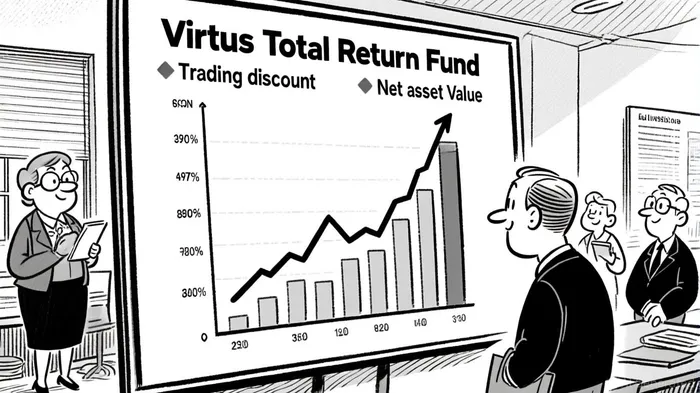
In the ever-evolving landscape of closed-end funds, the Virtus TotalZTR-- Return Fund (ZTR) has emerged as a case study in strategic capital management. By leveraging conditional tender offers, ZTRZTR-- has sought to address persistent trading discounts to its net asset value (NAV) while aligning management incentives with shareholder interests. These efforts, executed in 2024 and 2025, underscore a disciplined approach to capital structure optimization and value creation-a critical imperative for funds grappling with liquidity mismatches and market inefficiencies.
The Mechanics of Conditional Tender Offers
ZTR's strategy hinges on a dual-tiered conditional tender offer program. The first offer, triggered in December 2024, was activated when the fund's average trading discount surged to 12.51% during the measurement period from May 31, 2024, to November 26, 2024, as announced in the first conditional tender offer. This allowed ZTR to repurchase up to 10% of its shares at 98% of NAV, a price designed to incentivize participation while mitigating dilution risks. A second conditional tender offer, announced in October 2025 after an average trading discount of 11.41% during April 1–September 26, 2025, initiated a new repurchase window from November 3 to December 3, 2025, per the second conditional tender offer.
These offers are not mere theoretical constructs. The January 2025 tender, for instance, was oversubscribed by 3.3x, with 20.2 million shares tendered-a testament to investor demand for liquidity at a price closer to intrinsic value. By accepting shares on a pro rata basis, ZTR ensured fairness while reducing its outstanding share count by 10%, a move that could technically support its market price and narrow the discount further.
Capital Structure Optimization: Leverage, NAV, and Risk Management
ZTR's leverage ratio of 34.23% as of September 2023-a figure derived from $207 million in regulatory leverage relative to $604.754 million in total investment exposure-highlights the fund's reliance on borrowed capital, according to the CEFConnect profile. While the sources do not provide post-tender leverage metrics, the reduction in share count inherently lowers equity volatility. By repurchasing discounted shares, ZTR effectively reduces its equity base, which, in a low-interest-rate environment, could enhance return on equity (ROE) metrics without increasing debt levels.
Moreover, the fund's NAV trends suggest a positive trajectory. As of November 30, 2024, ZTR's NAV had appreciated by 13.494% on assets, a performance bolstered by its hybrid strategy of combining equity and fixed-income investments (CEFConnect data). The conditional tender offers, by narrowing the discount, aim to align market price with NAV, thereby reducing the risk of "discount volatility" that often plagues closed-end funds.
Shareholder Value Creation: From Return of Capital to Sustainable Gains
The evolution of ZTR's distribution strategy further illustrates its commitment to value creation. In 2024, distributions were heavily reliant on return of capital (100% in August 2024), a practice that, while necessary during periods of underperformance, does not reflect earnings growth, as disclosed in the Section 19(a) notice. By September 2025, however, the composition had shifted: 20% of distributions were attributed to return of capital, with the remainder sourced from net realized long-term capital gains and investment income (Morningstar disclosure). This transition signals improved portfolio performance and a move toward sustainable returns, which are critical for long-term shareholder value.
Expert Perspectives and Market Reception
Analysts have largely endorsed ZTR's approach. The oversubscription of the January 2025 tender, for example, was interpreted as a vote of confidence in management's ability to execute its strategy. Additionally, the shift in distribution sources-from return of capital to income and gains-has been viewed as a positive development, suggesting that ZTR's active sector rotation and disciplined risk management (managed by Duff & Phelps and Newfleet Asset Management) are beginning to bear fruit (CEFConnect commentary).
However, challenges remain. The fund's reliance on NAV-based financing-a tool increasingly adopted in private markets to enhance liquidity-introduces structural risks, including valuation sensitivities and governance complexities, according to a Hogan Lovells outlook. While ZTR's leverage ratios remain within conservative bounds, the broader market's scrutiny of non-dilutive capital tools underscores the need for transparency and prudent risk management.
A Path Forward
ZTR's conditional tender offers represent more than a tactical response to discount pressures; they are part of a broader narrative of capital structure optimization. By reducing share counts, aligning with shareholder liquidity needs, and transitioning toward earnings-driven distributions, the fund is laying the groundwork for sustainable value creation. Yet, the long-term success of this strategy will depend on its ability to maintain NAV growth, manage leverage prudently, and navigate the evolving regulatory landscape surrounding NAV-based financing.





Comentarios
Aún no hay comentarios