
Virtus Total Return Fund Inc.'s Strategic Capital Management: Assessing the Impact of Its Second Conditional Tender Offer on Shareholder Value and Liquidity
Virtus Total Return Fund Inc. (NYSE: ZTR) has long grappled with a persistent trading discount to its net asset value (NAV), a challenge common to many closed-end funds. In 2024 and 2025, the fund implemented a series of conditional tender offers to address this issue, with the second such offer-triggered by an 11.41% average discount during April–September 2025-offering a critical test of its capital management strategy. This article evaluates the potential impact of the second conditional tender offer on shareholder value and liquidity, contextualized by historical performance and market dynamics.
The Mechanics of the Second Conditional Tender Offer
The second conditional tender offer, announced in October 2025, is structured to repurchase up to 10% of ZTR's outstanding shares at 98% of NAV, net of expenses, as of the expiration date (December 3, 2025), according to a Yahoo Finance release. This mechanism mirrors the first tender offer in 2024, which similarly targeted a 10% threshold and was detailed in a Virtus press release. The offer's activation was contingent on the average trading discount exceeding 10% during the 180-day measurement period-a condition met with an 11.41% discount, as reported in a Morningstar report.
Historical Context: Lessons from Prior Offers
ZTR's first tender offer in 2024, which ran from April to May 2024, was oversubscribed, with shareholders tendering approximately 20.4 million shares-double the intended 10% target. The fund accepted shares on a pro-rata basis, purchasing 6.17 million shares at $6.4386 per share (98% of NAV), according to the fund's final results notice. While this action temporarily reduced the discount, the subsequent measurement period revealed a renewed discount of 12.51% by late 2024, necessitating a second conditional offer, as reported by Seeking Alpha. This pattern suggests that while tender offers provide short-term relief, structural factors-such as market sentiment or fund performance-may perpetuate long-term discounts.
Impact on Shareholder Value: Capital Efficiency and NAV Alignment
Repurchasing shares at a discount to NAV inherently creates value for remaining shareholders. For ZTRZTR--, the second tender offer aims to reduce the discount by removing undervalued shares from circulation, thereby increasing the NAV per share for non-participating investors. An InvestorsHangout analysis notes that similar tender offers in closed-end funds have historically narrowed discounts by 1–3 percentage points post-exercise, though outcomes vary based on market conditions. If the second offer achieves its 10% repurchase target, it could potentially elevate the fund's NAV per share by approximately 1.01%, assuming no change in total assets (calculated based on ZTR's 2024 tender offer results and NAV per share).
However, the effectiveness of this strategy hinges on the fund's ability to sustainably improve its market valuation. As observed in coverage from StockTitan, ZTR's 2024 tender offer did not fully resolve the discount, indicating that repeated interventions may be necessary unless broader market dynamics shift StockTitan.
Liquidity Considerations: A Double-Edged Sword
Tender offers serve as a liquidity mechanism for shareholders, particularly in markets where secondary trading is limited or inefficient. By offering to repurchase shares at 98% of NAV, ZTR provides an alternative to selling in the open market, where prices may trade significantly below NAV. This is especially valuable for investors seeking to exit positions without exacerbating the discount through increased supply.
Yet, liquidity benefits must be balanced against potential dilution risks. If the fund's discount persists post-offer, future tender programs may require larger repurchase percentages or higher prices to achieve meaningful impact, potentially straining capital reserves. As stated by Virtus in its SEC filing, the fund's ability to execute future offers depends on continued compliance with discount thresholds and regulatory approvals.
Strategic Implications and Market Outlook
The second conditional tender offer underscores ZTR's commitment to shareholder-centric capital management. However, its long-term success will depend on addressing the root causes of the discount. A Bloomberg analysis suggests that improving the fund's yield profile or diversifying its portfolio could enhance investor appeal, reducing reliance on periodic buybacks. Additionally, the fund's management must navigate regulatory scrutiny, as frequent tender offers may raise questions about governance practices in closed-end funds.
Conclusion
Virtus Total Return Fund's second conditional tender offer represents a calculated effort to stabilize its trading discount and enhance liquidity. While historical data indicates that such programs can yield modest value creation, their efficacy is contingent on broader market conditions and structural improvements. For investors, the offer presents an opportunity to participate in a disciplined repurchase process, though it also highlights the challenges inherent in managing closed-end fund discounts. As ZTR moves forward, the market will be watching to see whether this strategy can evolve from a reactive measure to a proactive solution for sustainable value creation.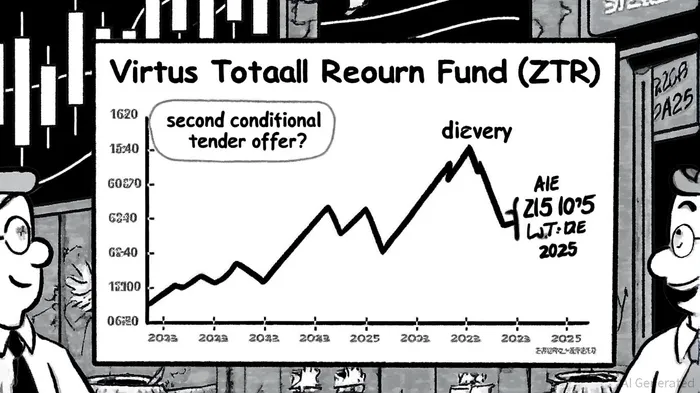





Comentarios
Aún no hay comentarios