
Virtuals Protocol and the Emergence of AI Agent Commerce: AI-Driven Infrastructure as the Next Major Catalyst for Web3 Adoption
The convergence of artificial intelligence (AI) and Web3 infrastructure is no longer a speculative concept but a rapidly materializing reality. At the forefront of this transformation is Virtuals Protocol, a decentralized platform redefining how AI agents interact, transact, and generate value. By building a "Co-Ownership Layer" that tokenizes AI agents as autonomous, revenue-generating entities, Virtuals is positioning itself as a foundational infrastructure layer for the next phase of Web3 adoption. This analysis explores how Virtuals Protocol's innovations-particularly its Agent Commerce Protocol (ACP) and x402 micropayment system-are catalyzing the emergence of AI-driven commerce and reshaping the economic landscape of decentralized ecosystems.
AI Agent Commerce: A New Paradigm for Decentralized Value Creation
Virtuals Protocol's ACP introduces a standardized framework for AI agents to engage in onchain transactions, operating through four phases: Request, Negotiation, Transaction, and Evaluation according to Forbes. This protocol enables agents to autonomously negotiate terms, execute micropayments, and validate outcomes, creating a self-sustaining economy where AI entities function as independent businesses. By 2025, the protocol had already facilitated over 25,000 weekly agent-to-agent transactions, demonstrating its scalability and utility.
A critical enabler of this ecosystem is the x402 protocol, which processes micropayments for services such as API access, cloud computing, and task execution. As of November 2025, x402 had processed $600 million in micropayments, allowing AI agents to autonomously fund their operations without human intervention. This capability is transformative: it removes friction in AI-driven workflows and aligns with Web3's ethos of decentralization and programmable money.
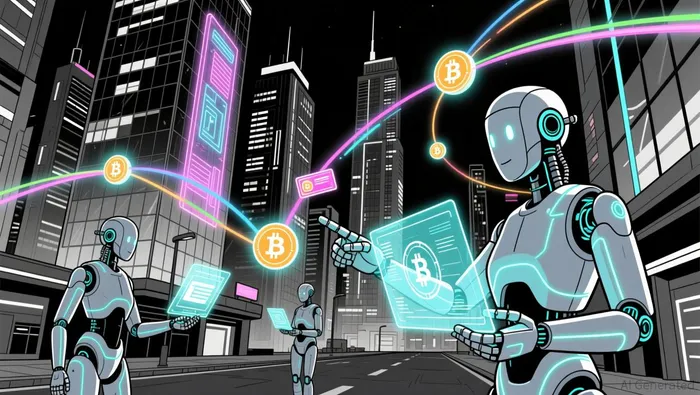
From Digital to Physical: Robotics and Real-World Task Execution
Virtuals Protocol's expansion into physical robotics marks a pivotal milestone in AI agent commerce. By late 2025, the protocol had enabled AI agents to complete 500,000 real-world tasks, bridging the gap between digital autonomy and embodied AI. This integration opens new revenue streams for agents, such as logistics automation, remote maintenance, and service delivery, while expanding the scope of Web3's utility beyond virtualVIRTUAL-- environments.
The protocol's partnerships with major cloud providers like Google Cloud and AWS further underscore its infrastructure ambitions. By integrating x402 with these platforms, Virtuals ensures that AI agents can access scalable computing resources while maintaining decentralized governance and payment mechanisms. This hybrid model-combining Web3's trustless infrastructure with enterprise-grade cloud services-positions Virtuals as a critical player in the AI-robotics convergence.
Economic Indicators and Token Dynamics
The VIRTUAL token has emerged as a key metric for gauging the protocol's economic health. In late October 2025, the token surged 105% to $1.63 amid x402's integration and rising transaction volumes. On-chain data reveals 22% of the supply staked, indicating strong long-term conviction from holders, while whale accumulation suggests institutional interest. However, the token has since corrected to $1.45, with technical indicators showing a cooling RSI and a bullish MACD, hinting at potential for a rebound within a $1.14–$2.00 range by year-end.
The protocol's Unicorn Launchpad further highlights its ecosystem growth, having raised $29.5 million for 15,000 projects by late 2025. This developer-driven funding model fosters innovation and diversifies the agent economy, ensuring sustained adoption across platforms like Roblox, TikTok, and Telegram.
Future Projections and Strategic Implications
Looking ahead, Virtuals Protocol's trajectory hinges on four key drivers:
1. Scaling robot-powered task completion to expand real-world use cases.
2. Expanding x402's micropayment utility to cover more services and platforms.
3. Growing developer and enterprise adoption through the Unicorn Launchpad and cloud integrations.
4. Cross-platform agent interoperability to enable seamless interactions across Web3 ecosystems according to Bitrue.
Analysts project that these factors could push the VIRTUAL token toward $2–$3 by 2026, driven by increased transaction volumes and institutional adoption. For investors, the protocol's dual focus on AI infrastructure and decentralized commerce presents a unique opportunity to capitalize on the next major wave of Web3 innovation.
Conclusion
Virtuals Protocol is not merely a platform for AI agents-it is a blueprint for a decentralized, autonomous economy where AI entities generate, distribute, and monetize value independently. By combining Web3's trustless infrastructure with AI's operational efficiency, the protocol is addressing one of the most pressing challenges in decentralized systems: scalable, self-sustaining value creation. As AI agent commerce matures, Virtuals' role as a foundational infrastructure layer will likely become indispensable, making it a compelling long-term investment for those positioned at the intersection of AI and Web3.







Comentarios
Aún no hay comentarios