
Virtual Bull Market Dynamics vs. Spot Market Fundamentals: Navigating Overvaluation Risks and Strategic Exits
The Divergence Between Virtual Bull Markets and Physical Fundamentals
The U.S. equity market has entered a "virtual bull market" characterized by technical momentum and investor sentiment decoupled from traditional economic fundamentals. Between 2023 and 2025, the S&P 500 surged 30.8%, driven by a golden-cross trade and a 25%+ annualized return from the Magnificent 7 (Mag7) stocks, which now account for 30% of the index's market capitalization [1]. This performance contrasts sharply with the physical commodity markets, where copper and aluminum prices have faced downward pressure due to global demand constraints and supply-side disruptions.
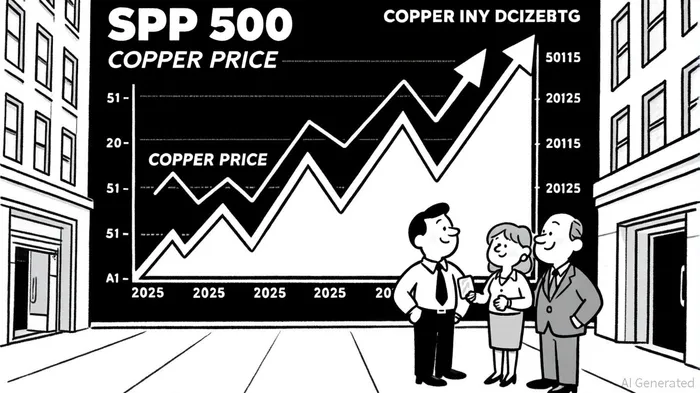
For instance, copper prices, a critical barometer of industrial demand, peaked at $10,200/ton in early 2025 but fell 10% by Q2 2025 amid U.S. tariff policies and recession risks [2]. Similarly, aluminum demand growth is projected at just 1% year-over-year, creating a potential surplus despite a 40% surge in construction material costs in 2024 [3]. This divergence underscores a market environment where equity indices are increasingly driven by algorithmic trading, passive capital flows, and speculative positioning rather than industrial activity [4].
Valuation Metrics Signal Overvaluation Risks
The S&P 500's forward P/E ratio stands at 23.18, down from 26.84 in 2024, while its trailing P/E is 25.90—both levels near historical extremes [5]. The Rule of 20 valuation metric, which adds the 10-year Treasury yield and earnings growth, suggests the market is trading at a premium given current inflationary pressures [6]. Meanwhile, the CAPE ratio (cyclically adjusted P/E) is at 38, triple the long-term average, implying a 66-67% correction would be needed to align with historical norms [7].
The Mag7's valuations are even more extreme. TeslaTSLA-- trades at a P/E of 122x, while AmazonAMZN-- and NvidiaNVDA-- carry multiples of 37.9x and 26.6x, respectively [8]. These metrics reflect divergent investor perceptions of growth potential but also highlight systemic concentration risk. For example, Nvidia's PEG ratio of 0.5x suggests its valuation is justified by high growth, but Tesla's 122x P/E relies on unproven monetization of AI-driven innovations [9].
Actionable Exit Strategies for a Fragile Market
Given the overvaluation risks and structural imbalances, investors should adopt proactive strategies to mitigate downside exposure:
- Sector Rotation: Shift capital from overvalued tech stocks to sectors with stronger fundamentals, such as healthcare, energy, and financials. These sectors have shown relative resilience amid macroeconomic uncertainty [10].
- Hedging with Derivatives: Utilize put options or inverse ETFs to protect against a potential 25%+ correction in the Mag7 or broader S&P 500. Convertible arbitrage strategies can also balance long equity positions with short credit exposure [11].
- Diversification and Cash Reserves: Reduce concentration in large-cap tech by increasing allocations to small-cap equities, real assets (e.g., infrastructure, commodities), and defensive stocks. Maintaining 15–20% cash reserves provides liquidity for opportunistic entries during market dips [12].
- AI-Driven Portfolio Management: Leverage algorithmic tools to dynamically adjust asset allocations based on real-time macroeconomic signals and sentiment analysis. These systems can identify early signs of market rotation or policy shifts [13].
Conclusion
The current virtual bull market, while impressive in duration and magnitude, is increasingly disconnected from the physical economy. As J.P. Morgan Research notes, global copper demand is expected to grow at only 1% annually, while the S&P 500's valuation multiples suggest a 66% correction to align with historical averages [14]. Investors must remain vigilant, balancing optimism about AI-driven growth with caution regarding overvaluation and concentration risk. By diversifying portfolios, hedging exposure, and leveraging data-driven strategies, market participants can navigate the fragile landscape of 2025 and beyond.







Comentarios
Aún no hay comentarios