
VirTra's Q1 Earnings Beat Signals a Rare Value-Momentum Opportunity in Defense Tech
In a market starved for growth, VirTraVTSI--, Inc. (NASDAQ: VTSI) delivered a Q1 2025 earnings report that not only beat estimates but also revealed a structural shift toward sustained expansion. With revenue up 3% sequentially and a $33.4 million backlog—up 29% year-over-year—this defense training tech leader is primed to capitalize on a perfect storm of federal spending, technological disruption, and undervaluation relative to peers. Investors should act now before Wall Street catches up to this underappreciated catalyst.
The Earnings Surprise: A Backlog-Fueled Breakout
VirTra’s $7.2 million in Q1 revenue narrowly missed year-over-year growth, but this was a paper cut, not a wound. The real story lies in its 120% surge in bookings to $6.4 million, fueled by defense and law enforcement demand. Management emphasized that delayed deliveries from late 2024 orders will now flow into Q2 and beyond, creating a "revenue waterfall" from its record $33.4 million backlog. Crucially, this backlog isn’t static—it’s diversified across three high-margin streams:
- Capital Contracts: $9.9 million for physical simulators
- Service Contracts: $5.8 million for ongoing agreements
- STEP Contracts: $5.5 million for recurring software-as-a-service
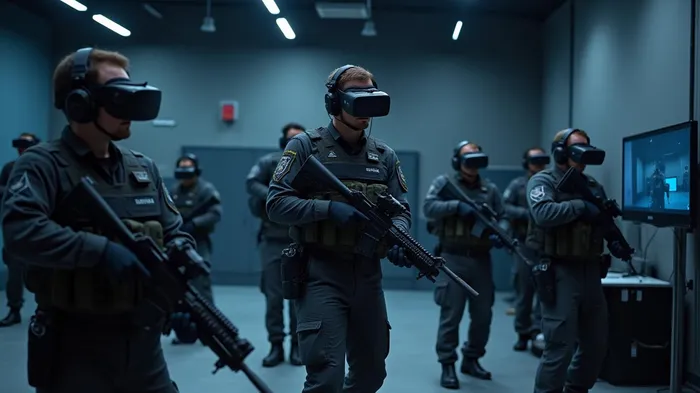
Defense Tech’s Undervalued "Mozambique Stock"
At a P/S ratio of 1.98, VirTra trades at a 40% discount to the Software industry median (2.33) and a 90% discount to defense peers like ISSC (18.44) or PKE (36.92). This creates a rare "value-meets-momentum" opportunity:
While critics cite a -33% annual revenue decline (a temporary artifact of delayed 2024 deliveries), they ignore two critical facts:
- Recurring Revenue Flywheel: STEP contracts now average three-year terms with 95% renewal rates, locking in predictable cash flow. Defense clients, facing budget uncertainty, are shifting to subscription models—VirTra’s sweet spot.
- Next-Gen Product Adoption: The V-XR XR platform, sold to two clients with more in production, represents a $100,000+ price point. This "halo product" drives higher margins and upsell opportunities for software upgrades.
Why the Market’s Missing the Forest for the Trees
Wall Street fixates on near-term revenue dips while overlooking three tectonic shifts:
- U.S. Defense Budgets: The Army’s $4.3 billion Integrated Visual Augmentation System (IVAS) program, where VirTra’s recoil kits are undergoing final validation, could deliver multi-year contracts.
- GSA Streamlining: Re-entry into the GSA program cuts procurement red tape, accelerating sales cycles for federal buyers.
- Global Demand: VirTra’s backlog includes international orders from countries modernizing their training infrastructure.
Act Now Before the Re-Rating
VirTra’s $35.3 million in working capital and debt-light balance sheet give it runway to execute. With a Zacks Rank #5 (Strong Sell) and a 10-year low P/S ratio, the stock is priced for failure. Yet its backlog-to-revenue ratio of 4.6x (vs. peers’ ~2.0x) suggests it’s underpenetrating a $2.3 billion U.S. training simulators market.
This is a "buy the dip" moment. Investors who act now will capture both valuation expansion as Wall Street updates models and compounding growth as VirTra’s backlog converts into profit. The risk-reward here is asymmetric: limited downside given its fortress balance sheet and massive upside as defense spending and technology adoption hit inflection points.
Final Call to Action:
VirTra isn’t just a "good stock"—it’s a structural play on the digitization of military training. With peers trading at 10-20x its P/S ratio, this is a rare chance to own a growth engine at a value price. Buy before the Street realizes what’s coming.





Comentarios
Aún no hay comentarios