
Virgin Galactic: Navigating Near-Term Turbulence for Long-Term Space Tourism Dominance
Virgin Galactic (NYSE: SPCE) stands at a pivotal juncture. The company's Q2 2025 financials reveal stark challenges: a projected cash burn of $105M–$115M, a 75% revenue drop to $500K, and a debt-to-equity ratio of 1.55. Yet, its $567M cash reserve and ambitious Delta Class spacecraft program offer a path to long-term market leadership in the booming space tourism sector. Investors must weigh these near-term risks against Virgin Galactic's potential to capitalize on a $10–$15B space tourism market by 2030.
The Near-Term Storm: Cash Burn and Operational Hurdles
Virgin Galactic's financial health is fragile. Its Q1 2025 net loss narrowed to $84M (down 17% year-over-year), but free cash flow remains dire. To survive until its 2026 commercialization target, the company must slash quarterly spending to below $100M by Q4 2025.
The strategic pause in commercial flights since late 2023—now framed as a “strategic reallocation” to Delta Class development—has drawn skepticism. While this pause conserves cash, it risks customer attrition and investor confidence. Virgin's 675 pre-booked reservations (at $600K+ per ticket) provide a financial buffer, but execution risks loom large. Delays in Delta Class testing or regulatory approvals could extend cash burn timelines, forcing equity dilution or debt issuance.
Operational Progress: Delta Class as the Catalyst
The Delta Class spacecraft—designed to carry six passengers and conduct up to 125 flights annually by 2026—are central to Virgin's future. Key milestones include:
- Summer 2026: First research payload flight.
- Fall 2026: Private astronaut missions.
- 2027: Revenue target of $450M, fueled by 1,000+ annual passengers.
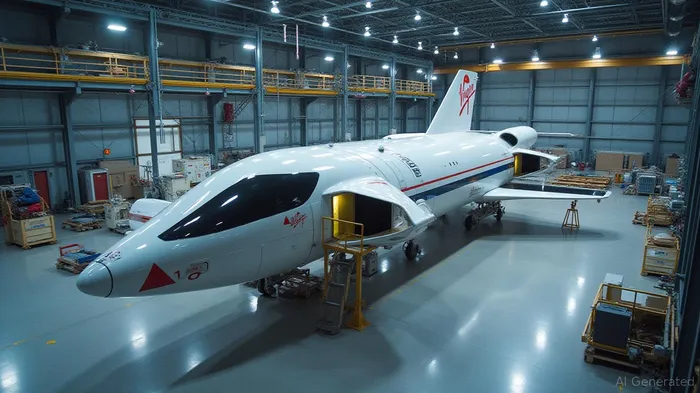
The Delta program's progress is tangible. Rocket motor systems, avionics, and carbon-fiber structures are nearing completion, with glide tests scheduled for early 2026. The Phoenix, Arizona manufacturing facility—now operational—will accelerate assembly, reducing costs per flight.
Competitive Landscape: Navigating a Crowded Race to the Stars
Virgin faces formidable rivals:
- Blue Origin: Dominates suborbital tourism with frequent New Shepard flights, targeting hundreds of passengers annually by 2026.
- SpaceX: Aiming for $10M orbital seats by 2030 and five private orbital missions annually by 2027.
- Global entrants: China's state-backed space tourism initiatives and Axiom Space's ISS missions threaten Virgin's premium positioning.
Virgin's edge lies in its first-mover advantage, premium branding, and Delta's scalability. By 2026, Delta's twice-weekly flight cadence could outpace legacy spacecraft, while its research and government partnerships (e.g., HALE-Heavy aircraft for defense contracts) diversify revenue streams.
Market Potential: The $15B Prize
The space tourism sector is growing at a 15–20% CAGR, with suborbital flights capturing over 70% of the market by 2030. Virgin's $450M 2027 revenue target aligns with this trajectory. However, execution is critical:
- Technical risks: Delays in Delta's testing or safety incidents could derail timelines.
- Regulatory hurdles: FAA approvals and international compliance add uncertainty.
- Demand volatility: Ultra-high-net-worth customers may shift preferences as competitors lower prices.
Investment Thesis: A High-Risk, High-Reward Play
Near-term risks:
- Cash burn: SPCE's stock has already fallen 40% year-to-date, reflecting investor anxiety.
- Execution dependency: Missed 2026 milestones could trigger a liquidity crisis.
Long-term upside:
- Valuation discount: Trading below cash reserves ($1.5B valuation vs. $567M cash), SPCE offers an asymmetric opportunity if Delta succeeds.
- Market dominance: A $450M revenue stream by 2027 could revalue SPCE at $3–5B, unlocking 100–200% gains.
Conclusion: Hold for Now, but Keep an Eye on 2026
Virgin Galactic is a high-risk bet for the cautious investor. Its near-term cash burn and execution hurdles justify skepticism, but its $15B market opportunity and strategic moves (Delta Class, HALE diversification) make it a compelling long-term play.
Investment advice:
- Hold: For now, SPCE's valuation and cash runway provide a margin of safety.
Historically, this strategy underperformed, with an average loss of 88.77% and a peak drawdown of 94.21%, underscoring the risks of short-term timing.
- Buy: Consider adding to positions if Delta's 2026 milestones are met (e.g., successful research flights, resumed bookings).
- Avoid: If cash reserves dip below $200M before 2026 or Delta faces major delays.
The stars may still be Virgin Galactic's to conquer—but only if it survives the storm.





Comentarios
Aún no hay comentarios