
Vingroup's $500M EV Charging Push: A Strategic Bet on Southeast Asia's Green Energy Revolution
Southeast Asia's green energy revolution is gaining momentum, driven by ambitious policy frameworks, urbanization, and a growing appetite for sustainable infrastructure. At the forefront of this transformation is Vingroup, Vietnam's largest conglomerate, which has committed $500 million to expand its EV charging network across the region. This strategic push, led by V-GREEN (Vingroup's green energy subsidiary), underscores the critical role of private credit in accelerating EV infrastructure and offers institutional investors a compelling case for long-term returns.
The Strategic Imperative: Filling Southeast Asia's Infrastructure Gap
Southeast Asia faces a staggering $60 billion infrastructure investment gap, particularly in clean energy and transportation, according to a PIDG report. Traditional banks, constrained by risk-aversion and limited reach, have left a void that private credit is uniquely positioned to fill. V-GREEN's partnerships with Taiwanese firm eTreego and Indonesian Prime Group exemplify this dynamic. By 2030, the collaboration aims to deploy 100,000 EV charging portals across Vietnam, Indonesia, and the Philippines, with a projected $1.2 billion investment in Indonesia alone, according to a V-GREEN announcement. These projects are not just about scale-they are about addressing systemic bottlenecks. For instance, Vietnam's national goal to reduce greenhouse gas emissions by 75% by 2030, according to a Cleantechnica article, hinges on widespread EV adoption, which in turn depends on accessible charging infrastructure.
Private credit's flexibility allows for tailored solutions to navigate Southeast Asia's fragmented regulatory landscape. In Indonesia, V-GREEN's partnership with Chargecore, ChargepointCHPT--, Amarta Group, and CVS includes guaranteed annual returns of up to 25% for the first three years, according to a VinFast release. Such structured deals mitigate risks for institutional investors while aligning with national decarbonization targets.
ROI Potential: Policy Tailwinds and Market Dynamics
The financial appeal of V-GREEN's initiatives is bolstered by Southeast Asia's rapid EV market growth. Thailand's "30@30" policy aims for 30% zero-emission vehicle production by 2030, while Indonesia's localization mandates seek to reduce EV import dependencies by 40% by 2030, according to an Anariev analysis. These policies create a self-reinforcing cycle: government incentives lower entry barriers for EV manufacturers, which in turn drive demand for charging infrastructure.
Data from 2025 reveals a compound annual growth rate (CAGR) of over 24% for EV charging equipment in the region, with revenues approaching $260 million, the Anariev analysis found. For institutional investors, this translates to scalable returns. V-GREEN's $300 million investment in Indonesia's 63,000 charging ports, for example, leverages a mix of direct ownership (20%) and business cooperation contracts, ensuring diversified risk exposure, as noted in the VinFast release. Moreover, renewable energy integration in charging stations could reduce operational costs by 30%, further enhancing profitability, the Anariev analysis suggests.
Challenges and Mitigation Strategies
Despite the optimism, challenges persist. Grid instability and uneven distribution of charging points remain hurdles, with utilization rates hovering at 20–30% in some countries, the Anariev analysis notes. However, private credit's agility allows for innovative solutions. Blended finance models-combining philanthropy, public grants, and private capital-have already proven effective in de-risking marginally bankable projects. For instance, PIDG's AquaOne bond in Vietnam attracted institutional interest by structuring long-term, low-risk returns, according to the PIDG report.
Regulatory complexity also demands local expertise. V-GREEN's partnerships with regional players like eTreego and Prime Group mitigate this by leveraging on-the-ground knowledge. Additionally, secondary trading platforms and private credit marketplaces are emerging to enhance liquidity, a critical factor for institutional investors seeking exit strategies, as highlighted by PIDG.
Long-Term Outlook: A Win-Win for Investors and the Planet
V-GREEN's $500 million push is not just a bet on infrastructure-it's a strategic alignment with Southeast Asia's decarbonization agenda. By 2030, the region is projected to host over 10 million public charging points, according to the Anariev analysis, creating a durable asset class for private credit. For institutional investors, the combination of policy tailwinds, scalable returns, and ESG alignment makes this sector particularly attractive.
Conclusion
Vingroup's EV charging initiatives exemplify how private credit can catalyze Southeast Asia's green energy transition. By addressing infrastructure gaps, leveraging policy incentives, and structuring risk-mitigated returns, these projects offer institutional investors a unique opportunity to combine financial and environmental impact. As the region's EV ecosystem matures, early movers like V-GREEN are poised to reap outsized rewards-provided they maintain agility in navigating regulatory and operational challenges.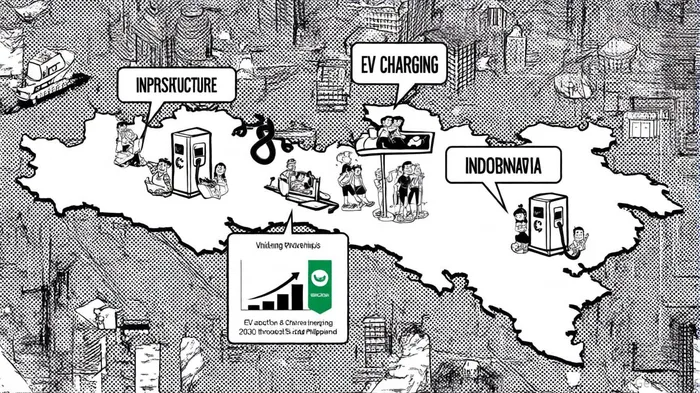





Comentarios
Aún no hay comentarios