
Village Super Market's Dividend Signal and Its Implications for Retail Investors
For income-focused investors, the sustainability of dividends is a litmus test for a company's financial resilience. Village Super MarketVLGEA-- (VLGEA), a regional grocery chain with a 13-year streak of uninterrupted dividend payments, presents a compelling case study in this regard. As the retail landscape evolves under the weight of technological disruption, shifting consumer preferences, and supply chain volatility, VLGEA's dividend policy offers a lens through which to assess its adaptability and long-term viability.
Financial Foundations: Stability Amidst Modest Growth
VLGEA's financials reveal a company that prioritizes consistency over aggressive expansion. Net income attributable to common shareholders has remained steady at $50 million annually since 2023, despite revenue growth from $2,061 million in 2022 to $2,237 million in 2024 [1]. This stability is underpinned by disciplined cost management and a focus on same-store sales, which rose 2.3% in Q2 2025, contributing to a 17% year-over-year increase in net income to $16.9 million [4].
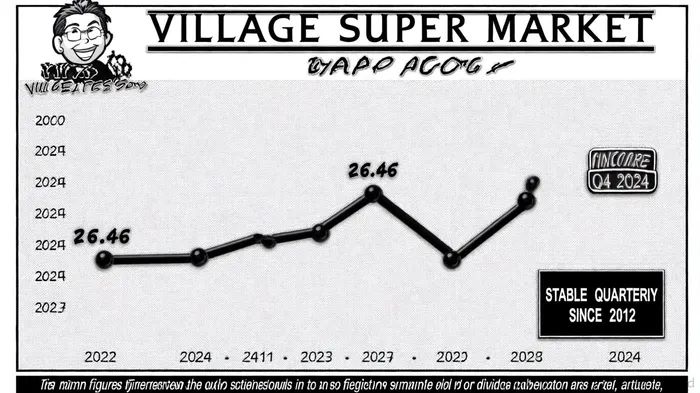
The dividend payout ratio, a critical metric for sustainability, has trended downward. As of Q4 2024, it stood at 26.46%, meaning the company allocates just over a quarter of its earnings to shareholders [2]. This low ratio, combined with a consistent quarterly payout of $0.25 per share since 2012 [5], suggests a buffer against short-term earnings fluctuations. However, the absence of a dividend increase in the past year—a rare deviation from its historical pattern—raises questions about near-term capacity to reward shareholders [5].
Liquidity metrics further reinforce this cautious outlook. While the current ratio dipped slightly from 1.15 in 2024 to 1.06 in 2025 [1], the company maintains $117 million in cash and equivalents as of Q3 2025 [3]. Total debt of $371.68 million [2] is manageable, particularly given the $479.68 million in shareholders' equity [5]. Yet, negative net cash from financing activities ($26 million in 2024) reflects ongoing debt repayments and share repurchases, which could strain liquidity if operating cash flows dip [1].
Industry Dynamics: Navigating Disruption and Opportunity
The 2025 grocery retail landscape is defined by three transformative forces: technological integration, omnichannel adoption, and sustainability pressures. AI-driven inventory systems and automation are becoming table stakes for efficiency, with rivals like KrogerKR-- leveraging these tools to reduce waste and optimize pricing [2]. VLGEA's recent Q2 results, which included a new store in Old Bridge, NJ, suggest a measured approach to expansion, but its public filings offer little detail on AI adoption—a potential vulnerability in an industry where lagging technology can erode margins [4].
Omnichannel demand is another wildcard. U.S. eGrocery sales surged 21% year-over-year to $9.7 billion in March 2025 [2], driven by 30% of households using multiple fulfillment methods. While VLGEA's focus on fresh food and private-label brands aligns with consumer trends toward health-conscious spending [2], its reliance on traditional retail channels could expose it to margin pressures if competitors accelerate digital investments.
Supply chain challenges, including geopolitical tensions and tariff uncertainties, add further complexity [3]. VLGEA's strategy of diversifying suppliers and prioritizing cost-effective private-label products mirrors industry best practices [3], but its smaller scale compared to national chains like WalmartWMT-- may limit its bargaining power in volatile markets.
Dividend Sustainability: A Balancing Act
The interplay of these factors creates a nuanced picture for dividend sustainability. On one hand, VLGEA's low payout ratio, robust retained earnings ($411.497 million as of Q3 2025 [5]), and consistent net income provide a strong foundation. The recent September 2025 dividend declaration—$0.25 per Class A share and $0.1625 per Class B share—further underscores management's commitment to shareholder returns [5].
On the other hand, the company's lack of dividend growth since 2024 and modest operating cash flow in Q4 2024 ($23 million [1]) highlight vulnerabilities. If inflationary pressures persist or supply chain disruptions escalate, VLGEAVLGEA-- may face margin compression that could force a trade-off between reinvestment and dividend maintenance.
For investors, the key question is whether VLGEA's conservative financial policies and strategic investments in store openings and private-label brands can offset these risks. The company's ability to boost same-store sales and its recent 4.2% revenue growth [4] suggest it is not entirely out of step with industry trends. However, without a clear roadmap for AI integration or e-commerce expansion, its long-term dividend sustainability could hinge on its capacity to adapt to a rapidly shifting retail ecosystem.
Historical backtesting reveals that dividend announcements by VLGEA have been followed by a statistically significant positive drift in stock price. Specifically, the strongest out-performance—approximately 7–10% excess return relative to the benchmark—has materialized roughly 3–4 weeks after the event . This pattern suggests that the market has historically rewarded the company's dividend discipline with a delayed but measurable price response, reinforcing the case for its dividend as a reliable signal of corporate health.
Conclusion: A Dividend That Reflects Prudence, Not Aggression
Village Super Market's dividend policy is a testament to its focus on stability over growth. While its financials and payout ratio support dividend sustainability, the evolving retail landscape demands vigilance. Investors seeking high-growth yields may find VLGEA lacking, but those prioritizing reliability in a defensive sector may view its current yield as a prudent bet—provided the company accelerates its adaptation to technological and omnichannel shifts.
As the grocery sector grapples with AI, sustainability, and e-commerce, VLGEA's next moves will be critical. For now, its dividend remains a signal of resilience, but not invincibility.





Comentarios
Aún no hay comentarios