
Viking Therapeutics: Reassessing Valuation in a Shifting GLP-1 Landscape
The Consolidation Playbook
The GLP-1 market is no longer a niche. By 2025, it has become a $95 billion juggernaut, driven by the explosive demand for obesity and diabetes treatments according to market analysis. Eli LillyLLY--, with its blockbuster Zepbound and Mounjaro, has captured 58% of U.S. prescriptions, while Novo Nordisk's sales force has cut forecasts again at 42%. Yet, both giants are now pivoting to oral formulations to address patient preferences and market gaps. Lilly's orforglipron and Novo's semaglutide pill are set for 2026 launches, signaling a sector-wide shift toward convenience according to industry reports.
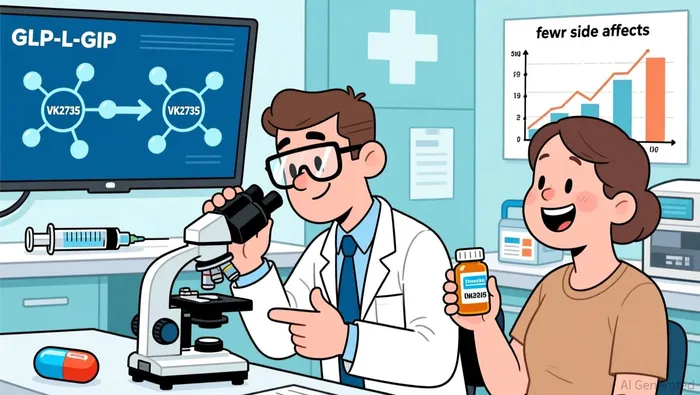
Viking, however, is not merely chasing this trend. Its oral VK2735, which demonstrated 12.2% weight loss in Phase II, is designed to outperform existing therapies by combining GLP-1 and GIP pathways while minimizing gastrointestinal side effects according to Jefferies insights. The company's "start low and go slow" titration strategy-a response to patient tolerability concerns-positions it as a potential disruptor in a market where adherence remains a critical barrier according to market analysis.
Valuation in the Shadow of Giants
Viking's valuation, however, tells a different story. Despite Wall Street's 179% price target for its stock over the next year, the company's market cap lags far behind its peers. Eli Lilly, with $15 billion in quarterly revenue from GLP-1 drugs alone, trades at a P/S ratio that reflects its commercial dominance. Viking, by contrast, is a pre-revenue entity with $700 million in cash reserves-enough to fund operations through Phase III data readouts but insufficient to justify its current premium according to financial analysis.
The disconnect is stark. Analysts at Jefferies have labeled VK2735 "class-leading", citing its tolerability and efficacy, yet Viking's stock has plummeted 52% from its 2024 peak. This volatility underscores the sector's skepticism toward unproven assets. Even CureGene's CG-0416, a non-GLP-1 oral therapy with synergistic potential, has not spurred a re-rating of Viking's shares according to recent news. The market is betting on execution risk: can Viking replicate its Phase II success in Phase III, or will it face the same hurdles that have derailed smaller players?
Strategic Re-Rating: A Sector-Wide Phenomenon
The GLP-1 sector's consolidation is not just about products-it's about power. Lilly's partnership with Cipla in India, where 75% of patients prefer pills, and Novo's aggressive pricing strategies in the U.S. are reshaping competitive dynamics. For Viking, the challenge is twofold: securing regulatory approval for its oral formulation and differentiating itself in a market where "me-too" therapies are increasingly commoditized.
Yet, Viking's financials offer a glimmer of hope. Its $700 million cash runway, coupled with an amylin agonist pipeline slated for 2026 according to financial analysis, suggests a long-term play. The company's focus on weight maintenance-a persistent problem for GLP-1 users-could carve out a niche. But this requires more than scientific promise; it demands a strategic pivot. As one analyst noted, "Viking needs to prove it can scale beyond Phase III and build a commercial engine."
Conclusion: A High-Stakes Gamble
Viking Therapeutics embodies the paradox of the GLP-1 sector: a company with groundbreaking science but a valuation that reflects the sector's inherent risks. While its oral VK2735 could redefine obesity treatment, the path to commercialization is fraught with uncertainty. In a consolidating market where NovoNVO-- and Lilly are tightening their grip, Viking's success hinges on its ability to execute flawlessly and capture a fraction of the $95 billion pie. For investors, the question is not whether the sector will grow-but whether Viking can avoid becoming a casualty in its relentless evolution.





Comentarios
Aún no hay comentarios