
Viking Therapeutics: Pioneering Metabolic Disease Innovation Amid Market Volatility
The biotech sector has long been a theater of high-stakes innovation, where scientific breakthroughs and market forces collide. In 2025, Viking TherapeuticsVKTX-- (VKTX) has emerged as a standout player in the metabolic disease space, defying broader market volatility with a stock that has drawn both skepticism and bullish optimism. The company's recent advancements in its pipeline-particularly its dual GLP-1/GIP agonist, VK2735-have positioned it at the intersection of unmet medical needs and commercial potential. Yet, as with any high-growth story, the question remains: Is Viking's outperformance a reflection of its scientific ingenuity, or a speculative bet on a crowded market?
A Dual-Action Approach to Obesity and Diabetes
Viking's lead candidate, VK2735, is advancing through pivotal trials with a strategy that mirrors the success of GLP-1/GIP agonists like Eli Lilly's Zepbound. According to Viking's press release, the VANQUISH program-comprising two Phase 3 trials-aims to evaluate subcutaneous VK2735 in obese adults and those with type 2 diabetes. With 4,500 and 1,100 participants respectively, these trials are designed to demonstrate statistically significant weight loss thresholds (≥15% and ≥20%) over 78 weeks, a critical benchmark for regulatory approval and commercial differentiation. Early Phase 2 data showed a 14.7% weight loss compared to placebo, with gastrointestinal side effects deemed manageable, according to an earnings review.
What sets Viking apart is its dual-pathway strategy: while subcutaneous delivery is well-established, the company is simultaneously testing an oral formulation of VK2735 in a Phase 2 trial (VENTURE-Oral Dosing). This oral approach, if successful, could disrupt the market by offering a non-invasive alternative to injectables, a segment dominated by Novo Nordisk and Lilly. Analysts at StockWave Insights note that Viking's oral formulation retains the dual agonist mechanism, potentially outpacing competitors like Wegovy and Mounjaro, which rely on single-pathway delivery.
Financial Resilience and Strategic Risk-Taking
Despite a Q2 2025 net loss of $65.6 million, Viking's balance sheet remains robust, with $808 million in cash as of June 30, 2025, according to Viking's Q2 2025 report. This financial buffer has enabled the company to scale manufacturing and secure multi-year agreements with Corden Pharma, ensuring supply chain stability for VK2735, according to a Panabee report. The aggressive R&D spend-up 153% year-over-year-reflects a calculated bet on late-stage trials, a strategy that aligns with a Markets.com analysis projecting a $139 billion GLP-1 market by 2030.
However, Viking's ambitions extend beyond obesity. The company is developing VK2809, a thyroid hormone receptor beta agonist for non-alcoholic steatohepatitis (NASH), and plans to file an IND for a novel amylin agonist by year-end, according to InvestorsHangout. This diversified pipeline addresses a critical gap in metabolic disease management, where comorbidities like diabetes and liver disease often coexist.
Market Dynamics and Analyst Optimism
Viking's stock has experienced a rollercoaster ride in 2025, with a 22.39% decline in August followed by a partial recovery in early September, as shown on the MarketBeat chart. Yet, analysts remain bullish. A "Strong Buy" consensus rating, with a $86.42 price target (implying a 209% upside), underscores confidence in Viking's ability to capture market share if VK2735 secures approval, according to StockAnalysis. The rationale? A $3.5 billion revenue projection by 2030, assuming VK2735 achieves 10% of the obesity market, as discussed in a Rolling Out article.
Critics, however, caution against over-optimism. The recent Phase 2 results for the oral formulation of VK2735, while not disastrous, revealed tolerability concerns that could impact long-term adherence, according to StocksToday. Moreover, the GLP-1 space is increasingly crowded, with giants like Novo Nordisk and Lilly expanding their portfolios. Viking's success will hinge on differentiating its offerings through efficacy, delivery methods, and pricing power.
Conclusion: A High-Reward, High-Risk Proposition
Viking Therapeutics embodies the paradox of modern biotech: a company with no marketed products but a $2.92 billion market cap, driven by the promise of metabolic disease innovation. Its dual GLP-1/GIP pipeline, combined with oral delivery ambitions, offers a compelling narrative in a sector hungry for differentiation. Yet, the path to commercialization is fraught with clinical and regulatory hurdles. For investors, the key will be balancing the allure of a potential blockbuster with the realities of a volatile market.
As Viking prepares for pivotal trial readouts in late 2025, the coming months will test not only the science but the mettle of its strategy. In the words of one analyst, "The question isn't whether Viking can win-it's whether it can win fast enough to justify the current valuation."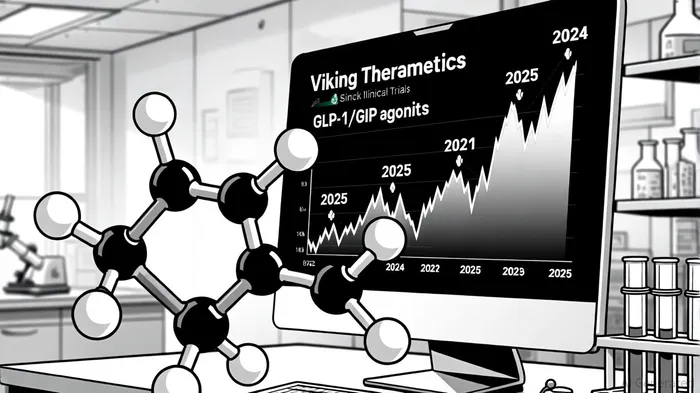





Comentarios
Aún no hay comentarios