
VIG: A Balanced Approach to Long-Term Growth and Risk Mitigation in a Diversified Portfolio
Investors seeking a blend of stability and growth often turn to dividend-focused ETFs like the Vanguard Dividend Appreciation Index Fund (VIG). As markets fluctuate between bull and bear cycles, the role of such instruments in a diversified portfolio becomes critical. This analysis evaluates VIG's historical performance, market resilience, and psychological appeal to determine its suitability as a low-stress, long-term investment.
Historical Performance: Growth vs. Volatility
Over the past decade, VIG has delivered a total return of 240.49%, translating to a compound annual growth rate (CAGR) of 13.02%[1]. While this trails the S&P 500's 14.50% CAGR[1], VIG's lower volatility—15.78% annualized versus 18.83% for the S&P 500[3]—suggests a more conservative profile. Additionally, VIG's trailing twelve-month (TTM) dividend yield of 1.66%[4] outpaces the S&P 500's 1.09%[4], offering investors a buffer of income. This combination of moderate returns, reduced risk, and higher yields positions VIG as a compelling option for those prioritizing capital preservation alongside growth.
Market Resilience: Navigating Downturns
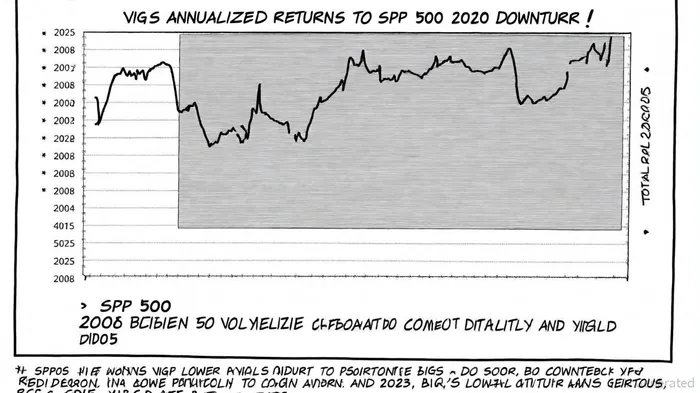
VIG's performance during past crises underscores its defensive characteristics. During the 2008 financial crisis, it recorded a -26.69% total return, yet outperformed the Russell 1000 Index by 6.1%[2]. Similarly, in the 2020 pandemic-induced sell-off, VIG outperformed the same index by 2.95%[2], aided by its focus on high-quality, dividend-growing companies less likely to cut payouts during downturns. However, in 2022—a year marked by rising interest rates and inflation—VIG underperformed with a -9.80% return[1], highlighting its vulnerability to macroeconomic shifts. These patterns suggest that while VIG is not immune to market stress, its quality tilt and sector diversification (notably in consumer staples and healthcare[2]) provide a cushion during turbulent periods.
Investor Psychology: The Dividend Premium
Behavioral finance reveals that investors often gravitate toward dividend-paying stocks during uncertainty. The regular income stream offers psychological comfort, reducing anxiety about market volatility[3]. For instance, during the 2008 and 2020 crises, VIG's dividend focus likely attracted risk-averse investors seeking stability[2]. However, this appeal is not without caveats. In high-interest-rate environments, dividend stocks may lose luster as fixed-income alternatives become more attractive[2]. Nonetheless, for long-term investors, the compounding effect of reinvested dividends and the resilience of high-quality firms can outweigh short-term fluctuations.
Strategic Implications for Portfolios
VIG's role in a diversified portfolio lies in its ability to balance growth and risk. Its lower volatility compared to broader indices[3] makes it a natural hedge against market swings, while its dividend yield[4] provides a steady income stream. For investors prioritizing long-term stability, VIG's historical outperformance during crises[2]—despite occasional underperformance in high-interest-rate years[1]—reinforces its value. However, its sector concentration in non-cyclical industries[2] means it may lag during technology-driven booms, necessitating complementary exposure to growth-oriented assets.
Conclusion
The Vanguard Dividend Appreciation ETF (VIG) emerges as a robust candidate for investors seeking a low-stress, long-term strategy. Its historical performance, defensive resilience during downturns, and psychological appeal align with the goals of risk mitigation and steady growth. While it may not outpace the S&P 500 in all market conditions, its unique attributes make it a valuable addition to a well-rounded portfolio.







Comentarios
Aún no hay comentarios