
The U.S.-Vietnam Trade Deal: A Catalyst for Asian Supply Chain Restructuring and Investment Opportunities
The U.S.-Vietnam trade agreement, finalized in July 2025, has ignited a seismic shift in global supply chains. By imposing a 20% tariff on Vietnamese exports and a 40% duty on transshipped goods—primarily targeting Chinese-origin products—the deal is accelerating manufacturing relocations and reshaping investment landscapes across Asia. For investors, this is a critical inflection point: sectors with exposure to Vietnam's key exports (electronics, apparel, and machinery) are poised for growth, while emerging markets overly reliant on transshipment risk obsolescence. Meanwhile, U.S. industries gaining tariff-free access to Vietnam's market present compelling opportunities. Let's dissect the implications.
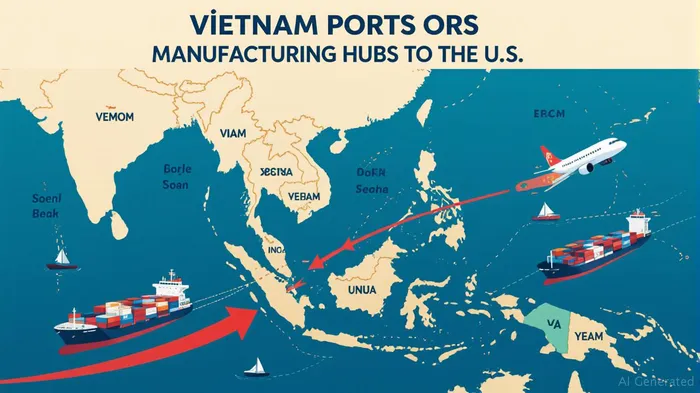
Manufacturing Exodus: Asia's New Supply Chain Order
The 20% tariff on Vietnamese goods directly penalizes companies using the country as an export hub to the U.S. Simultaneously, the 40% transshipment levy creates a steep penalty for firms mislabeling Chinese-made goods. This dual mechanism forces manufacturers to either:
1. Diversify Supply Chains: Companies reliant on Vietnam (e.g., NikeNKE--, Lululemon) may expand production into countries like Indonesia or the Philippines to avoid tariffs.
2. Re-shore or Near-shore: U.S. firms may repatriate production or invest in Mexico's maquiladoras, where existing trade agreements offer lower costs than tariff-hit Vietnam.
The result? A fragmented supply chain landscape favoring firms with geographic flexibility. Vietnam's electronics sector—a $100+ billion industry dominated by Samsung, IntelINTC--, and Foxconn—faces the largest headwinds. . Meanwhile, U.S. semiconductor firms like Texas InstrumentsTXN-- (TXN) or Applied MaterialsAMAT-- (AMAT) could benefit from Vietnam's need for advanced tech inputs.
The Vulnerable: Thailand and Malaysia in the Crosshairs
Emerging markets that haven't negotiated reciprocal trade deals with the U.S. are sitting ducks. Thailand and Malaysia, for example, face the threat of 46% tariffs unless they strike similar deals by July 9, 2026. Their risk profile is twofold:
- Transshipment Dependency: Both countries are hubs for Chinese goods bound to the U.S., making them vulnerable to U.S. scrutiny.
- Sector Exposure: Thailand's automotive sector (Toyota, Honda) and Malaysia's semiconductor industry (Intel, AMD) are particularly exposed.
. Investors should consider shorting these markets or avoiding equities tied to their export-reliant industries until trade terms clarify.
U.S. Sectors: Winners in Vietnam's Open Market
Vietnam's pledge to grant “zero tariffs” on U.S. imports opens doors for sectors with competitive advantages:
1. Agriculture: U.S. soybean, corn, and poultry exporters (e.g., Tyson FoodsTSN-- (TSN), Cargill) gain direct access to Vietnam's growing consumer market.
2. Energy: Vietnam's hunger for LNG to fuel its industries aligns with U.S. liquefaction capacity. Cheniere EnergyLNG-- (LNG) and Tellurian (TELL) could benefit.
3. Luxury and Autos: U.S. SUVs (Ford (F), GMGM-- (GM)) and high-end brands (Coach, Ralph Lauren) face no tariffs, making them competitive against European rivals.
Investment Playbook: Positioning for the New Order
- Long Vietnam Exposure:
- ETFs: The iShares MSCIMSCI-- Vietnam ETF (VNM) tracks companies like Vinhomes (VHM) and Masan Group, which may thrive in a reshaped supply chain.
Sector Plays: Electronics (FPT Corporation), textiles (Vietnam Textile Garment Group), and logistics (Gemadept) could see restructuring-driven demand.
Short Over-Exposed Asian Peers:
Avoid Thailand's automotive stocks (e.g., ToyotaTM-- Auto Thailand) and Malaysia's semiconductor plays (e.g., Renesas Electronics) until trade terms stabilize.
U.S. Re-shoring Plays:
- Manufacturing: CaterpillarCAT-- (CAT), BoeingBA-- (BA) may benefit from U.S. firms repatriating production.
Technology: Intel (INTC) could capitalize on Vietnam's need for chip imports.
Currency Strategy:
- The U.S. dollar (USD) may strengthen against the Vietnamese dong (VND) as Vietnam's trade surplus shrinks. Investors could short VND via forex markets or inverse ETFs.
Risks and Uncertainties
- Transshipment Enforcement: The U.S. has yet to clarify thresholds for “substantial transformation” of goods. A near-zero tolerance for Chinese inputs could disrupt Vietnam's electronics sector.
- Geopolitical Fallout: China's potential retaliation (e.g., tariffs on Vietnamese goods) could backfire on Vietnam's economy.
- Legal Challenges: Ongoing lawsuits under the IEEPA cloud the tariffs' longevity.
Conclusion
The U.S.-Vietnam deal is a watershed moment for Asian supply chains. Investors should pivot toward Vietnam's key export sectors and U.S. industries gaining tariff-free access, while hedging against overexposed peers. This isn't just about tariffs—it's a structural shift toward a more fragmented, U.S.-centric manufacturing world. Move swiftly, but stay attuned to enforcement clarity and geopolitical fireworks.





Comentarios
Aún no hay comentarios