
Vietnam's Rice Renaissance: Capitalizing on Post-India Market Shifts
The global rice market is undergoing a seismic shift. After years of export curbs, India's rice trade liberalization has unleashed a flood of 24 million tonnes of rice annually, reshaping trade dynamics and pricing. While this poses challenges for competitors, Vietnam is uniquely positioned to exploit opportunities in this new landscape. By leveraging its quality differentiation, strategic pricing, and policy resilience, Vietnam can carve out a niche in premium segments and solidify its role as a reliable supplier. Here's how investors can capitalize on this transformation.
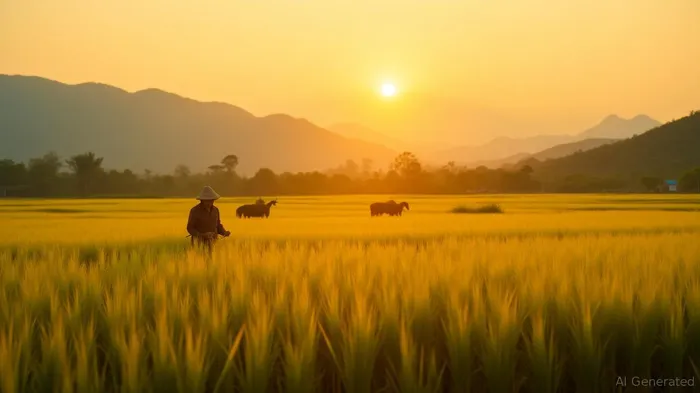
The New Global Rice Order: Vietnam's Strategic Advantage
India's export surge has driven global rice prices down to $385–$400 per tonne, pressuring competitors like Thailand to slash targets and cede market share. Vietnam, however, has adopted a dual-pronged strategy:
1. Premium Segments Dominance: Focusing on high-quality fragrant rice (e.g., Jasmine) for markets like the EU, Japan, and the U.S., where India's lower-cost, bulk-oriented offerings hold less appeal.
2. Strategic Price Management: Maintaining competitive pricing in bulk markets while avoiding direct competition with India's rock-bottom rates.
Key Opportunities for Vietnam
1. High-Quality Market Expansion
Vietnam's premium rice varieties command prices 20–30% higher than bulk rice. With the USDA projecting global demand for specialty rice to grow at 3% annually, Vietnam's 40% share of the $3.2 billion jasmine rice market is a fortress.
2. Diversified Geopolitical Partnerships
Vietnam's Free Trade Agreements (FTAs) with the EU (EVFTA) and UK (UKVFTA) offer zero-tariff access to high-income markets. Meanwhile, its diplomatic ties with China and the Philippines—both major rice importers—position it to capture 5–6 million tonnes of annual demand.
3. Sustainable Production Growth
Vietnam's rice yields are among the world's highest (7.2 tonnes/ha), and its government is investing $500 million in irrigation and seed technology to boost output further. This scalability ensures it can meet rising demand without compromising quality.
Risks and Mitigation Strategies
- Competition from India: While India dominates bulk markets, Vietnam's focus on premium segments insulates it from direct price wars.
- Domestic Supply Risks: Vietnam's strict export quotas (e.g., 5–7 million tonnes annually) and stockholding rules ensure farmers are protected against oversupply.
- Currency Volatility: The U.S. dollar's strength has boosted Vietnam's export competitiveness; however, the central bank's policy tools (e.g., interest rates) provide a buffer against currency fluctuations.
Investment Thesis: Where to Look
- Export-Driven Firms: Companies like Trung An Corporation (producer of Jasmine rice) and Vinafood 1 (a state-owned exporter) are well-positioned to benefit from premium pricing and geopolitical tailwinds.
- Agricultural ETFs: The Market Vectors Agribusiness ETF (MOO) offers diversified exposure to global agri-companies, including Vietnam's rice sector.
- Land and Infrastructure Plays: Farmland developers (e.g., Hoang Anh Gia Lai) and logistics firms (e.g., Vietnam Logistics JSC) could see upside from increased export activity.
Final Call: A Buy on Value and Resilience
Vietnam's rice sector is a textbook example of competitive differentiation in a commoditized market. With India's dominance confined to bulk segments, Vietnam's premium strategy ensures profitability even in a price-sensitive environment. Investors should consider:
- Long positions in Vietnam's agribusiness stocks.
- Overweight allocations to Southeast Asian ETFs with strong rice sector exposure.
The global rice market's post-India era is here. Vietnam's blend of quality, policy discipline, and market foresight makes it a standout play in this new order.
Disclaimer: This analysis is for informational purposes only. Always conduct thorough due diligence before making investment decisions.







Comentarios
Aún no hay comentarios