
Vietnam Dong and Gold Price Dynamics on September 26, 2025: Currency Volatility and Safe-Haven Demand in Emerging Markets
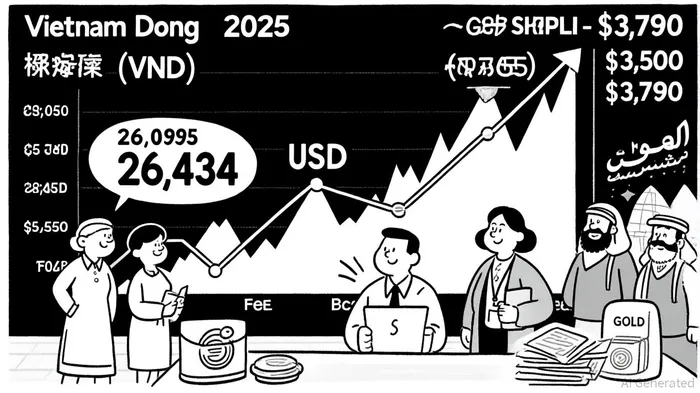
On September 26, 2025, the Vietnam Dong (VND) and gold markets reflected the complex interplay of currency volatility and safe-haven demand in emerging markets. The VND traded at 26,403 per U.S. Dollar (USD), a 0.5% increase from its three-month average and slightly above the September monthly average of 26,360.6 VND per USD [1]. This rate, while stable within a 1.3% range (26,095–26,434 VND per USD), underscored broader trends of depreciation driven by U.S. tariffs on Vietnamese exports and proactive monetary policy by the State Bank of Vietnam [2]. Meanwhile, gold prices surged to $3,751 per troy ounce on September 25, 2025, as reported by Fortune, reflecting a 33.73% annual increase and a 1.67% daily decline from the previous day's record high of $3,790.82 [3].
VND Volatility: Trade Pressures and Policy Interventions
The VND's depreciation was a deliberate strategy to bolster Vietnam's export sector, which accounts for 90% of GDP. The State Bank of Vietnam allowed the currency to weaken by 3.5% in 2025, aiming to offset the impact of U.S. tariffs on key exports like textiles and electronics [4]. However, this policy came at a cost: the VND had depreciated 7.32% year-to-date, raising inflationary pressures and eroding purchasing power. Analysts warned that the U.S. Treasury had placed Vietnam on a currency manipulation watchlist, adding uncertainty to the Dong's trajectory [5].
The USD's strength against the VND was further reinforced by favorable U.S. economic data, including the core PCE price index, and speculation about prolonged U.S.-China tariff negotiations. These factors created a “flight to safety” dynamic, where investors favored the USD over emerging market currencies like the VND [6].
Gold as a Safe Haven: Geopolitical and Monetary Drivers
Gold's surge in September 2025 was fueled by a perfect storm of geopolitical tensions and monetary policy shifts. Record highs were driven by conflicts in the Middle East and Eastern Europe, as well as the Federal Reserve's quarter-point rate cut, which initially pushed gold to $3,707 per ounce before retreating to $3,634 [7]. Central banks in emerging markets, including Vietnam, accelerated gold purchases to diversify reserves away from the USD, adding structural support to prices [8].
The inverse relationship between gold and the USD typically holds, but September 2025 saw exceptions. After the Fed's rate cut, the USD's unexpected strength—driven by bond yield spikes—temporarily dampened gold's appeal. However, long-term demand for gold as a hedge against inflation and currency devaluation remained robust, particularly in markets like Vietnam where the VND's depreciation heightened inflation risks [9].
Interconnected Dynamics: Currency Volatility and Safe-Haven Demand
The VND's depreciation and gold's rally highlight a critical trend in emerging markets: the search for stability amid global uncertainty. As the VND weakened, Vietnamese investors and institutions increasingly turned to gold as a store of value. This shift was amplified by the U.S. Dollar Index's strength, which made gold more expensive in local currency terms for VND holders, paradoxically increasing demand for physical gold as a hedge [10].
Moreover, the State Bank of Vietnam's currency interventions created a feedback loop. By allowing the VND to depreciate, the bank indirectly supported gold prices by eroding confidence in the local currency. This dynamic mirrored broader patterns in emerging markets, where central banks often balance export competitiveness with inflationary risks, inadvertently fueling safe-haven demand for assets like gold [11].
Investment Implications
For investors, the September 2025 dynamics suggest a dual strategy: hedging against VND volatility with gold while monitoring policy shifts in Vietnam and the U.S. Given the VND's projected 0.6% monthly appreciation by September's end [12], short-term currency plays could complement long-term gold positions. However, risks remain: a potential Fed rate cut reversal or resolution of U.S.-China trade tensions could weaken gold's appeal and stabilize the VND.
Emerging market investors should also consider diversifying into gold-backed assets or hedging VND exposure through forward contracts. The interplay between currency depreciation and safe-haven demand will likely persist, particularly as geopolitical tensions and inflationary pressures remain elevated.
Conclusion
The Vietnam Dong and gold markets on September 26, 2025, exemplify the challenges and opportunities in emerging markets. The VND's strategic depreciation and gold's record rally reflect a broader shift toward risk mitigation and asset diversification. As global uncertainties persist, investors must navigate these dynamics with a nuanced understanding of both currency volatility and safe-haven demand.







Comentarios
Aún no hay comentarios