
Vietnam's 2026 Economic Outlook and Resilience in a Shifting Global Trade Landscape
Vietnam's economy is poised to navigate a complex global trade environment in 2026, with its export-driven sectors serving as both a barometer of resilience and a catalyst for strategic investment. Despite headwinds from U.S. tariff policies, global supply chain shifts, and geopolitical tensions, Vietnam's GDP growth projections remain robust, supported by domestic reforms, foreign direct investment (FDI), and a diversified trade strategy. For investors, the country's key sectors-electronics, textiles, and green energy-present compelling opportunities, albeit with risks that demand careful mitigation.
GDP Growth: A Foundation of Resilience
Vietnam's 2026 GDP growth is forecasted to range between 6.0% and 6.8%, in a VietnamPlus piece reporting on an ADB report and assessments by the World Bank and OECD. The ADB attributes this resilience to domestic reforms and public investment, while the World Bank's March 2025 update emphasizes Vietnam's ability to adapt to export challenges, particularly with major partners like the U.S. and China. These projections underscore Vietnam's capacity to maintain growth even as external pressures mount, positioning it as a regional economic anchor.
FDI and Public Investment: Fueling Domestic Demand
Foreign direct investment remains a cornerstone of Vietnam's economic strategy. In 2025, FDI pledges surged by 32.6%, while disbursements rose by 8.1%, reflecting sustained international confidence. Public investment, meanwhile, reached 31.7% of its annual target-the highest since 2018-supporting infrastructure and energy projects critical to long-term growth. This dual focus on FDI and public spending not only bolsters domestic demand but also enhances Vietnam's capacity to absorb external shocks.
Trade Diversification: Mitigating U.S. Tariff Risks
Vietnam's trade strategy in 2026 hinges on diversification to counteract the impact of U.S. tariffs, which now affect 46% of its exports, according to S&P Global. The EU-Vietnam Free Trade Agreement (EVFTA) has been pivotal, eliminating over 90% of tariffs and boosting exports to Europe to $51.7 billion in 2024, according to Vietnam Briefing. Emerging markets in India, the Middle East, and Africa are also gaining traction, with sectors like textiles and machinery leading the charge, as noted in a Modern Diplomacy analysis. Additionally, Vietnam is tapping into the Halal market, leveraging its Muslim-majority neighbors to expand export opportunities.
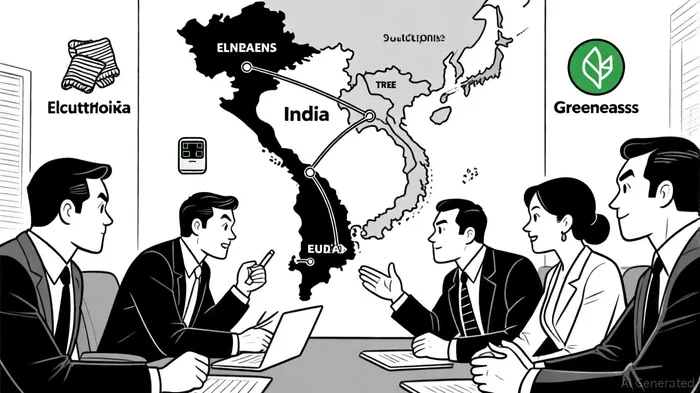
Strategic Sectors: Electronics, Textiles, and Green Energy
Electronics: Vietnam's electronics sector, driven by firms like Samsung and LEGO, has become a global manufacturing hub. Export revenue reached $126.5 billion in 2024, supported by tax incentives and infrastructure investments. However, reliance on imported components and U.S. tariff risks necessitate supply chain diversification and R&D investment.
Textiles: The textile industry, a traditional strength, saw $44 billion in exports in 2024, bolstered by FTAs and a skilled labor force. To counter U.S. trade policies, Vietnamese firms are adopting advanced processing technologies and branding strategies to enhance competitiveness.
Green Energy: Vietnam's renewable energy market is attracting significant FDI, with solar and wind projects benefiting from tax holidays and land-use exemptions. The government aims to double power generation capacity by 2030, creating opportunities for investors in clean energy and waste-to-energy projects.
Risk Mitigation: Navigating Currency and Geopolitical Challenges
Investors must address risks such as currency fluctuations and geopolitical tensions. The Vietnamese đồng depreciated 3.2% against the U.S. dollar in 2023, impacting production costs. Financial tools like forward contracts and dual-currency pricing can mitigate these risks. Geopolitical uncertainties, including U.S.-China dynamics, require diversified sourcing strategies and local partnerships.
Conclusion: A Strategic Investment Case
Vietnam's 2026 economic outlook is underpinned by structural reforms, FDI inflows, and a proactive trade strategy. While global uncertainties persist, the country's focus on high-tech manufacturing, green energy, and market diversification offers a roadmap for sustained growth. For investors, the key lies in aligning with Vietnam's policy incentives, leveraging its skilled workforce, and adopting risk-mitigation strategies tailored to sector-specific challenges.







Comentarios
Aún no hay comentarios