
Vietjet's Boeing 737 Fleet Expansion and Strategic Implications for the Asian Aviation Sector
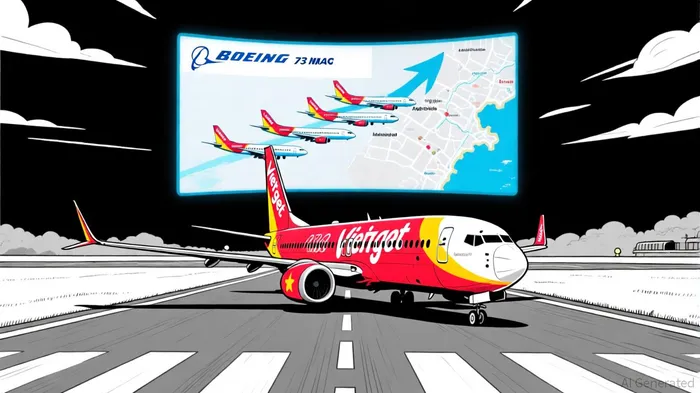
Vietjet's long-awaited delivery of its first BoeingBA-- 737 MAX aircraft in 2025 marks a pivotal moment in its fleet modernization and expansion strategy. After a nine-year delay caused by the global 737 MAX grounding, the COVID-19 pandemic, and U.S. tariff policies[1], the airline is now poised to leverage its $24 billion order for 200 737 MAX aircraft to strengthen its position in Southeast Asia and beyond. This move, part of a broader $65 billion investment in the U.S. aerospace industry, underscores Vietjet's commitment to capital efficiency and long-term profitability in a post-pandemic aviation landscape[2].
Capital Efficiency: Fuel, Maintenance, and Route Optimization
The 737 MAX's fuel efficiency is a cornerstone of Vietjet's cost strategy. With an average fuel consumption of 750 gallons per hour, the aircraft's operating costs are significantly lower than older models, translating to approximately $2,250 per hour at current fuel prices[3]. This efficiency is further bolstered by a $3 billion, 12-year Rate Per Flight Hour (RPFH) agreement with CFM International for 215 Leap-1B engines, ensuring predictable maintenance expenses and shielding the airline from volatile repair costs[4]. Such structured agreements are critical for low-cost carriers like Vietjet, which rely on tight cost controls to maintain profitability.
Route optimization also plays a key role. The 737 MAX's range and capacity are ideally suited for Vietjet's medium-haul leisure routes, such as its new Phu Quoc–Singapore and Vietnam–Japan services[5]. By aligning its fleet with high-demand corridors, Vietjet can maximize load factors—a metric that has already exceeded 83% in the Asia-Pacific region in 2025[6]. This aligns with broader industry trends: Asian airlines are increasingly prioritizing fuel-efficient aircraft to offset rising operational costs and meet sustainability goals[7].
Post-Pandemic Recovery and Regional Demand
The Asia-Pacific aviation sector is experiencing robust post-pandemic recovery, with passenger traffic up 8.3% year-on-year in Q2 2025[8]. Vietjet's expansion into Thailand via its subsidiary Thai Vietjet Air—transferring 50 737 MAX aircraft to enhance regional connectivity—positions it to capitalize on this growth[9]. Meanwhile, rivals like AirAsia and Cathay Pacific are also modernizing fleets with A321neos and 777-9s, reflecting a regional shift toward efficiency and capacity discipline[10].
However, challenges persist. The transition to sustainable aviation fuel (SAF) and the high costs of environmental compliance could strain profitability, with industry-wide investments in SAF projected to reach $3.9 trillion to $8.1 trillion[11]. Vietjet's partnerships with U.S. aerospace firms, including GEGE-- and HoneywellHON--, may provide a competitive edge in navigating these hurdles[12].
Strategic Implications for Investors
Vietjet's fleet expansion is not merely operational but strategic. By securing long-term engine support and financing deals, the airline mitigates risks associated with supply chain disruptions and geopolitical tensions, such as U.S.-Vietnam trade discussions[13]. Its focus on low-cost, high-efficiency operations aligns with IATA's 2025 profit forecasts, which highlight fuel cost relief and improved load factors as key drivers[14].
For investors, Vietjet's $65 billion U.S. aerospace investment—encompassing engines, maintenance, and widebody capabilities—signals a forward-looking approach. The potential order for 20 Boeing 787 Dreamliners further suggests ambitions to compete on long-haul routes, diversifying revenue streams beyond leisure travel[15].
Conclusion
Vietjet's 737 MAX fleet expansion exemplifies a calculated response to post-pandemic challenges and opportunities. By prioritizing fuel efficiency, structured maintenance agreements, and route optimization, the airline is positioning itself to thrive in a competitive, capital-intensive industry. As Asian aviation demand continues to outpace global recovery trends, Vietjet's strategic investments—both in technology and regional partnerships—offer a compelling case for long-term profitability.





Comentarios
Aún no hay comentarios