
Victory Day Alliance: How Putin and Xi’s Strategic Bond Shapes Investment Horizons
The meeting between Vladimir Putin and Xi Jinping in Moscow on May 8–9, 2025, marked a historic alignment of Russia and China’s geopolitical ambitions. As the two leaders celebrated Russia’s Victory Day—commemorating WWII’s end—they underscored their shared narrative of historical sacrifice and mutual support in the face of Western pressure. With the Ukraine war entering its fourth year, this partnership carries profound implications for global markets, offering opportunities in energy and infrastructure while posing risks tied to sanctions and regional instability.
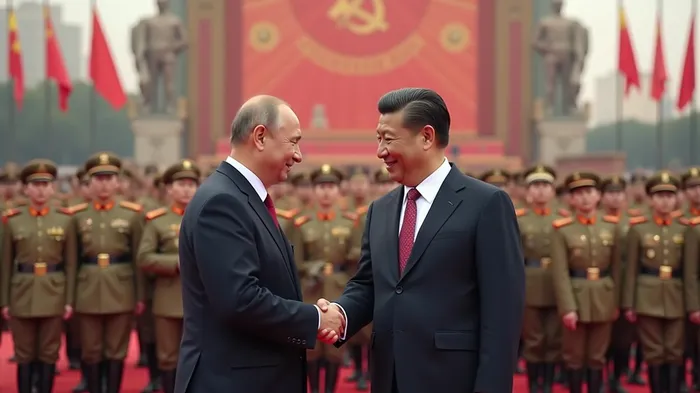
Geopolitical Developments: A New Era of Sino-Russian Synergy
The joint statement issued after their meeting explicitly endorsed Russia’s war aims in Ukraine, framing them as a fight against “root causes” like NATO expansion and Western “hegemony.” This marked a shift from China’s earlier neutrality, now aligning with Russia’s revisionist stance. Key developments include:
- Economic Integration: Bilateral trade hit a record $245 billion in 2024, with Russia becoming China’s top importer of automobiles and a critical energy partner. Over $200 billion in investments are underway across 90 priority projects, including energy pipelines, rail upgrades, and nuclear power plants.
- Currency Decoupling: Nearly all trade is now settled in yuan and rubles, bypassing the U.S. dollar and shielding transactions from Western sanctions.
- Military Coordination: Russia’s military reforms and industrial buildup—such as a new explosives plant boosting artillery production by 50%—are bolstered by Chinese economic support.
Investment Implications: Sectors to Watch
The alliance’s economic and strategic alignment creates opportunities in three key areas:
1. Energy and Infrastructure
- Opportunity: Chinese firms are expanding in Russian energy projects, such as the Power of Siberia gas pipeline (31 billion cubic meters annually) and the planned Far Eastern Gas Pipeline.
- Risk: Western sanctions on Russian energy exports could disrupt these ventures.
2. Technology and Manufacturing
- Opportunity: Joint ventures in semiconductors, aerospace, and AI leverage China’s tech prowess and Russia’s defense expertise. Chinese automakers like Geely and BYD are capitalizing on Western sanctions-driven gaps in Russia’s automotive market.
- Risk: U.S. export controls on critical technologies may hinder collaboration.
3. Financial Markets
- Currency Plays: The yuan-ruble trade system offers investors exposure to emerging markets insulated from dollar volatility.
- Risk: Sanctions on Russian assets could spook investors, especially in sectors like mining or energy.
Risks and Challenges
- Sanctions Exposure: Investors in Russian assets face compliance risks. For example, Western sanctions on Russian oil exports have already caused volatility in energy stocks like Rosneft.
- Geopolitical Volatility: The Ukraine war’s civilian toll—12,910 Ukrainian deaths and 652 Russian civilian fatalities—fuels regional instability. A prolonged conflict risks destabilizing supply chains and energy flows.
- Diplomatic Fallout: China’s alignment with Russia may strain ties with Europe and the U.S., deterring foreign direct investment in sectors like tech and finance.
Conclusion: Navigating a Fractured World
The Putin-Xi allianceAENT-- represents a tectonic shift in global power dynamics, with China and Russia carving out a multipolar economic bloc. Investors must balance opportunities in energy, infrastructure, and tech with the risks of sanctions and escalating conflict.
- Key Data:
- Bilateral trade: $245 billion (2024) → $300 billion+ by 2027 (projected).
- Ukrainian energy capacity: 9 GW (2024) vs. 56 GW pre-war.
- Russian GDP growth: 5.6% (2022–2024) → 1.5% (2025 forecast).
For investors, the path forward requires sector-specific due diligence. Energy and infrastructure projects in Eurasia offer long-term growth, while tech collaborations demand vigilance against export controls. However, the alliance’s durability hinges on navigating the fine line between mutual economic gain and Western backlash. As Putin and Xi’s Victory Day symbolism fades, the real test lies in whether their partnership can endure the grind of war and sanctions—or become another chapter in the geopolitical chess match reshaping global markets.
In this fractured landscape, investors must remain agile, prioritizing diversification and risk mitigation while capitalizing on the Sino-Russian axis’s strategic momentum.







Comentarios
Aún no hay comentarios