
Viña Concha y Toro's Strategic Resilience: Navigating Margin Pressures and Premium Growth in Q2 2025
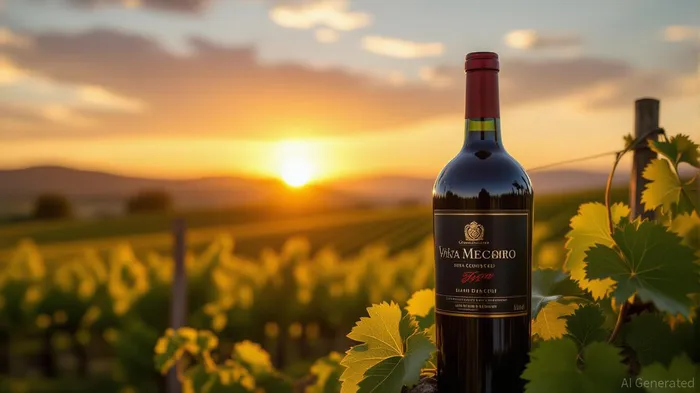
The global wine market, long a blend of tradition and volatility, has become a proving ground for companies that can balance operational rigor with visionary strategy. Viña Concha y ToroTORO--, Chile's most storied winery and the world's largest by volume, delivered its Q2 2025 earnings report amid a backdrop of rising tariffs, shifting consumer preferences, and macroeconomic headwinds. The results offer a nuanced portrait of a company that is both vulnerable to external pressures and remarkably adept at leveraging its strengths—particularly in premium branding and sustainability—to secure its long-term dominance.
Margin Pressures: A Test of Operational Discipline
Viña Concha y Toro's Q2 2025 earnings report revealed a 3.2% revenue increase to $258.6 million, driven by a 2.1% rise in average bottle prices. However, operating income fell 15.3% year-over-year to CLP$28.161 million, reflecting margin compression from three key factors:
1. Tariff measures in key export markets, particularly in the U.S. and Europe, which added costs to already strained supply chains.
2. Higher taxes in markets like Brazil and China, where regulatory environments are increasingly unpredictable.
3. Aggressive competition in lower-value segments, where price wars have eroded profitability.
The operating margin contracted to 11.5%, a 250-basis-point decline, underscoring the fragility of margins in a sector where cost discipline is paramountPARA--. Yet, the company's management, led by CEO Eduardo Guilisasti, has not blinked. By prioritizing premium brands and vertical integration, it has mitigated some of these pressures. For instance, premium and superior brands accounted for 54.3% of total sales, a testament to the company's ability to shift toward higher-margin offerings.
Premium Brand Growth: The Engine of Resilience
The standout performance in Q2 2025 was the explosive growth of Don Melchor, the winery's flagship brand. Sales surged 208.3% year-over-year, driven by its 2024 Wine Spectator ranking as the world's top wine. This meteoric rise is not an anomaly but a strategic bet on premiumization, a trend that has reshaped global wine consumption.
The company's portfolio strategy is clear: double down on high-value, low-volume labels while rationalizing weaker segments. Other notable performers included:
- Casillero del Diablo: +1.2% sales growth, a steady performer in mass-market segments.
- Diablo: +14.2%, benefiting from targeted marketing in emerging markets.
- Trivento Reserve: +2.7%, reflecting the success of its Argentine subsidiary in capturing premium Argentine Malbec demand.
These results highlight a critical insight: in a fragmented and competitive industry, brand equity is the ultimate differentiator. Viña Concha y Toro's ability to command premium prices—despite macroeconomic uncertainty—speaks to the strength of its heritage and storytelling.
Long-Term Positioning: Sustainability as a Strategic Asset
While short-term margin pressures persist, Viña Concha y Toro's long-term positioning is anchored in its sustainability initiatives. The company's 2025 strategy, “Uncork a Better Future,” is more than a PR campaign; it is a blueprint for resilience. Key pillars include:
- 100% renewable energy by 2030, reducing exposure to volatile energy markets.
- Native forest conservation and biodiversity regeneration, which align with global ESG trends and reduce operational risks.
- Supplier decarbonization, with tools and training provided to over 4,000 partners to track and reduce emissions.
Notably, Viña Concha y Toro is the only winery in S&P Global's Sustainability Yearbook 2025 and the first Chilean company to achieve B Corp certification. These accolades are not symbolic; they translate into competitive advantages. As consumers increasingly prioritize sustainability, the company's green credentials position it to capture market share in ESG-driven sectors.
Investment Implications: A Case for Strategic Patience
For investors, Viña Concha y Toro presents a compelling but nuanced opportunity. The company's Q2 2025 results demonstrate resilience in the face of margin pressures, but also underscore the need for continued cost discipline. The shift toward premiumization is working—Don Melchor's success is a masterclass in brand-led growth—but this strategy requires long-term capital allocation and patience.
The sustainability agenda adds another layer of complexity. While the company's ESG initiatives are robust, their financial impact is still emerging. For example, the 440-basis-point EBITDA margin expansion in Q1 2025 was driven by cost discipline rather than direct revenue from green initiatives. However, as renewable energy costs decline and carbon pricing mechanisms gain traction, these sustainability bets could become profit centers.
Recommendation: Investors with a 5–7 year horizon should consider Viña Concha y Toro as a core holding in a diversified portfolio. The company's strategic resilience—its ability to adapt to margin pressures, capitalize on premium growth, and lead in sustainability—positions it to outperform in a volatile sector. However, near-term volatility is likely, given its exposure to global tariffs and economic cycles.
In the end, Viña Concha y Toro's story is one of duality: a traditional winemaker navigating the challenges of a modern world while staying true to its roots. For those who can see beyond the quarterly numbers, the rewards may be as rich as its most celebrated vintages.







Comentarios
Aún no hay comentarios