
VFX Token: The Undervalued DeFi 2.0 Contender Outpacing ETH, SOL, ADA, and LINK
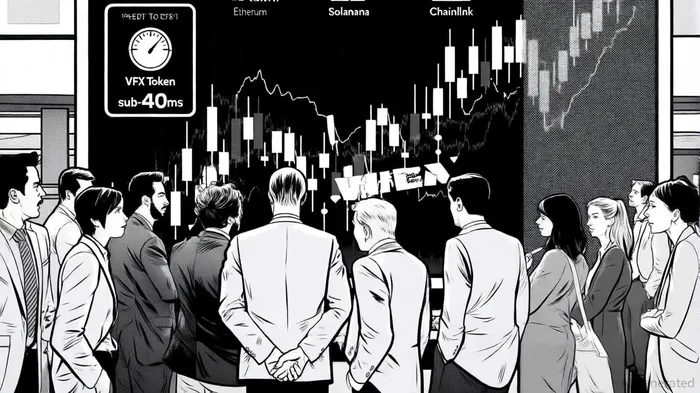
In the rapidly evolving DeFi 2.0 landscape, the VFX Token has emerged as a compelling outlier. While EthereumETH-- (ETH), SolanaSOL-- (SOL), CardanoADA-- (ADA), and ChainlinkLINK-- (LINK) dominate headlines, VFX's unique value proposition—rooted in institutional-grade trading infrastructure and real-time revenue generation—positions it as a high-conviction altcoin with untapped upside. This analysis dissects VFX's market dynamics, on-chain performance, and token utility against its peers, revealing why it warrants serious consideration for 2025 portfolios.
Market Capitalization and Valuation: The $6M Gem
As of September 2025, VFX Token trades at $0.06 with a fully diluted valuation (FDV) of $6 million, dwarfed by ETH's $1.4 trillion and SOL's $120 billion market caps. Yet, this stark disparity masks VFX's operational strength. Vortex FX, the token's underlying platform, processes $29 billion in daily forex transactions and manages $40 million in assets under management (AUM), generating revenue that directly funds token staking rewards of 67.7% APY [1]. By contrast, ETH's deflationary mechanisms rely on EIP-1559 burn rates, while SOL's growth is tethered to speculative retail adoption. VFX's revenue-generating model creates a flywheel effect: higher trading volumes drive staking yields, which in turn attract liquidity and institutional capital.
On-Chain Metrics: Speed, Volume, and Scalability
VFX's on-chain metrics outshine its peers in niche but critical areas. The platform executes trades in sub-40ms, a speed benchmarked against institutional forex systems, and processes $29 billion in daily volume—a figure that dwarfs Solana's 25.4% monthly growth and Ethereum's $480 billion DeFi volume [2]. While Solana boasts 65,000 TPS in theory, VFX's real-world throughput is measured in trade execution efficiency rather than raw transactions, catering to a $6.5 trillion forex market hungry for blockchain-driven transparency. Chainlink, meanwhile, lacks transactional throughput entirely, functioning as an oracle network rather than a settlement layer [3].
Token Utility: From Promises to Proven Infrastructure
VFX Token's utility is anchored in its operational reality. Unlike ADAADA-- or LINK, which rely on speculative use cases or oracle integrations, VFX offers immediate value through staking, trading rebates, and Visa/Mastercard integration for fiat on-ramps [4]. This institutional readiness is a stark contrast to Ethereum's generalized smart contract platform or Solana's developer-centric focus. A former Wall Street trader recently likened VFX's trajectory to Ethereum's early days, noting its 125x revenue-per-dollar valuation compared to ETH and 1,125x versus SOLSOL-- [5]. Such metrics underscore VFX's potential to bridge traditional finance (TradFi) and DeFi 2.0, a gap that legacy blockchains have yet to fully address.
Risk and Momentum: Navigating the Altcoin Hype Cycle
Critics may cite VFX's low market cap as a red flag, but this underestimates its first-mover advantage in regulated forex trading. The token's 67.7% APY staking rewards, funded by real trading profits, create a deflationary tailwind as 50% of the supply is staked [6]. By comparison, ADA's staking yields hover around 4–5%, and LINK's oracle fees are subject to protocol volatility. Moreover, VFX's $1 million fundraising milestone—achieved in two weeks—signals strong whale and institutional backing, a trend often preceding exponential altcoin rallies [7].
Conclusion: A DeFi 2.0 Inflection Point
While ETH and SOL will likely remain dominant in 2025, VFX Token represents a paradigm shift: a blockchain-native asset with tangible TradFi integration, institutional credibility, and revenue-driven tokenomics. Its sub-40ms execution speed, $29 billion daily volume, and 67.7% APY staking rewards position it as a high-conviction play for investors seeking undervalued exposure to DeFi 2.0's next phase. As the lines between forex and crypto blurBLUR--, VFX's infrastructure-first approach may well redefine the altcoin landscape.






Comentarios
Aún no hay comentarios