
Vestas' 42-MW Wind Order in Germany: A Strategic Inflection Point for Renewable Growth
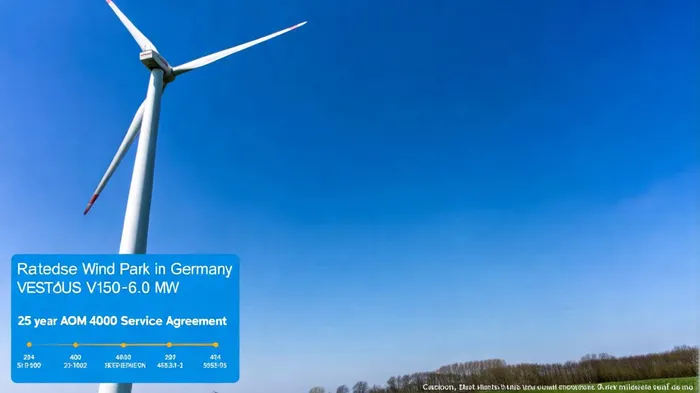
The recent announcement of Vestas' 42-MW wind order in Germany—specifically the Rastede Wind Park—marks a pivotal moment in the company's strategic evolution and Europe's renewable energy transition. This project, awarded by Alterric Deutschland GmbH, involves the deployment of seven V150-6.0 MW turbines and a 25-year AOM 4000 service agreement, underscoring Vestas' dual focus on cutting-edge technology and long-term operational reliability [1]. With delivery slated for Q2 2026 and commissioning by Q4 2026, the project aligns with Germany's aggressive decarbonization goals and Vestas' broader ambition to dominate the onshore wind sector [2].
Strategic Implications: From Project to Portfolio
The Rastede project is not an isolated win but part of a broader trend. Vestas has secured similar 42-MW projects in Germany, such as the Bosau wind park, which includes a 20-year AOM 5000 service agreement and turbine deliveries starting in Q1 2025 [3]. These contracts highlight Vestas' ability to lock in recurring revenue through service agreements, a critical differentiator in an industry where margins often hinge on post-sale performance. By bundling high-capacity turbines with extended service commitments, Vestas transforms one-time sales into long-term partnerships, enhancing customer retention and cash flow predictability.
This strategy is paying off. In Q1 2025, Vestas reported a 29% year-over-year revenue increase to EUR 3.5 billion, driven by higher activity in its Power Solutions segment and improved pricing [4]. The EBIT margin before special items improved to 0.4% from -2.5% in Q1 2024, signaling a return to profitability amid industry-wide cost pressures [4]. The company's order backlog now stands at EUR 69.8 billion, up EUR 8.8 billion from March 2024, with 3.1 GW of new orders in the quarter alone [4]. This backlog, combined with a 30% global market share in 2024 (up from 28% in 2023), positions Vestas as a clear leader in a maturing wind energy sector [4].
Europe's Green Transition: A Tailwind for Vestas
Germany's energy transition is a key driver of Vestas' regional momentum. The country aims to achieve 70% renewable electricity by 2030, with onshore wind playing a central role [5]. Projects like Rastede and Bosau demonstrate Vestas' alignment with this vision, leveraging its technical expertise to deliver scalable, reliable solutions. The 25-year service agreement in Rastede, for instance, ensures optimal turbine performance over decades, reducing downtime and maximizing returns for investors—a critical factor in an era of tightening ESG (Environmental, Social, and Governance) standards.
Moreover, Vestas' service business is a hidden gem. With 157 GW under service and EUR 36.9 billion in future revenue from service agreements, the company is capitalizing on the shift from capital-intensive installations to asset-light maintenance [4]. This recurring revenue stream provides stability, even as global turbine installations slow outside China. For investors, this model reduces exposure to cyclical demand swings and positions Vestas as a “must-have” in a portfolio focused on sustainable infrastructure.
Investment Considerations: Risks and Rewards
While Vestas' momentum is undeniable, risks remain. Supply chain bottlenecks and inflationary pressures could delay projects like Rastede, though the company's Q1 2025 guidance (revenue of EUR 18-20 billion and EBIT margin of 4-7%) suggests confidence in its execution [4]. Additionally, regulatory shifts in Europe—such as potential changes to renewable subsidies—could impact long-term profitability. However, Vestas' diversified order book (3.1 GW in Q1 alone) and strong EMEA focus mitigate these risks, as does its leadership in offshore wind, where Europe remains a growth frontier.
Conclusion: A Catalyst for Long-Term Value
The Rastede Wind Park is more than a project—it is a microcosm of Vestas' strategic reinvention. By combining high-capacity turbines with extended service agreements, the company is redefining value creation in the wind sector. As Europe accelerates its green transition, Vestas' regional dominance and financial discipline position it as a prime beneficiary. For investors, the 42-MW order in Germany is not just a headline; it is a harbinger of sustained growth in a world increasingly powered by wind.







Comentarios
Aún no hay comentarios