
Vertical Aerospace's Flightpath 2030: Strategic Execution and Investor Sentiment in the eVTOL Sector
Vertical Aerospace (EVTL) has emerged as a pivotal player in the electric vertical takeoff and landing (eVTOL) sector, a market poised for explosive growth as urban air mobility transitions from concept to commercial reality. The company's recent Capital Markets Day on September 17, 2025, offered investors a rare glimpse into its long-term financial strategy and operational roadmap, addressing critical questions about certification timelines, manufacturing scalability, and revenue diversification. This analysis evaluates Vertical's strategic execution and investor sentiment through the lens of these disclosures, assessing its potential to deliver on ambitious growth projections.
Strategic Execution: From Prototypes to Profitability
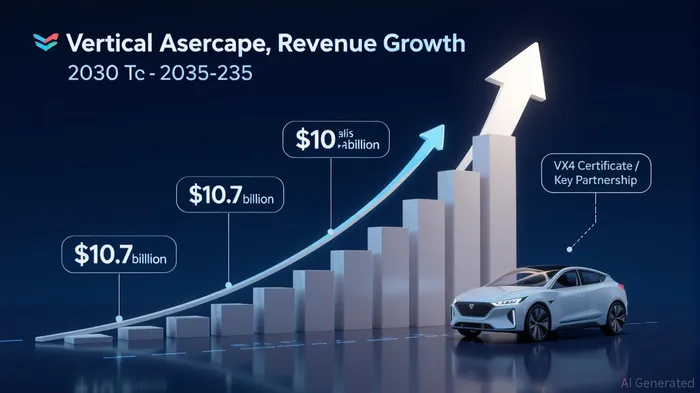
Vertical's Flightpath 2030 strategy, unveiled during the Capital Markets Day, outlines a clear path to commercialization. The company now targets $1.0 billion in consolidated annual revenues by 2030, with a gross profit margin of 20%, and scales to $10.7 billion by 2035, with a 40% margin[2]. These figures hinge on three pillars: certification of its VX4 eVTOL aircraft, an asset-light manufacturing model, and a recurring revenue stream from battery sales.
Certification and Operational Milestones
Vertical has made tangible progress in de-risking its timeline. A historic piloted airport-to-airport flight in July 2025 demonstrated the VX4's viability, while a partnership with Aciturri for airframe manufacturing solidified its asset-light approach[2]. The company now projects certification for the VX4 by 2028 and its hybrid-electric variant by 2029[2]. Strengthening this credibility is the appointment of Patrick Ky, former Executive Director of EASA, to its board—a move that signals regulatory expertise and aligns with investor demands for transparency[2].
Asset-Light Manufacturing and Cost Efficiency
Vertical's collaboration with Aciturri reduces capital expenditures and accelerates production scalability. By outsourcing airframe manufacturing, the company avoids the high costs of in-house facilities, a critical advantage in a capital-intensive industry[2]. Additionally, Vertical's “Razorblade model”—selling high-margin batteries alongside aircraft—positions it to capture recurring revenue. Management anticipates battery sales will account for half of long-term revenue, with gross margins exceeding 40%[1]. This diversification mitigates risks tied to aircraft sales alone and aligns with broader trends in sustainable aviation.
Investor Sentiment: Bridging Valuation and Potential
Vertical's stock has traded at a discount to its long-term projections, with a current market capitalization of approximately $440 million and a 12-month analyst price target of $10.43[3]. The Capital Markets Day aimed to close this gap by providing granular data on certification costs, production timelines, and financial metrics.
Market Reactions and Analyst Confidence
The event appears to have bolstered confidence. CantorCEPT-- Fitzgerald initiated coverage with an Overweight rating and an $8.00 price target, citing Vertical's “differentiated order book” and multi-pronged revenue strategy[4]. Meanwhile, short interest has declined, suggesting bearish sentiment is waning[4]. These signals indicate growing recognition of Vertical's disciplined execution, particularly its ability to secure partnerships and regulatory credibility.
Risks and Skepticism
Despite progress, challenges remain. Certification delays, supply chain bottlenecks, and competition from rivals like Archer AviationACHR-- and Joby AviationJOBY-- could test Vertical's timeline. However, the company's focus on an OEM model—selling aircraft to established operators rather than building its own fleet—differentiates it in a crowded market[1]. This approach leverages existing infrastructure and operator expertise, reducing entry barriers.
A Data-Driven Catalyst
Vertical's Capital Markets Day provided the hard metrics investors have long awaited. By detailing certification costs, manufacturing roadmaps, and battery economics, the company has laid the groundwork for a re-rating of its stock. The projected $10.7 billion revenue by 2035, coupled with a 40% gross margin, suggests a compelling long-term value proposition—if execution remains on track.
Conclusion
Vertical Aerospace's strategic execution—marked by regulatory credibility, asset-light manufacturing, and diversified revenue streams—positions it as a strong contender in the eVTOL sector. While risks persist, the company's recent milestones and investor-friendly disclosures suggest it is transitioning from innovation to commercial viability. For investors, the key will be monitoring progress against its 2028 certification timeline and the scalability of its battery business. If Vertical can maintain its disciplined approach, the gapGAP-- between its current valuation and long-term potential may narrow significantly.





Comentarios
Aún no hay comentarios