
Vertex Pharmaceuticals' Long-Term Growth Potential: Pipeline Innovation and Genetic Medicine Leadership
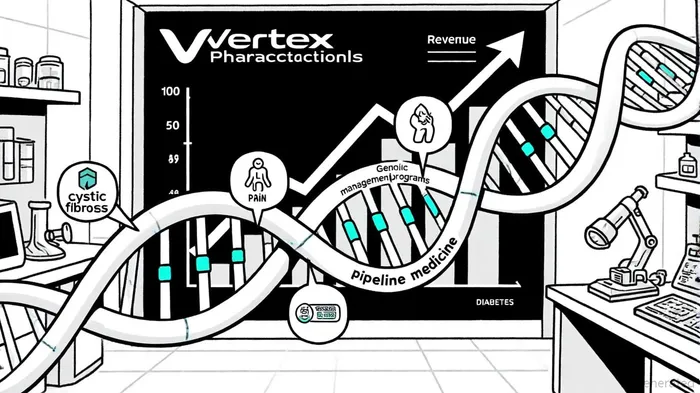
Vertex Pharmaceuticals stands at the forefront of genetic medicine, leveraging its expertise in cystic fibrosis (CF) to pioneer transformative therapies across a broadening spectrum of diseases. With a 12% year-on-year revenue increase in Q2 2025, reaching $2.96 billion[1], the company has demonstrated resilience and innovation, even as it navigates the complexities of high-cost gene therapies and competitive pressures. Its long-term growth potential hinges on three pillars: dominance in CF, strategic expansion into new therapeutic areas, and technological leadership in gene editing and cell therapy.
Cystic Fibrosis Dominance and Strategic Expansion
Vertex's CF portfolio remains its cornerstone, with TRIKAFTA and ALYFTREK capturing 90% of the U.S. market for eligible patients[4]. The approval of ALYFTREK in late 2024 for specific CFTR mutations[2] and the expansion of TRIKAFTA to younger populations[5] underscore Vertex's ability to extend its market reach. However, the company is not resting on its laurels. It has diversified into gene therapy with Casgevy (CTX001), a CRISPR-based treatment for sickle cell disease and beta thalassemia, which received UK approval in 2023 and is now in Phase 3 trials globally[3]. This pivot reflects a deliberate strategy to apply its CFTR modulation expertise to other genetic disorders.
Pipeline Innovation: Beyond CF
Vertex's pipeline extends beyond its CF franchise into high-growth areas such as pain management, diabetes, and kidney disease. VX-548, a non-opioid analgesic, addresses the $20 billion U.S. market for acute pain management[2], while zimislecel, a stem-cell-derived therapy for Type 1 Diabetes, is in Phase 3 trials and could treat 125,000 patients with severe hypoglycemia[1]. Additionally, povetacicept for IgA nephropathy and suzetrigine for diabetic neuropathy highlight Vertex's focus on unmet medical needs. These programs are underpinned by proprietary platforms, including selective ion-channel inhibitors and gene-editing technologies, which provide a durable competitive moat[4].
Strategic Shifts and Reimbursement Challenges
A notable strategic pivot is Vertex's decision to abandon adeno-associated virus (AAV) vectors in gene therapy, aligning with industry trends to mitigate safety and manufacturing risks[3]. This shift, while costly in the short term, positions the company to lead in non-viral delivery methods. However, reimbursement remains a hurdle. Casgevy's $2.2 million price tag necessitates innovative payment models, such as outcomes-based agreements and annuity payments[1]. Vertex's engagement with payers and regulators to structure these models demonstrates its adaptability in a cost-conscious healthcare environment.
Competitive Landscape and Financial Strength
While competitors like Regeneron and Gilead Sciences boast higher revenues[6], Vertex outperforms them in profitability, with a net margin of 34.84%[3]. Its focus on niche, high-margin genetic therapies allows it to maintain pricing power despite broader industry pressures. Analysts note that Vertex's institutional ownership (90.8%) and R&D investments[4] further insulate it from market volatility. Challenges persist, however, as smaller biotechs like Alnylam and 4D Molecular Therapeutics gain traction in RNA and gene therapies[5].
Financials and Growth Projections
Vertex's Q2 2025 revenue growth of 12%[1] outpaced the industry average of 8.81%[3], reflecting strong execution. With a market share of 1.41% in Q1 2025[6], the company is projected to reach $14.7 billion in revenue by 2028[5], driven by Casgevy's commercialization and the maturation of its pipeline. Strategic collaborations, such as its partnership with Moderna on VX-522 (an mRNA-based CFTR therapy), also signal long-term R&D agility[2].
Conclusion
Vertex Pharmaceuticals' long-term growth is anchored in its ability to translate scientific innovation into commercial success. By expanding its CF dominance into genetic therapies for rare diseases, addressing reimbursement challenges proactively, and maintaining a robust pipeline, Vertex is well-positioned to sustain its leadership in the $150 billion biotech sector. For investors, the company represents a compelling blend of near-term revenue stability and transformative long-term potential.





Comentarios
Aún no hay comentarios