
Verkle Trees to Transform Ethereum in 2026 Hegota Upgrade
- Verkle Trees enable stateless clients and reduce node hardware requirements for EthereumETH-- validators.
- The Hegota upgrade will compress verification proofs to lower operational costs and boost scalability.
- Ethereum accelerates its development cadence with Hegota following Glamsterdam in 2026.
- Network fundamentals strengthened in 2025 despite price pressure, setting stage for adoption.
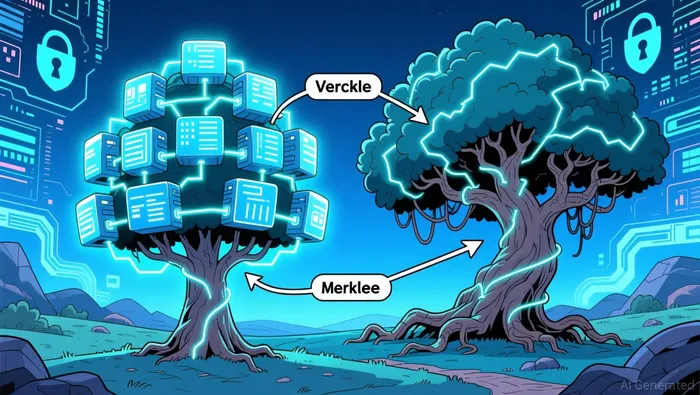
Ethereum's Hegota upgrade, slated for late 2026, will implement Verkle Trees to fundamentally reshape the network's data structure and scalability capabilities. This cryptographic innovation replaces Merkle Patricia Trees to combat state bloat while reducing hardware barriers for node operators. The upgrade arrives amid Ethereum's accelerated development cadence and follows Glamsterdam in early 2026. Investors eye potential long-term efficiency gains as the network addresses key growth constraints.
What Are Verkle Trees and How Do They Improve Ethereum?
Verkle Trees compress transaction verification data through advanced cryptography. This allows stateless clients to validate blocks without storing Ethereum's entire historical state. The innovation slashes node hardware requirements significantly compared to current systems.
By minimizing storage demands, Verkle Trees democratize node operation for smaller participants and solo stakers. Full nodes maintain network security while partial nodes reduce operational overhead. The structure also enhances compatibility with Layer 2 solutions by enabling more efficient data proofs. This technical foundation supports higher throughput without congestion risks.
How Will Hegota Enhance Ethereum's Scalability and Decentralization?
The Hegota upgrade implements Verkle Trees alongside state expiry mechanisms to prevent unchecked data growth. This directly combats bloat from DeFi, NFTs, and memeMEME-- coin activity that strains network resources. Storage requirements could drop substantially for node runners.
Lower hardware demands may expand validator participation, strengthening decentralization against centralization risks. The upgrade sustains Ethereum's gas target at 180 million while improving Layer 2 efficiency. These changes support higher transaction throughput and reduced user costs across the ecosystem. Hegota's timing reflects Ethereum's faster upgrade cadence to address competitive pressures.
What Does This Mean for Ethereum Investors in 2026?
Hegota could stabilize Ethereum's staking ecosystem by broadening validator participation. Reduced operational costs might attract more node operators, potentially decreasing centralization concerns. The scalability improvements position Ethereum to handle increasing institutional adoption.
Despite ETH's 28% price slide in 2025, network activity hit record highs with 275 million active addresses. Smart contract deployments reached 8.7 million as Layer 2 adoption surged. These fundamentals suggest underlying strength despite market sentiment. The upgrade cycle demonstrates Ethereum's commitment to maintaining smart contract leadership.
Technical progress hasn't always aligned with price action, creating potential valuation opportunities. The shift from deflationary dynamics post-Dencun requires investor adjustment. Still, Verkle Trees' efficiency gains could support long-term value through sustainable scaling.







Comentarios
Aún no hay comentarios