
Veritex Holdings' Exit from S&P 600: A Tipping Point for Small-Cap Bank Stocks?
The removal of Veritex HoldingsVBTX-- (VBTX) from the S&P SmallCap 600 index in October 2025 has sparked a broader conversation about the resilience and future of small-cap bank stocks. As the Dallas-based lender was delisted following its $1.9 billion acquisition by Huntington BancsharesHBAN-- (HBAN), the transaction underscores a growing trend of consolidation in the regional banking sector. This shift not only reshapes index composition but also signals a recalibration of investor priorities in an era of heightened regulatory scrutiny and competitive pressure.
Strategic Rationale Behind the Acquisition
Huntington's acquisition of VeritexVBTX-- is emblematic of a larger strategy to dominate high-growth markets. By absorbing $13 billion in assets and expanding its footprint in Texas-a state with a robust economy and a fragmented banking landscape-HBAN aims to bolster its net interest income and loan growth. According to a Panabee report, the deal is projected to be modestly accretive to earnings per share and neutral to capital at closing, with integration expected to accelerate Huntington'sHBAN-- regional ambitions. This aligns with the company's Q2 2025 financial performance, which already demonstrated strong loan growth and asset quality, as the Panabee report noted.
For small-cap banks, the transaction highlights the dual pressures of scale and efficiency. As larger institutions like Huntington leverage mergers to enhance profitability, smaller peers face a stark choice: consolidate or risk obsolescence. The acquisition adds approximately $9 billion in loans and $11 billion in deposits to Huntington's balance sheet, illustrating how strategic mergers can create economies of scale previously unattainable for standalone small-cap banks, as detailed in a StockTitan announcement.
Investor Sentiment and Index Rebalancing
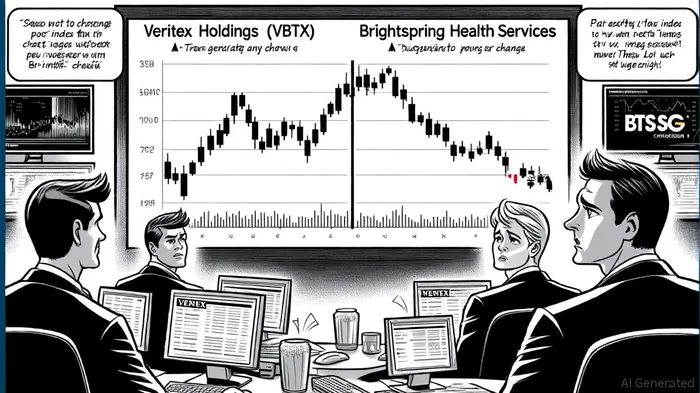
The immediate market reaction to Veritex's removal was telling. VBTXVBTX-- shares fell nearly 5% in a single day and nearly 12% over the past month, despite a 15% year-to-date gain, the Panabee report observed. Analysts attribute this pullback to a recalibration of expectations, as the stock trades at a price-to-earnings ratio of 14.3-above both its sector average and historical fair value, according to the Panabee coverage. Meanwhile, BrightSpring Health Services (BTSG), the company replacing VBTX in the S&P 600, saw a 5.28% surge in after-hours trading, reflecting the index's influence on liquidity and institutional investment flows, according to a GuruFocus report.
This divergence underscores the psychological weight of index inclusion. Small-cap stocks often experience heightened volatility when added to or removed from major indices, as passive and active fund managers adjust portfolios accordingly. For Veritex, the exit from the S&P 600 may have accelerated its acquisition timeline, as the company's standalone valuation became less attractive in a market increasingly favoring scale.
Broader Implications for the Sector
The Veritex-Huntington deal could serve as a blueprint for future consolidation. Small-cap banks, which have historically been valued for their community-focused models, now face a reality where growth is increasingly tied to strategic acquisitions. Huntington's success in Texas-a market with a population of over 30 million and a thriving energy sector-demonstrates how regional expansion can unlock value. However, this trend also raises concerns about reduced competition and the potential for regulatory pushback, particularly in markets where post-merger deposit concentrations exceed thresholds.
Investors must also weigh the trade-offs between growth and governance. While Huntington's acquisition is expected to enhance its capital position, the integration of Veritex's operations will require careful management of costs and cultural alignment. A GuruFocus piece notes that the deal is projected to be "modestly accretive," suggesting that aggressive cost synergies may not be on the table-a contrast to the high-margin, low-cost strategies often pursued in larger bank mergers.
Conclusion
Veritex Holdings' removal from the S&P 600 is more than a technicality-it is a symptom of a sector in flux. As small-cap banks navigate a landscape defined by regulatory complexity, technological disruption, and the need for scale, strategic mergers will likely become the norm rather than the exception. For investors, the key takeaway is clear: the days of small-cap banking as a purely defensive play are fading. Instead, the focus is shifting to companies that can balance growth with governance, leveraging acquisitions to build resilient, customer-centric institutions.
In the short term, the market's mixed reaction to Veritex's exit and BrightSpring's inclusion suggests that index changes remain a powerful, albeit unpredictable, force. For long-term investors, the challenge will be distinguishing between fleeting volatility and enduring value-a task that demands both patience and a nuanced understanding of the sector's evolving dynamics.





Comentarios
Aún no hay comentarios