
Veolia's Hybrid Bond Issuance: A Strategic Opportunity for Yield-Seeking Investors
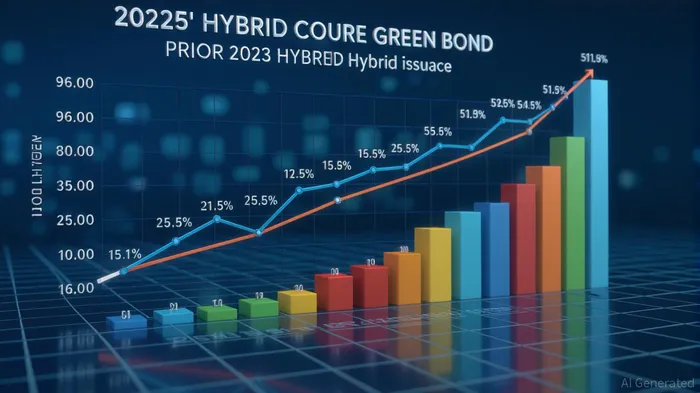
Institutional investors seeking yield in a low-growth, high-volatility environment must balance return potential with risk mitigation. Veolia's May 2025 hybrid green bond issuance—raising €500 million through deeply subordinated perpetual notes with a 4.371% coupon—presents a compelling case study in this regard. By analyzing the bond's risk-adjusted returns, capital structure implications, and alignment with ESG (Environmental, Social, and Governance) trends, we uncover why this issuance could be a strategic opportunity for yield-seeking investors.
Risk-Adjusted Returns: A Cost-of-Capital Optimization
Veolia's hybrid green bond offers a coupon rate of 4.371%, fixed until August 2030, with a current yield to maturity of 4.33% based on its market price of 102.074 EUR [1]. This represents a significant improvement over the company's prior hybrid debt, such as the 2023 €600 million issuance with a 6% coupon [2]. The reduction in borrowing costs reflects favorable market conditions and Veolia's strong credit profile, with long-term junior subordinated debt rated BBB (S&P) and Baa3 (Moody's) [3].
The absence of a concession in the 2025 issuance—despite its €2.7 billion order book (5.4x oversubscription)—underscores investor confidence in Veolia's financial solidity and its commitment to ecological transformation [4]. For institutional investors, this signals a low-risk, high-liquidity environment, where demand for green bonds is outpacing supply. The bond's perpetual structure, while introducing some reinvestment risk, is offset by its deeply subordinated nature, which prioritizes senior debt holders and reduces default risk.
Capital Structure Implications: Refinancing and Resilience
Veolia's issuance replaces existing hybrid debt, effectively deleveraging its balance sheet while extending its debt maturity profile. By refinancing higher-coupon obligations (e.g., the 6% 2023 issue) with lower-cost perpetual notes, the company reduces its interest burden and enhances financial flexibility. This is critical in an era of rising regulatory and operational costs in the environmental services sector.
The hybrid structure itself—a blend of debt and equity-like features—allows Veolia to strengthen its capital base without diluting equity. For investors, this means the bond serves as a buffer for senior creditors while offering subordinated holders a claim on future earnings growth. The alignment with the company's Green Financing Framework further enhances its appeal, as proceeds are earmarked for projects that reduce carbon footprints and align with global sustainability goals [5].
Strategic Alignment with ESG Trends
The green bond's oversubscription highlights a broader shift in capital markets toward ESG-aligned investments. With global green bond issuance projected to surpass €1 trillion annually by 2026, investors are increasingly prioritizing instruments that combine financial returns with positive environmental impact. Veolia's focus on water management, waste-to-energy, and circular economy projects positions it as a leader in this transition.
For institutional investors, the bond's dual mandate—refinancing legacy debt and funding green initiatives—creates a “double bottom line” benefit. It not only offers competitive yields but also contributes to decarbonization efforts, a factor that is becoming central to portfolio resilience in the face of climate-related regulatory risks.
Conclusion: A Win-Win for Investors and the Planet
Veolia's hybrid green bond issuance exemplifies how companies can leverage market conditions and ESG trends to optimize capital structures while delivering attractive risk-adjusted returns. For institutional investors, the bond's low concession, favorable credit ratings, and alignment with sustainability goals make it a rare opportunity to balance yield generation with long-term value creation. As markets continue to price in ecological and regulatory transitions, such instruments will likely become cornerstones of resilient portfolios.







Comentarios
Aún no hay comentarios