
Venezuelan Oil's Strategic Potential: Assessing U.S. Energy Market Implications and Investment Risks
Venezuela's vast oil reserves-estimated at 303 billion barrels-position it as a critical player in global energy markets, yet its production capacity has plummeted to 934,000 barrels per day as of November 2025, down from a peak of 3.5 million barrels per day in the early 2000s. This decline, driven by mismanagement, underinvestment, and U.S. sanctions, has left the country's infrastructure in disrepair and its crude production capacity severely constrained. However, recent geopolitical shifts, including the U.S. military intervention in January 2026 and Trump's pledge to invest billions in Venezuela's oil sector, have reignited debates about the potential for U.S. energy firms to capitalize on this resource-rich nation. This analysis evaluates whether U.S. access to Venezuela's reserves could yield long-term energy cost advantages or pose significant production risks for domestic oil companies.
The State of Venezuela's Oil Industry and U.S. Involvement
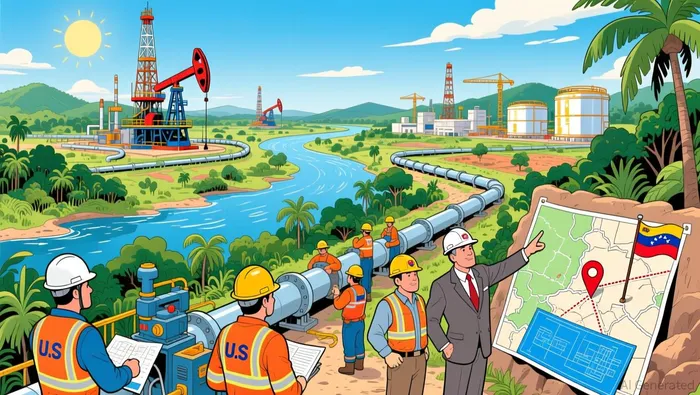
Venezuela's oil infrastructure has deteriorated over two decades of political instability and sanctions. Wells remain inactive, refineries operate at a fraction of capacity, and the country's extra-heavy, sour crude-requiring specialized refining infrastructure-has become a logistical and economic burden. U.S. sanctions, imposed to pressure the Maduro regime, have further isolated Venezuela from global financial systems and restricted access to critical equipment. Despite these barriers, ChevronCVX-- has maintained limited operations under sanctions waivers, while other U.S. firms have hesitated to re-enter without assurances of political stability.
The Trump administration's recent intervention, however, signals a shift. Trump has vowed to prioritize U.S. oil companies in rebuilding Venezuela's infrastructure, citing the strategic value of its reserves and proximity to U.S. Gulf Coast refineries optimized for heavy crude. This move aligns with broader U.S. energy policy goals to reduce reliance on alternative crude sources and counter Chinese influence in the region.
Refining Infrastructure and Crude Quality: A Double-Edged Sword
Venezuela's extra-heavy crude, while challenging to refine, is highly valuable for U.S. Gulf Coast refineries, which are uniquely equipped to process such feedstock into diesel, asphalt, and other high-margin products. Historically, these refineries relied on discounted Venezuelan barrels to enhance operational efficiency and margins. However, Venezuela's production decline has forced refiners to seek alternatives, often at higher costs.
Reviving Venezuela's output could theoretically lower energy costs for U.S. refiners. Goldman Sachs analysts estimate that a return to 2.5 million barrels per day by 2030 could reduce global oil prices by $4 per barrel, though this would require sustained investment and political stability. In the short term, however, global oil markets remain oversupplied, and even a modest increase in Venezuelan production is unlikely to disrupt prices significantly.
Geopolitical Risks and Investment Hurdles
While the potential rewards are substantial, U.S. energy firms face significant risks. Restoring Venezuela's oil infrastructure to pre-2000s levels would require tens of billions of dollars in capital, with production recovery expected to take years. Political instability remains a wildcard; even with Maduro's removal, legal reforms and asset compensation are uncertain. Industry experts caution that without clear legal protections, companies may avoid large-scale investments, opting instead for cautious participation.
Sanctions, though relaxed in recent months, still pose operational challenges. U.S. firms must navigate complex regulatory frameworks to access Venezuela's reserves, and geopolitical tensions with China and Russia could further complicate market dynamics. Additionally, the environmental and social costs of reviving Venezuela's oil industry-particularly in ecologically sensitive regions- could attract regulatory scrutiny.
Strategic Implications for U.S. Energy Equities
For U.S. energy firms, Venezuela represents both an opportunity and a high-stakes gamble. Companies like Chevron, already active in the country, are well-positioned to scale up production if political and legal conditions stabilize. However, broader participation from firms such as Exxon MobilXOM-- and ConocoPhillips will depend on risk mitigation strategies, including government guarantees and phased investment plans.
From a market perspective, a successful U.S. reengagement could reduce energy costs for Gulf Coast refiners and enhance U.S. energy security. Yet, the long timeline for returns and exposure to geopolitical volatility make this a high-risk, high-reward proposition. Investors must weigh the potential for discounted crude access against the likelihood of prolonged operational delays and regulatory hurdles.
Conclusion: A Calculated Bet on the Future
Venezuela's oil reserves hold transformative potential for U.S. energy markets, but realizing this potential requires navigating a complex web of geopolitical, economic, and infrastructural challenges. While the Trump administration's aggressive intervention and the strategic advantages of U.S. refining capabilities offer a compelling case for investment, the risks of political instability, capital intensity, and market oversupply cannot be ignored. For U.S. energy firms, the key to success lies in a balanced approach: leveraging existing partnerships, securing legal protections, and adopting a long-term perspective that aligns with both corporate and national energy security goals.





Comentarios
Aún no hay comentarios