
The Venezuela Shock: A Rotation Catalyst for Energy and Industrial Sectors in 2026
The geopolitical upheaval in Venezuela has emerged as a pivotal catalyst for asset reallocation in 2026, reshaping dynamics in energy and industrial markets. The U.S. military intervention, culminating in the capture of President Nicolás Maduro, has triggered a recalibration of global energy strategies, with investors and policymakers recalibrating their bets on oil, infrastructure, and geopolitical risk. While Venezuela's oil sector remains a shadow of its former self- production has plummeted by over 1.5 million barrels per day since 2019 due to sanctions and mismanagement-the potential for a U.S.-led revival of its vast reserves is already influencing capital flows.
The Energy Sector: A High-Stakes Reopening
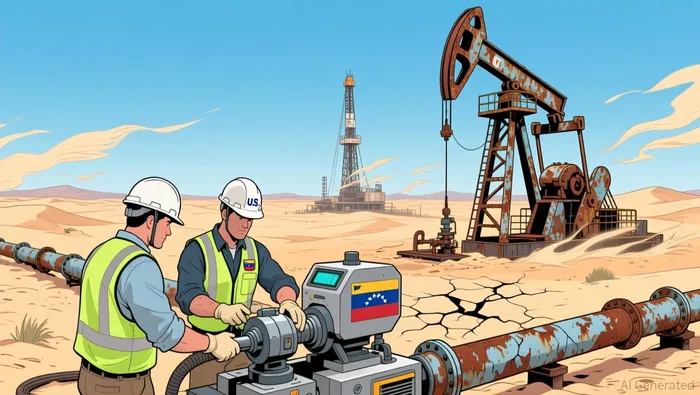 The U.S. administration's stated intent to restore Venezuela's oil infrastructure and open the sector to American firms has injected optimism into energy markets. According to a report by Rystad Energy, reviving production to 3 million barrels per day would require $183 billion in capital expenditure between 2026 and 2040, a figure that underscores the scale of the challenge. However, analysts project that with sanctions lifted and political stability restored, output could rise to 1.3–1.4 million barrels per day within two years, potentially reaching 2.5 million bpd by the late 2030s.
This potential surge, however, faces headwinds. The global oil market is already oversupplied, and a rapid increase in Venezuelan production could further depress prices. Yet, for investors, the long-term appeal lies in Venezuela's status as the country with the world's largest proven oil reserves. As stated by Bloomberg, U.S. energy giants like ChevronCVX-- and ExxonMobilXOM-- have already seen their stocks rise in anticipation of a renewed role in the region, signaling a shift in capital toward energy equities.
Industrial Sectors and Geopolitical Realignment
The Venezuela shock is not confined to energy markets. The U.S. intervention reflects a broader strategy to counter Chinese and Russian influence in Latin America, a move that could reshape industrial supply chains. For instance, the need to rebuild Venezuela's oil infrastructure-aging pipelines, refineries, and exploration equipment-has created opportunities for industrial firms specializing in heavy machinery and engineering services.
Investors are also factoring in the geopolitical ripple effects. The U.S. operation has heightened regional tensions, prompting a reallocation of assets toward defense and industrial sectors. As noted by Capital Economics, markets are pivoting toward value-oriented and cyclical sectors, prioritizing industries with tangible assets amid heightened geopolitical volatility. This trend is evident in the performance of energy ETFs like the Energy Select Sector SPDR, which have outperformed tech-heavy indices in early 2026.
Strategic Asset Reallocation: Risks and Opportunities
While the Venezuela scenario offers compelling investment opportunities, it is not without risks. The global energy transition, with its emphasis on renewables, could dampen long-term demand for oil. Additionally, the success of U.S. efforts in Venezuela hinges on political stability-a fragile assumption in a country marked by decades of turmoil.
Nevertheless, the immediate outlook for energy and industrial sectors remains bullish. According to a report by Janus Henderson, the Venezuela crisis has accelerated a broader realignment of global capital, with investors favoring sectors that align with U.S. strategic interests. This includes not only energy but also defense contractors and industrial firms poised to benefit from infrastructure rebuilding.
Conclusion
The Venezuela shock of 2026 has crystallized as a defining event for energy and industrial markets, acting as both a risk and a rotation catalyst. For investors, the key lies in balancing the short-term volatility of geopolitical shocks with the long-term potential of a revitalized Venezuelan oil sector. As the U.S. seeks to reassert its influence in Latin America, the interplay between energy security, industrial demand, and geopolitical strategy will continue to shape asset allocation decisions. In this environment, strategic reallocation toward energy and industrial equities-while hedging against geopolitical uncertainties-appears to be the prudent path forward.





Comentarios
Aún no hay comentarios