
Venezuela's Post-Maduro Market Volatility: Opportunity or Mirage?
The Caracas Stock Index (IBVC) has become one of the most talked-about anomalies in global markets in early 2026. A 50% single-day surge on January 6, followed by a 17.90% gain the next session, pushed the index to a record 6,010 points-a 4,117.09% increase year-over-year. This volatility, driven by the U.S.-backed removal of Nicolás Maduro and the promise of sanctions relief, has sparked a frenzy of speculation. But is this a once-in-a-time opportunity, or a speculative mirage? Let's dissect the numbers, risks, and potential for an ETF-based vehicle to capitalize on this high-stakes market.
The Catalysts: Political Repricing and Oil Hopes
The IBVC's meteoric rise began in late 2025, with a 22% gain on December 29 alone. By January 2026, the index had surged 148% from its December 23 level, fueled by the U.S. military's capture of Maduro and a $2 billion oil deal with Washington. Investors are betting on three key factors:
1. Sanctions relief: The U.S. has signaled a partial rollback of restrictions to allow imports of oil equipment, potentially reviving Venezuela's ailing 1-million-barrel-per-day production.
2. Infrastructure investment: A caretaker administration has hinted at foreign participation in rebuilding energy and transportation networks.
3. Sovereign risk re-rating: Government and PDVSA bonds jumped 30% post-January 6, reflecting optimism about fiscal stability.
However, these hopes rest on a fragile foundation. Venezuela's oil sector, once a global powerhouse, has been crippled by decades of mismanagement and U.S. sanctions. Pre-Maduro, production had plummeted from 3.5 million barrels per day in the early 2000s to a shadow of its former self. Even with sanctions easing, restoring output will require years of capital expenditure and political stability-both of which remain uncertain.
Market Dynamics: Speculative Frenzy or Sustainable Growth?
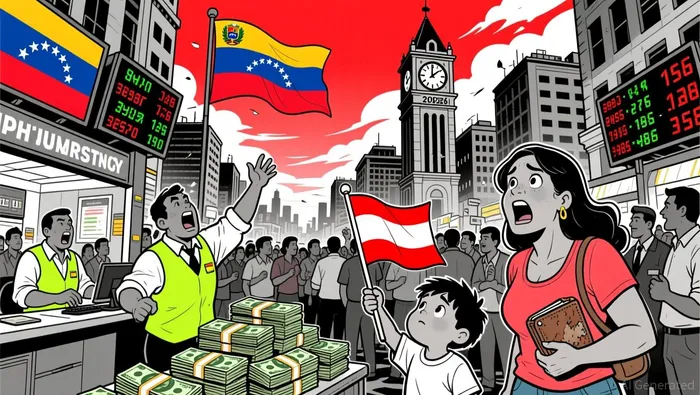
The IBVC's performance is emblematic of a market driven by domestic demand and limited international participation. Capital controls and geopolitical risks have kept foreign investors at bay, leaving the index vulnerable to hyper-volatility. For instance, the index's 50% single-day jump on January 6 was fueled by a small pool of local traders and state-linked entities. This lack of liquidity means prices can swing wildly with minimal news, creating a casino-like environment.
Moreover, the index's composition exacerbates risks. It is heavily concentrated in a handful of state-owned or politically connected firms, many of which lack transparency. As one analyst noted, "This isn't a diversified market-it's a high-conviction bet on Venezuela's political transition." While this concentration can amplify returns in a bullish scenario, it also magnifies downside risks if the new administration falters.
The ETF Angle: Feasibility and Challenges
The idea of an ETF tracking the Caracas market is tantalizing but fraught with hurdles. First, liquidity remains a critical barrier. Even with the IBVC's recent gains, daily trading volumes remain minuscule compared to global benchmarks. An ETF would likely face significant bid-ask spreads and slippage, eroding returns for investors.
Second, geopolitical risks are ever-present. The U.S. blockade on Venezuelan oil exports, while potentially easing, could reignite if relations sour. Additionally, the caretaker administration's legitimacy is untested; any reversal in political momentum could trigger a collapse in asset prices.
That said, an ETF could still serve a niche audience. For high-net-worth investors and hedge funds, a leveraged or inverse product might offer a way to hedge or speculate on short-term volatility. However, a long-only ETF would require robust safeguards, including real-time risk monitoring and a diversified basket of assets beyond the IBVC.
Conclusion: High-Risk, High-Reward or a Mirage?
Venezuela's post-Maduro market surge is a textbook case of "risk-on" euphoria. The IBVC's gains reflect a re-pricing of political and economic optimism, but the underlying fundamentals-debt-laden state enterprises, a battered oil sector, and a history of hyperinflation-remain unresolved. For most investors, this market is a high-stakes gamble best left to specialists.
An ETF-based vehicle could work, but only for those with deep pockets and a stomach for volatility. If the new administration delivers on its promises-sanctions are lifted, oil production rebounds, and Venezuela reintegrates into global markets-the rewards could be astronomical. But if the political experiment fails, the IBVC's gains could vanish as quickly as they appeared.
In the end, Venezuela's market is a reminder that even the most dramatic rebounds are only as solid as the foundation beneath them.







Comentarios
Aún no hay comentarios