
Venezuela's Political Shifts and the Strategic Re-entry of U.S. Energy Giants: Chevron, Exxon, and ConocoPhillips
The political landscape in Venezuela has undergone a seismic shift in late 2025, marked by the U.S.-led removal of President Nicolás Maduro and the subsequent pledge to revitalize the country's oil sector. This development has reignited interest in Venezuela's energy potential, particularly for U.S. energy giants like ChevronCVX--, ExxonMobilXOM--, and ConocoPhillipsCOP--. However, the path to re-entry is fraught with geopolitical risks and complex economic challenges that demand a nuanced assessment of long-term value creation.
A New Political Order and U.S. Strategic Priorities
The U.S. military operation that and his wife in January 2026 marked a dramatic departure from traditional diplomatic engagement. President Donald Trump framed the intervention as a necessary step to counter narcotics trafficking and stabilize Venezuela's oil infrastructure, while also signaling a willingness to assume direct governance during the transition. This move, however, has been met with resistance from interim President , a close Maduro ally, who has condemned U.S. involvement as colonialist. The political vacuum left by Maduro's ouster raises critical questions about the durability of the new leadership and the potential for hardline elements within the regime to resist U.S. influence.
The State of Venezuela's Oil Sector: A Tale of Decline and Opportunity
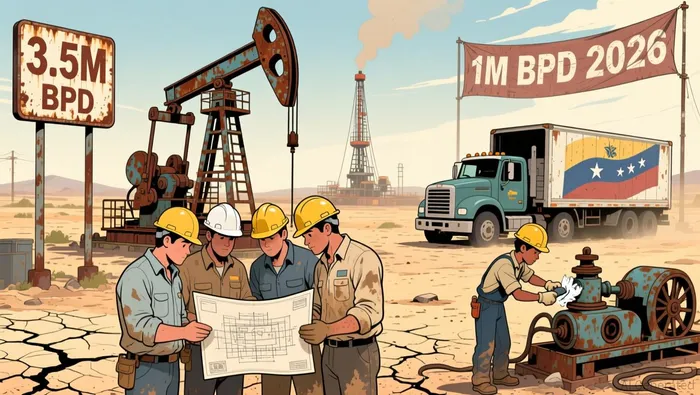 Venezuela's oil production has plummeted to approximately 1 million barrels per day, . Decades of mismanagement, expropriation of foreign assets, and U.S. sanctions have crippled Petróleos de Venezuela S.A., leaving its infrastructure in disrepair. The Trump administration's pledge to allow U.S. companies to invest in Venezuela's oil sector hinges on the assumption that Chevron, ExxonXOM--, and ConocoPhillips can rebuild this infrastructure. However, analysts estimate that restoring production .
Sanctions, Policy Reforms, and the Path to Re-entry
The U.S. has maintained a stringent sanctions regime against PDVSA, blocking its access to global financial systems and export markets. While the removal of Maduro has created a window for U.S. companies to re-enter, the transition period remains politically volatile. Chevron, the only U.S. firm currently operating in Venezuela under special licenses, has been granted renewed authority to produce and export oil. However, broader re-entry by Exxon and ConocoPhillips will depend on the resolution of existing contracts with Chinese firms and the establishment of a stable legal framework according to the latest analysis.
Geopolitical Risks and Strategic Implications
The U.S. intervention in Venezuela has significant geopolitical ramifications. China, which daily, has criticized the operation as a destabilizing act. Meanwhile, the U.S. seeks to leverage Venezuela's oil reserves to enhance its energy security, particularly for Gulf Coast refineries optimized to process heavy crude according to industry analysis. Yet, the precedent of military intervention risks undermining U.S. credibility in Latin America and emboldening other powers to challenge sovereignty norms. For U.S. energy companies, the geopolitical fallout could translate into regulatory headwinds and reputational risks, particularly in markets where U.S. influence is contested.
Long-Term Value Creation: Balancing Potential and Uncertainty
, the long-term value for U.S. energy firms hinges on several factors. First, political stability is essential to attract sustained investment. The interim government under Rodríguez has yet to demonstrate a commitment to legal reforms or debt restructuring, leaving uncertainty about the rule of law. Second, security risks remain acute, with the U.S. State Department issuing travel advisories due to high crime rates. Third, the global oil market's oversupply could limit the economic returns from a surge in Venezuelan production.
Conclusion: A High-Stakes Gamble
The re-entry of U.S. energy giants into Venezuela is a high-stakes proposition. While the potential to access the world's largest oil reserves is undeniable, the geopolitical and operational risks are equally formidable. For Chevron, Exxon, and ConocoPhillips, success will depend on navigating a complex web of political transitions, sanctions, and market dynamics. Investors must weigh the allure of Venezuela's untapped resources against the likelihood of prolonged instability and the geopolitical costs of U.S. intervention. In this context, patience and a diversified risk management strategy may prove as critical as capital.





Comentarios
Aún no hay comentarios