
Venezuela's Political Shift: Implications for U.S.-Led Energy and Infrastructure Opportunities
The U.S. military's January 2026 intervention in Venezuela, culminating in the arrest of Nicolás Maduro and the interim leadership of Delcy Rodríguez, has created a seismic shift in the country's political and economic trajectory. This development, framed by President Trump as a strategic reset for Venezuela's energy sector, has opened a complex window of opportunity and risk for U.S. investors. The interplay between geopolitical maneuvering, infrastructure rehabilitation, and the uncertain political landscape demands a nuanced analysis of Venezuela's potential as an emerging market.
Energy Sector: A High-Stakes Rebuild
Venezuela's oil industry, once a global powerhouse, now sits at a crossroads. With proven reserves of 303 billion barrels-the largest in the world-its energy sector could theoretically become a cornerstone of U.S. energy security and global market stability. However, production has plummeted to less than 1 million barrels per day, a shadow of its 1990s peak of 3.5 million barrels per day, due to decades of underinvestment, sanctions, and mismanagement. Trump's pledge to secure up to 50 million barrels of oil for the U.S. market and his directive for U.S. companies to invest "at least $100 billion" in Venezuela's energy infrastructure signal an aggressive vision according to reports. Yet, the feasibility of this plan hinges on resolving critical challenges.
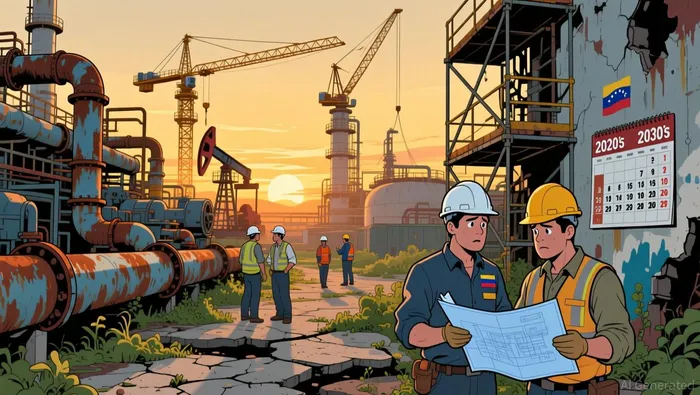 Restoring Venezuela's oil infrastructure requires annual investments of $10 billion over a decade, including rehabilitating pipelines, storage terminals, and aging equipment according to industry analysis. Even modest production increases-such as reaching 1.5 million barrels per day-could take two years if governance and sanctions are addressed, while full recovery to 3.5 million barrels per day may require 7–10 years of sustained investment as data shows. U.S. oil majors like ChevronCVX--, ExxonMobilXOM--, and ConocoPhillipsCOP--, which previously operated in Venezuela before nationalization policies in the 2000s, remain cautious. Industry executives cite unresolved legal claims, political instability, and a global oil market oversupply as major deterrents according to climate reports.
Infrastructure Rehabilitation: A $100 Billion Gamble
The U.S. government has positioned itself as a guarantor of stability, offering financial incentives such as Export-Import Bank guarantees and Development Finance Corp. support to mitigate risks for investors as government officials state. However, the Trump administration's assertion of "total safety" for U.S. operations contrasts sharply with the reality of Venezuela's fractured political landscape. Delcy Rodríguez, now interim leader, faces the daunting task of balancing U.S. demands with the entrenched interests of China, Russia, and Cuba, which have long supported the Maduro regime according to Atlantic Council analysis. Her ability to navigate this tension will determine whether foreign capital flows into Venezuela's energy sector or remains trapped in a web of geopolitical rivalries.
Meanwhile, María Corina Machado's democratic coalition, though victorious in the 2024 election, lacks the international or U.S. backing needed to solidify a post-Maduro transition. This vacuum of legitimacy complicates efforts to attract long-term investment, as investors seek clear governance frameworks and legal certainty as noted by the New York Times. The absence of a unified opposition leader also raises the risk of prolonged instability, which could deter capital inflows and exacerbate regional tensions.
Geopolitical Risks and Strategic Windows
The U.S. intervention has already triggered regional fallout. Colombia faces potential migration surges and border tensions, while Brazil has condemned the operation as "unacceptable," and Cuba loses a critical economic lifeline through Venezuelan oil according to CNBC reporting. These dynamics underscore the fragility of the current geopolitical equilibrium. For investors, the immediate risk lies in short-term disruptions to oil production, which could fall below 700,000 barrels per day amid political uncertainty according to Bhfs analysis. However, a stable, U.S.-aligned government could attract the investment needed to stabilize global oil markets and reduce U.S. reliance on Middle Eastern suppliers as Morgan Stanley reports.
The strategic window for early-stage capital appears narrow but potentially lucrative. U.S. companies that commit to infrastructure rehabilitation now could secure first-mover advantages as production ramps up. Yet, the global oil price environment-forecasted to remain around $55 per barrel in 2026-presents a headwind, as Venezuela's heavy, high-sulfur crude commands lower prices and higher production costs according to bipartisan analysis. Historical precedents, such as Iraq and Libya, suggest that regime changes in major oil producers rarely lead to rapid output increases, emphasizing the need for patience and sustained political stability as industry reports indicate.
Conclusion: Balancing Ambition and Prudence
Venezuela's energy sector represents a high-risk, high-reward proposition for U.S. investors. The Trump administration's aggressive intervention and financial incentives create a compelling narrative for infrastructure revival, but the path to profitability is fraught with geopolitical and operational challenges. Delcy Rodríguez's interim leadership and the unresolved role of María Corina Machado's coalition will shape the investment climate in the coming months. For now, the strategic window for early-stage capital remains open, but success will depend on aligning U.S. corporate interests with Venezuela's complex political realities and global market dynamics.





Comentarios
Aún no hay comentarios