
Venezuela's Oil Uncertainty: A Misunderstood Tail Risk in a Range-Bound Market
Venezuela's oil sector, once a cornerstone of global energy markets, remains a paradox: it holds 20% of the world's proven oil reserves according to CNN yet produces less than half of its 1990s output. This disconnect, driven by U.S. sanctions, political instability, and infrastructure decay, has created a unique tail risk-one that investors may be underestimating in a market otherwise characterized by range-bound volatility. While current production constraints limit immediate supply shocks, the long-term potential for a sudden surge in Venezuelan crude, should geopolitical conditions shift, warrants strategic positioning for volatility.
The Sanctions-Induced Stagnation
U.S. sanctions, reimposed in 2025 after the failure of Venezuela's electoral process, have crippled the country's oil exports. By December 2024, production had fallen to 963,000 barrels per day (b/d), with the Orinoco Belt-its primary producing region- slumping by 25% to 540,000 b/d. Exports to China, once a critical market, plummeted from 8.9 million barrels in November 2024 to 2 million in December, as the U.S. intensified enforcement of sanctions on tankers. The Trump administration's 2026 military operation to remove Nicolás Maduro further exacerbated instability, with plans to hand control of Venezuela's oil industry to American firms.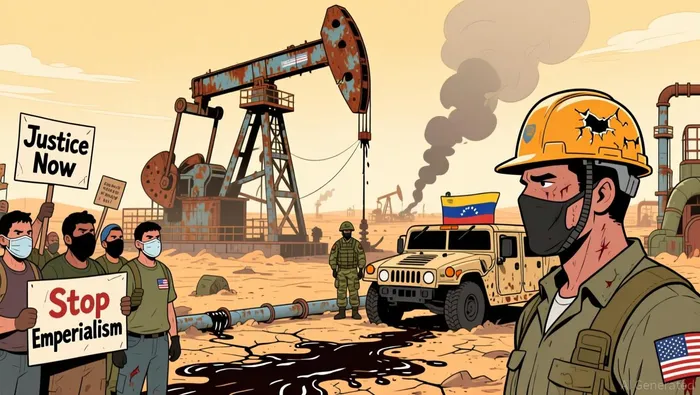 However, experts caution that reviving production to pre-sanction levels (3.5 million b/d) would require $185 billion in investment and decades of political stability according to Argam.
A Tail Risk in the Making
Despite these challenges, Venezuela's oil potential remains a latent tail risk. The country's 303 billion barrels of reserves could theoretically flood the market if sanctions are lifted or U.S. companies succeed in revitalizing infrastructure. Yet, such a scenario is contingent on resolving complex legal, political, and logistical hurdles. For instance, U.S. Gulf Coast refineries, which rely on Venezuela's heavy crude, face bottlenecks due to the lack of diluents for blending according to NB. Meanwhile, global oil markets, currently oversupplied, may absorb a modest production increase without triggering price spikes as Goldman Sachs noted. This creates a "Goldilocks" dilemma: the market is not pricing in a full-scale recovery but is also unprepared for a sudden, large-scale disruption.
Historical Parallels and Investor Lessons
History offers cautionary tales. The 2011 Arab Spring, for example, caused oil prices to surge as Libya's production collapsed according to CFR, while the 2018 U.S.-China trade war amplified volatility through speculative trading as reported by ERL. These events highlight how geopolitical risks-whether in Venezuela or elsewhere-act as both direct and indirect drivers of oil price swings. Today, Venezuela's situation mirrors these dynamics, albeit with a slower-burn trajectory. The muted market response to Venezuela's political upheaval- reflected in stable VIX and range-bound prices-suggests underappreciated risks.
Strategic Positioning for Volatility
Investors should consider hedging against Venezuela's tail risk through diversified strategies:
1. Gold as a Safe Haven: With geopolitical tensions persisting, gold's role as a hedge remains critical. Analysts project a target price of $5,000/oz by mid-2026, making it a compelling addition to energy-focused portfolios.
2. Oil Futures and Options: While near-term contracts reflect oversupply, longer-dated futures could benefit from a sudden production rebound. Positioning in options (e.g., straddles) allows investors to profit from volatility without directional bets.
3. Emerging Market Diversification: Venezuela's oil sector is intertwined with broader emerging market risks. Allocating to defensive equities or sovereign bonds in regions less exposed to geopolitical shocks can balance energy sector exposure.
Conclusion
Venezuela's oil uncertainty is not a headline risk but a tail risk-a quiet undercurrent that could surge if political or sanctions-related conditions shift. While the market's current complacency is understandable, the interplay of geopolitical fragility, infrastructure decay, and U.S. intervention creates a scenario where volatility is inevitable. For investors, the key lies in hedging against the unexpected, not the likely. As the Trump administration's Venezuela gambit unfolds, the oil market's next chapter may hinge on how swiftly-and how smoothly-this sleeping giant awakens.







Comentarios
Aún no hay comentarios