
Venezuela's Oil Sector: A Long-Term Strategic Opportunity Amidst Political Shifts?
Venezuela's oil sector, once a cornerstone of global energy markets, has languished under years of political turmoil, economic mismanagement, and U.S. sanctions. Yet, with recent geopolitical shifts-including the U.S. military's capture of President Nicolás Maduro and Donald Trump's pledge to "run" Venezuela-questions about the feasibility of revitalizing the state-owned oil company, PDVSA, have resurfaced. For investors, the key question is whether this represents a long-term strategic opportunity or a high-risk, high-cost endeavor with uncertain returns.
The State of PDVSA: A Sector in Decline
Venezuela's oil production has plummeted from a peak of over 3.5 million barrels per day in the late 1990s to approximately 1 million barrels per day in early 2026, according to a report. This collapse has been driven by U.S. sanctions, which severed access to capital, technology, and global markets, and disrupted critical imports such as diluent chemicals needed for heavy crude processing as detailed in analysis. PDVSA's infrastructure is in dire straits, with refineries operating at a fraction of their capacity. While limited U.S. licenses have allowed ChevronCVX-- to maintain some operations, broader recovery remains elusive.
U.S. Strategy and the Path to Revitalization
President Trump's plan to seize and revitalize Venezuela's oil industry hinges on attracting U.S. energy giants like Exxon MobilXOM--, Chevron, and ConocoPhillipsCOP-- to invest in infrastructure and production. Analysts estimate that restoring output to 4 million barrels per day-a level last seen in the 1990s-would require $100 billion in investment and a decade of sustained effort. This timeline assumes political stability, a critical precondition for foreign investment. As noted by KPTV, companies are hesitant to commit without assurances of contractual security and government continuity.
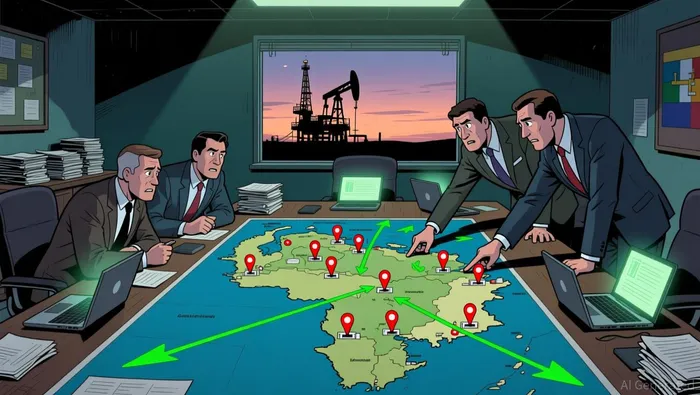 The U.S. strategy also faces logistical hurdles. Venezuela's heavy crude, while essential for U.S. Gulf Coast refineries, demands significant investment in specialized processing equipment. Moreover, legal uncertainties around ownership of oil resources and the potential for further U.S. interventions add layers of complexity.
Global Oil Supply Implications
Venezuela's 303 billion barrels of proven reserves represent a critical untapped resource in a world grappling with diesel shortages and shifting OPEC dynamics. Reviving production could ease global diesel supply constraints and provide an alternative to Russian oil, potentially pressuring Moscow in the energy market. However, immediate price volatility is unlikely, as global oil remains in surplus, and Venezuela's output is already factored into OPEC projections. OPEC+ has also maintained its current output policy, prioritizing market share over rapid adjustments to geopolitical disruptions.
Risks and Realities
Despite the potential, the risks are formidable. Political instability, corruption, and the legacy of U.S. sanctions create an environment where long-term commitments are perilous. As Cornelia Meyer cautions, rebuilding Venezuela's oil sector will require not only capital but also technology transfer and governance reforms-elements that remain unproven under Trump's proposed model. Furthermore, the involvement of U.S. companies is cautious; Chevron is the only major player currently operating in the country.
Conclusion: A Long-Term Gamble
For investors, Venezuela's oil sector embodies a paradox: a vast, underutilized asset with the potential to reshape global supply dynamics, yet one that demands patience, capital, and political will. While the U.S.-led revitalization of PDVSA could eventually yield returns, the timeline-measured in decades rather than years-and the risks of political and legal volatility make this a high-stakes proposition. In the short term, the sector is unlikely to significantly impact oil prices or OPEC's strategic calculus. For now, Venezuela's oil remains a long-term opportunity, contingent on a rare alignment of geopolitical stability and sustained investment.





Comentarios
Aún no hay comentarios