
Venezuela's Oil Sector: A High-Risk, High-Reward Bet in a Geopolitical Crosshair?
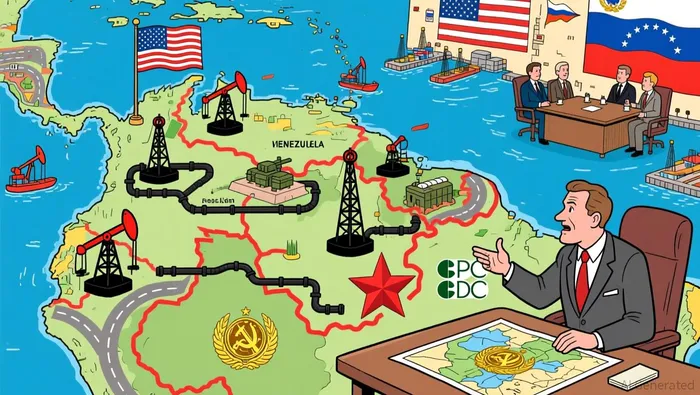
Venezuela's oil sector remains a paradox: a country with the world's largest proven oil reserves- approximately 304 billion barrels-yet producing less than 1 million barrels per day in 2025 due to decades of mismanagement, underinvestment, and U.S. sanctions. The recent U.S. capture of President Nicolás Maduro and the subsequent geopolitical upheaval have further complicated the sector's trajectory, creating a volatile landscape for investors. While the potential rewards of accessing Venezuela's vast hydrocarbon resources are undeniable, the risks-geopolitical, operational, and financial-are equally formidable. This analysis explores the strategic investment implications of Venezuela's oil sector in 2025, weighing its potential against the broader context of global energy markets and regional dynamics.
Geopolitical Risks: A Volatile Foundation
The U.S. military intervention in late 2025, culminating in Maduro's capture, has introduced unprecedented uncertainty. Analysts estimate that restoring Venezuela's oil production to pre-crisis levels (around 3 million barrels per day) would require $100 billion in investment and a decade of sustained effort. The U.S. Treasury's ongoing sanctions on entities involved in Venezuela's oil trade further complicate matters, heightening regulatory risks for international investors. Meanwhile, China's $10–12 billion in outstanding loans to Venezuela, previously secured through oil shipments, have been disrupted, creating a ripple effect on regional and global financial stability.
The geopolitical fallout extends beyond Venezuela. The U.S. intervention has raised alarms in Iran and other OPEC+ members, who now question the stability of their own energy exports in a world where U.S. military dominance appears unchallenged. This dynamic could indirectly influence oil prices, as markets price in the risk of similar interventions elsewhere.
Investment Challenges: Capital, Security, and Political Uncertainty
For U.S. oil majors like ExxonMobilXOM--, ChevronCVX--, and ConocoPhillipsCOP--, the opportunity to revitalize Venezuela's oil infrastructure is tempting but fraught with challenges. The State Department's "do not travel" warning for U.S. citizens underscores the acute security risks, including kidnapping and terrorism. Even if companies like Chevron-already operating in Venezuela-navigate these risks, the path to profitability is long. Modernizing aging infrastructure, rebuilding technical capacity, and securing long-term governance frameworks will require not only capital but also political stability, which remains elusive.
Financial institutions, including the World Bank and IMF, highlight Venezuela's economic distortions as a critical barrier. Despite the country's oil wealth, its contribution to global production remains minimal (1% of supply), and its business environment is among the most hostile in the world. Sanctions and authoritarian governance have stifled private investment, leaving PDVSA reliant on intermediaries and shadow fleets to bypass U.S. restrictions.
Comparative Analysis: Venezuela vs. Middle East and Russia
In contrast to Venezuela's instability, Middle Eastern and Russian oil producers maintain more predictable operational environments. Saudi Arabia, the UAE, and Iraq collectively hold 20% of global reserves and possess spare production capacity, allowing them to buffer market volatility. Their light and medium crude is also more versatile in global refining networks compared to Venezuela's heavy, sour crude, which requires costly blending.
Russia, meanwhile, has leveraged its energy exports to sustain geopolitical influence, particularly in Europe and Asia. While U.S. sanctions have curtailed Russian oil exports to some extent, its state-controlled sector remains resilient, with a CAGR of 3.5% projected for the Venezuela Oil and Gas Industry through 2032. Venezuela's reliance on Russian military and economic support-via discounted crude sales and shadow fleets- further underscores its vulnerability compared to its northern neighbor.
Market Implications: Price Volatility and Supply Dynamics
The EIA's projection of $69 per barrel for Brent crude in 2025 reflects a market oversupplied and insulated from Venezuela's disruptions. While the U.S. intervention has introduced short-term volatility, global supply gluts and OPEC+ production adjustments have mitigated immediate price spikes. However, the long-term implications are less certain. If Venezuela's production recovers to 4 million barrels per day by 2030, it could depress prices by 10–15%, assuming demand growth remains stagnant.
Strategic Investment Considerations
For investors, Venezuela's oil sector embodies the classic high-risk, high-reward proposition. The potential to access 303 billion barrels of reserves is unparalleled, but the path to monetization is littered with obstacles. Key considerations include:
1. Political Stability: A return to democratic governance or a stable authoritarian regime is critical for attracting sustained investment.
2. Sanctions Relief: U.S. policy shifts under a Trump administration could ease restrictions, but geopolitical tensions may delay such outcomes.
3. Infrastructure Costs: Rebuilding Venezuela's oil infrastructure will require partnerships with state and private actors willing to absorb long-term costs.
4. Global Market Conditions: A post-2026 energy transition could reduce demand for heavy crude, diminishing Venezuela's strategic value.
Conclusion
Venezuela's oil sector remains a geopolitical crosshair, where the interplay of U.S. intervention, Russian influence, and global market forces creates a high-stakes environment. While the rewards of unlocking its vast reserves are substantial, the risks-geopolitical, operational, and financial-demand rigorous due diligence. For investors with a long-term horizon and a tolerance for volatility, Venezuela could offer a unique opportunity. However, in a world increasingly prioritizing energy security and diversification, the sector's future hinges on navigating a complex web of political and economic uncertainties.





Comentarios
Aún no hay comentarios