
Venezuela Oil Resurgence Could Cement Lower Prices Long Term, Pressure Russia, Says Analyst
The recent U.S. military operation capturing Venezuelan President Nicolas Maduro has shifted global focus to Venezuela's oil sector. With the country holding the world's largest proven oil reserves at 303 billion barrels, there is potential for renewed interest in its energy industry. The U.S. has indicated plans to allow American oil companies to lead the restoration of Venezuela’s infrastructure. 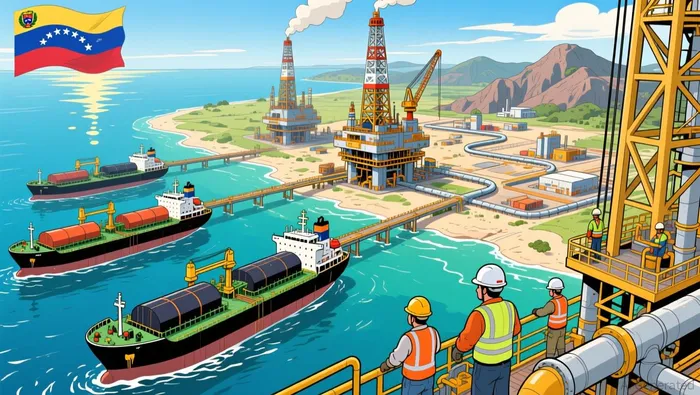
Chevron currently produces about 250,000 barrels per day in Venezuela and remains the only major U.S. company operating there. Analysts suggest that if the political situation stabilizes, other U.S. firms such as Exxon MobilXOM-- and ConocoPhillipsCOP-- may follow, though they are likely to proceed cautiously.
India has become a major player in Venezuela's oil trade. In 2024, India imported roughly 63,000–100,000 barrels per day, a 500% increase from the previous year. This surge highlights the strategic importance of Venezuela's crude as a non-Middle Eastern alternative, especially for Indian refiners who process heavy crude efficiently.
Why Is Venezuela's Oil Sector a Key Focus Now?
Venezuela's oil production has declined significantly from 3.5 million barrels per day in 1999 to just under 1 million today. This has been attributed to years of mismanagement, corruption, and U.S. economic sanctions. The U.S. military action has introduced a new geopolitical dynamic, with Trump announcing plans for American oil companies to invest billions to revitalize the country's energy infrastructure.
The U.S. government has also imposed a blockade on oil tankers entering or leaving Venezuela. This has forced PDVSA, the state-owned oil company, to store crude on tankers to avoid production cuts.
How Do Markets Respond to the Venezuela Situation?
Global oil prices have remained subdued around $60 per barrel, partly due to existing oversupply conditions. While the immediate impact of the U.S. military operation has not caused significant price swings, traders are assessing the potential for long-term supply changes. The capture of Maduro has added a geopolitical risk premium to oil markets. Analysts note that any sudden increase in Venezuelan oil production could act as a stabilizing force, potentially capping prices and reducing pressure on India and other oil importers.
What Are Analysts Watching Next?
Experts are closely monitoring how quickly Venezuela's oil infrastructure can be restored. Despite Trump's promises, the country's infrastructure has been decaying for years, and it will take time to repair. Political stability is a major concern for foreign investors. ChevronCVX-- and other firms are likely to prioritize employee safety and asset protection before committing to large-scale investments. OPEC+ has decided to maintain its current production strategy for now, indicating that the group is not yet seeing the Venezuela developments as a major disruptor to global oil balances. The U.S. plans to temporarily run Venezuela until a stable government is in place, but the timeline for this transition remains uncertain. Analysts like Phil Flynn suggest that if Venezuela's production increases significantly, it could help reduce global oil prices and put pressure on Russia, which has benefited from the decline in Venezuelan oil exports. India, as a major refiner, stands to gain from increased access to Venezuelan heavy crude. This could provide a strategic alternative to Middle Eastern imports and reduce exposure to geopolitical volatility. The path to reviving Venezuela's oil industry remains uncertain. While the country has the resources, the political and legal environment must stabilize for sustained investment to occur. Until a clear legal framework is established and political stability is achieved, international oil companies are unlikely to make large commitments. The U.S. government's approach to Venezuela's oil will likely influence how global markets interpret future production changes. If the country's oil output rises significantly, it could reshape crude trade flows and impact global pricing dynamics.





Comentarios
Aún no hay comentarios