
Venezuela's Oil Reserves: A Billion-Dollar Opportunity or a Decades-Long Liability?
The core paradox of Venezuela's oil industry is staggering. The country holds the world's largest proven reserves, with . Yet its actual production is a fraction of that potential, averaging roughly . . The gap is a direct result of decades of decline, .
This creates an immense, untapped opportunity for U.S. oil majors. The heavy, sour crude from the Orinoco Belt is a critical feedstock for refining diesel and other industrial fuels, a market that is currently tight. For a major Western producer, the potential to capture a significant share of this resource is enormous. The U.S. itself is the world's largest oil producer, but its output is light and sweet, making Venezuelan heavy crude a strategic complement. The political shift following the U.S. strike on Caracas has opened a potential window. President Trump has stated the goal is to rebuild the oil infrastructure, which will cost billions of dollars, it will be paid for by the oil companies directly, and get the oil flowing again.
Yet the path from opportunity to output is blocked by a formidable set of obstacles. The primary barrier is infrastructure decay. The Maduro regime's policies led to a lack of investment and maintenance, leaving the energy sector's capacity greatly diminished. Rebuilding this system will require massive capital expenditure and years of work. Second is political uncertainty. The immediate aftermath of Maduro's capture leaves the future of the country-and its oil industry-in doubt. While the U.S. has recognized an opposition figure as president, the transition could be unstable, and any new government may still impose restrictions. Third is the lack of immediate financial incentive. The U.S. has maintained sanctions on Venezuela's state-owned oil company, , for years. While ChevronCVX-- holds a waiver, the broader market remains restricted. For other majors, the risk of entering a newly reformed but still volatile system without clear, long-term contracts is high. The market's muted reaction to the strike, with oil prices falling modestly, reflects this reality: the potential is historic, but the near-term output is negligible. The opportunity is vast, but the reality of meaningful production remains a distant prospect.
The Path to Market Capture: Infrastructure, Investment, and Political Risk
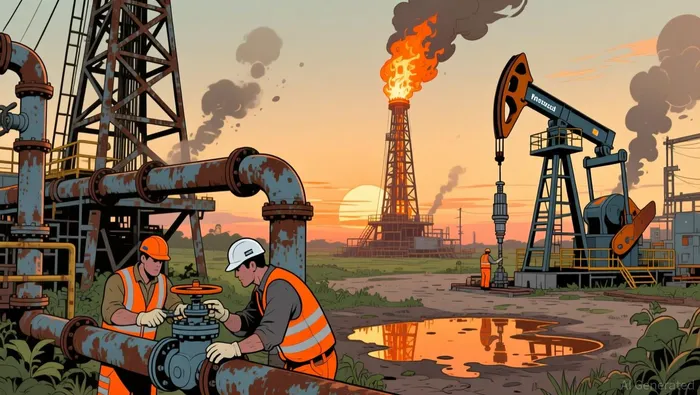
The promise of billions in U.S. oil investment is credible only if a stable political transition occurs with a clear legal framework for investment and debt settlement. The scale of the task, however, is staggering. Analysts estimate that turning Venezuela's oil industry around will require tens of billions of dollars and could take at least a decade of sustained commitment. This isn't a quick fix; it's a multi-year infrastructure rebuild. The country's production, which once peaked at 3.5 million barrels per day, has collapsed to around 800,000 barrels per day. . The sheer magnitude of this capital requirement and the long timeline are massive barriers to entry that will test the resolve of any company.
The legal and financial framework remains a critical uncertainty. The U.S. embargo on all Venezuelan oil remains in full effect, and companies like Chevron operate under a special waiver. For other majors like Exxon MobilXOM-- and ConocoPhillipsCOP--, the path back is complicated by unresolved compensation claims. ConocoPhillips alone is owed from the nationalization of its assets. While the Trump administration has signaled that companies returning to Venezuela would be reimbursed for their investment, the details are absent. As one industry representative noted, "it's highly unlikely that major Western oil companies will engage in talks until there is political stability that clarifies the key players and the legal framework." Without a clear, enforceable agreement on debt settlement and compensation, the financial risk is simply too high.
Political risk is the ultimate determinant. Companies are unlikely to commit billions without security and a stable government. The recent U.S. strike has created a power vacuum, and the transition to a new government is unproven. As one strategist warned, a botched political transition that has a feeling of U.S. dominance can lead to years of resistance. The historical precedent of nationalization under and the current presence of Russian-linked joint ventures in Venezuelan fields add to the perceived instability. For a company to justify such a massive, long-term investment, it needs a guarantee of security and a legal system that protects its assets and future profits.
The bottom line is a high-stakes gamble. The promise of vast reserves and potential reimbursement is real, but it is contingent on a perfect storm of political stability, legal clarity, and security. Until those conditions are met, the billions in promised investment will remain a plan, not a pipeline. The path to market capture is blocked by a decade-long rebuild, a murky legal framework, and a volatile political landscape.
The Financial and Market Impact: A Long-Term Bearish Signal
The financial and market impact of the recent U.S. action in Venezuela is a long-term bearish signal, not a near-term bullish one. While the immediate geopolitical shock has created a short-term supply disruption, the deeper forces at play-global oversupply, low prices, and the immense cost of rebuilding-point to a future where Venezuelan oil acts as a persistent drag on the market.
The near-term catalyst is a forced production cut. The U.S. blockade and oil embargo have paralyzed exports, with port captains not authorizing loaded tankers to sail. This has created a storage crisis, forcing PDVSA to shut wells and fill existing tanks. The result is a short-term supply disruption that could temporarily tighten the market. However, this is a forced contraction, not a strategic one. It reflects the immediate financial devastation of sanctions, which cut off the country's primary revenue stream. With over 95% of government income tied to oil, the economic pressure is extreme, and the operational response is to halt production rather than risk further losses.
The medium-term and long-term picture is defined by the immense cost and uncertainty of a potential ramp-up. President Trump's promise of billions in U.S. investment to rebuild Venezuela's "badly broken infrastructure" is a tantalizing prospect for the world's largest oil reserves. Yet the financial viability of such a project is questionable. The global oil market is already oversupplied, with prices down sharply in 2025. The current oversupply is driven by OPEC+ production increases and record U.S. output. In this environment, a sustained production ramp-up in Venezuela would be a massive bearish supply shock, potentially depressing prices further as the market absorbs a new, large source of heavy crude. As one analyst noted, the future of Venezuela "will have a bearish impact on the market, because there's really nowhere to go but up."
The primary friction is the staggering investment required and the political uncertainty. Analysts estimate stabilizing existing production alone would need "low single-digit billions of dollars" for workovers and repairs. Major Western oil companies like ExxonXOM-- and Chevron are still owed billions in compensation from past nationalizations and have not committed to new investment. They are waiting for political stability and clear legal frameworks before risking billions. As one industry representative put it, "No company is going to want to commit to invest billions of dollars for a long-term operation until they know what the terms are." This creates a long lead time and a high barrier to entry, meaning any future supply surge would be years away, not months.
The bottom line is a classic case of a long-term structural risk overshadowing a short-term tactical event. The immediate embargo creates a temporary supply crunch, but the market's dominant narrative is one of oversupply and weak demand. The promise of future Venezuelan production, while potentially transformative, is a distant and costly prospect. For now, the financial and market impact is a long-term bearish signal: a new, large source of oil is on the horizon, but the path to unlocking it is fraught with political, financial, and operational hurdles that will keep it from materially supporting prices in the near to medium term.
Catalysts and Risks: The Watchlist for Growth Investors
For growth investors, the potential in Venezuela's oil sector hinges on a narrow set of political and legal conditions. The primary catalyst is a clear, stable political transition that establishes a legal framework allowing for foreign investment and debt settlement. President Donald Trump's vision of U.S. oil majors spending billions to rebuild the country's "badly broken infrastructure" is contingent on this stability. The key financial hook is the massive compensation owed to companies that exited under nationalization. ConocoPhillips, for instance, is owed for seized assets, creating a powerful incentive to return. Without a recognized government and legal clarity, that money remains a theoretical claim, not a path to investment.
The primary risk is prolonged political instability or a U.S. withdrawal of support, which would leave the required billions of capital with no clear path to return. Analysts warn that a "botched political transition" could trigger years of resistance from armed groups, derailing any investment plan. The operational environment is already fraught with dilapidated infrastructure and security concerns. As one strategist noted, a successful ramp-up of production would depend on "everything going right," a high bar given the country's history of upheaval. The risk is that the U.S. focus shifts, leaving a temporary, unstable government without the sustained backing needed to attract the capital required for a multi-year recovery.
The key watchpoint is the evolution of U.S. sanctions policy and the willingness of oil majors to engage in talks. Chevron is the only American major currently operating, and its CEO has been in direct talks with the administration about maintaining a presence. Exxon has signaled caution, stating it would only consider Venezuela if the economics were right. For growth investors, the signal will be whether these companies move from monitoring to active negotiation. The thesis is that growth depends on three factors: a stable political handoff, the removal of sanctions, and a legal framework that allows for both investment and the settlement of billions in arbitration claims. Until these conditions align, the massive potential remains a stranded asset.





Comentarios
Aún no hay comentarios