
Venezuela's Oil Repositioning: Strategic Opportunities in U.S.-Led Energy Reallocation
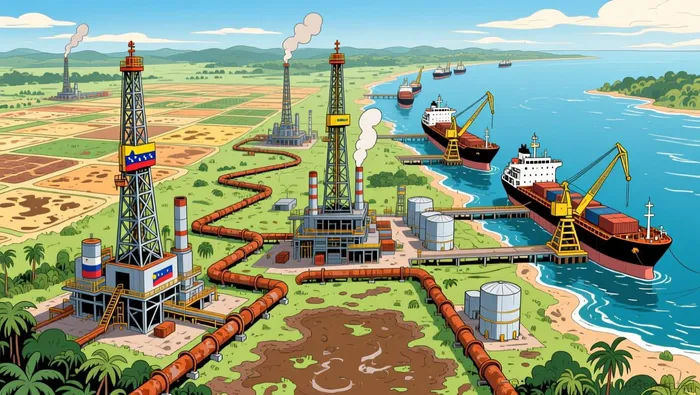
The geopolitical landscape of global energy markets is undergoing a seismic shift as the United States pivots toward reactivating Venezuela's dormant oil infrastructure. With Venezuela's proven reserves-the largest in the world at 303 billion barrels-remaining largely untapped due to years of mismanagement and sanctions, the Trump administration's aggressive intervention in early 2026 has opened a window for U.S. energy firms to reclaim a dominant role in the region. This analysis explores the strategic opportunities and risks inherent in this reallocation, focusing on infrastructure recovery, geopolitical dynamics, and market implications.
Infrastructure Recovery: A High-Stakes Gamble
The U.S. strategy hinges on the rapid mobilization of major oil firms to rebuild Venezuela's crumbling energy infrastructure. According to a report, restoring production to 1.5 million barrels per day (b/d) would require up to $7 billion in investment, while reaching pre-2010s levels of 2.5 million b/d could demand over $58 billion in capital expenditures. ChevronCVX--, the only U.S. company currently operating in Venezuela under a special license, is already producing 20% of the country's output and is positioned to scale up quickly according to supply chain analysis. However, broader participation from firms like ExxonMobilXOM-- and ConocoPhillipsCOP-- remains contingent on resolving outstanding legal claims-such as ConocoPhillips' $10 billion and Exxon's $2 billion in unpaid compensation from the 2007 nationalization under Hugo Chávez as reported by CNBC.
The Trump administration has proposed government reimbursement or revenue-sharing mechanisms to offset these risks, a move that could incentivize investment but raises questions about fiscal sustainability. Short-term initiatives, such as workover programs on existing wells, could boost production by 500,000 b/d within 18 months, but long-term recovery depends on political stability and legal reforms.
Geopolitical Implications: Stability vs. Uncertainty
The U.S. military's capture of Nicolás Maduro in January 2026 has reshaped regional dynamics. While Vice President Delcy Rodríguez has emerged as a pragmatic interim leader, the entrenched power of Chavismo and the absence of a strong opposition remain significant hurdles to stabilization. The U.S. has framed its involvement as a narrow effort to secure oil access and manage migration, but the operation has sparked condemnation from Russia, Iran, and Cuba, heightening regional tensions.
 Goldman Sachs analysts note that Venezuela's oil production is likely to remain flat at 900,000 b/d in 2026 unless sanctions are eased and political conditions improve according to Reuters. Meanwhile, global markets have reacted cautiously, with Brent crude prices stabilizing around $60.89 per barrel despite the geopolitical upheaval as reported by Economic Times. The African Energy Chamber has emphasized that sustained annual investment of $10 billion is necessary to grow production to 2.5 million b/d over the next decade, underscoring the scale of the challenge.
Investment Outlook: Calculated Risks in a Volatile Market
For investors, Venezuela's oil sector presents a paradox: vast reserves and strategic geopolitical positioning are offset by operational, legal, and political risks. The Trump administration's pledge to "run" Venezuela during the transition period has created a unique window for U.S. firms to secure assets and infrastructure at potentially discounted rates as reported by Axios. However, the lack of a stable legal framework and the unresolved claims of expropriated assets remain critical barriers.
Market projections vary widely. In a best-case scenario, with sanctions relief and political normalization, production could reach 1.6–1.8 million b/d by late 2026 according to Discovery Alert. Conversely, continued instability or renewed sanctions could keep output below 1 million b/d for years. The International Energy Agency's 2025 average of 1.1 million b/d suggests a fragile baseline, with short-term gains dependent on U.S. military and economic support as SP Global reports.
Strategic Opportunities and the Path Forward
The U.S.-led reallocation of Venezuela's energy assets offers a unique opportunity for investors willing to navigate high-risk, high-reward scenarios. Key considerations include:
1. Infrastructure Partnerships: Collaborations between U.S. firms and local operators could accelerate recovery while mitigating political exposure.
2. Sanctions Flexibility: A phased easing of sanctions, coupled with targeted legal reforms, could attract broader investment.
3. Regional Stability Initiatives: Engaging with Latin American allies to de-escalate tensions and support Venezuela's transition will be critical for long-term success.
While the Trump administration's vision of U.S. energy dominance in Venezuela is ambitious, its realization will depend on balancing geopolitical leverage with pragmatic economic strategies. For now, the Orinoco Belt remains a sleeping giant-one whose awakening could reshape global oil markets, but only if the right investments and political will align.







Comentarios
Aún no hay comentarios