
Venezuela's Oil Reawakening: Strategic Opportunities Amid Geopolitical Shifts
Venezuela's oil sector, long shadowed by political turmoil and economic collapse, is emerging as a focal point of geopolitical and investment intrigue. The U.S. military intervention in December 2025, which culminated in the capture of President Nicolás Maduro, has reshaped the landscape of international oil access and investment viability. While the country's vast hydrocarbon reserves- estimated at 303 billion barrels of oil equivalent-remain a tantalizing prize, the path to unlocking their value is fraught with strategic, economic, and political complexities.
Chevron's Strategic Dominance and the Path for U.S. Re-Entry
Chevron (CVX) stands as the sole U.S. supermajor currently operating in Venezuela, maintaining joint ventures with PDVSA and producing 140,000 to 240,000 barrels per day of heavy crude oil. These operations account for 23% of Venezuela's total output, positioning ChevronCVX-- as a critical player in the country's energy sector. With U.S. control over oil exports now enforced, Chevron is actively negotiating with Washington to expand its footprint, potentially redirecting crude sales to international markets. This alignment with U.S. interests could accelerate Chevron's access to Venezuela's underutilized reserves, offering a rare opportunity for a Western firm to capitalize on a politically reoriented regime.
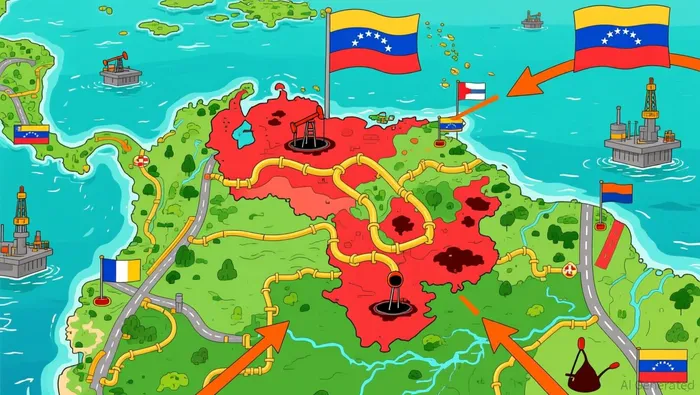 However, Chevron's dominance is not without competition. ConocoPhillipsCOP-- (COP) and ExxonMobilXOM-- (XOM), which were nationalized under Hugo Chávez, hold substantial claims for expropriated assets-$10 billion and $2 billion, respectively. If sanctions relief and political stability materialize, these firms could re-enter the market, leveraging their historical ties and technical expertise to reclaim lost ground. The U.S. government's prioritization of asset recovery and market control suggests a favorable environment for such re-entry, though the timeline remains contingent on Venezuela's evolving political dynamics.
Geopolitical Shifts and the Reshaping of Oil Alliances
The U.S. intervention has disrupted long-standing energy partnerships, particularly with China, which had relied on discounted Venezuelan crude via shadow fleets. By asserting control over oil exports, the U.S. has effectively curtailed China's access to these resources, weakening its regional influence. This shift creates a vacuum for U.S. refiners to benefit from heavy crude imports, though it also risks intensifying competition with Canadian producers, whose crude shares similar characteristics.
Meanwhile, the geopolitical fallout extends beyond bilateral relations. The U.S. operation has strained ties with Latin American neighbors, with Colombia preparing for border instability and the EU facing heightened risks from drug trafficking. These tensions underscore the fragility of the region's political equilibrium, complicating long-term investment planning.
Political Uncertainty and the Cost of Rebuilding
Despite the U.S.-backed interim government led by Delcy Rodríguez, Venezuela's political stability remains tenuous. Rodríguez's close ties to Maduro and the military's continued loyalty to the regime suggest a limited appetite for democratic reforms. U.S. officials, including President Donald Trump, have signaled a strategy of sustained pressure, prioritizing oil access and anti-drug efforts over immediate political transitions. This approach risks prolonging instability, deterring foreign investment, and exacerbating humanitarian crises.
Economically, the scale of required investment is staggering. Rystad Energy estimates that maintaining current production levels could cost $53 billion over 15 years, while restoring pre-2000 output would require $183 billion. These figures highlight the capital-intensive nature of Venezuela's oil sector, where aging infrastructure and operational inefficiencies demand sustained reinvestment. For U.S. firms, the high costs must be weighed against the potential for asset recovery and market share gains.
Strategic Opportunities for Oil Services Firms
Beyond exploration and production, oilfield services companies like Halliburton (HAL) and Schlumberger (SLB) could benefit from infrastructure rebuilding efforts. Venezuela's oil sector requires extensive modernization, from drilling equipment to refining capacity, creating a niche for firms specializing in technical solutions. However, the success of these ventures hinges on political stability and consistent access to funding-a scenario that remains uncertain in the short to medium term.
Conclusion: Balancing Risk and Reward
Venezuela's oil reawakening presents a paradox: immense potential amid profound uncertainty. For U.S. investors, the key lies in navigating the interplay between geopolitical leverage, asset recovery, and operational feasibility. Chevron's current dominance and the potential re-entry of ConocoPhillips and ExxonMobil offer strategic advantages, but these must be tempered against the risks of prolonged instability and exorbitant capital requirements.
In the short term, the U.S. government's control over oil exports and its alignment with Chevron could drive incremental gains. However, the medium-term outlook depends on Venezuela's ability to stabilize politically and economically-a challenge that remains unresolved. For now, Venezuela's oil sector remains a high-stakes arena where geopolitical shifts and corporate ambition collide.





Comentarios
Aún no hay comentarios