
Venezuela's Oil Market Volatility and the Strategic Case for Defensive Commodities
The geopolitical upheaval in Venezuela has reignited debates about the interplay between energy markets and defensive commodities. As the world's largest oil reserve holder-boasting 303 billion barrels-Venezuela's production has plummeted to less than 1 million barrels per day (bpd), a shadow of its 1970s peak of 3.7 million bpd according to Trading Economics. This collapse, driven by decades of mismanagement, U.S. sanctions, and recent military intervention according to Carbon Copy, has created a volatile backdrop for global oil markets. Simultaneously, the uncertainty has amplified demand for safe-haven assets like gold and silver, which surged by 1.9% and 3.5% respectively in early 2025 amid U.S.-Venezuela tensions. This analysis explores how geopolitical risks in Venezuela are reshaping investment strategies, emphasizing the dual roles of oil and precious metals in hedging against uncertainty.
Geopolitical Risks and Oil Market Dynamics
The U.S. military operation that removed Nicolás Maduro from power in early 2026 has introduced unprecedented volatility into Venezuela's oil sector. While this shift raises the possibility of foreign investment and infrastructure rebuilding, analysts caution that reviving production to pre-2010s levels (around 2.5 million bpd) could take six to seven years. Immediate gains are unlikely due to the state of Venezuela's oil infrastructure, which requires $80–$110 billion in capital investment.
Geopolitically, the U.S. intervention has disrupted regional power balances. China, a key importer of Venezuelan crude, now faces a potential realignment of trade flows toward the U.S. and its allies according to CNN. However, the short-term impact on global oil prices remains muted, as Venezuela's production constitutes a small fraction of global supply. Analysts project that even a modest increase to 1.5 million bpd would require political stability and sustained foreign participation. The long-term bearish outlook for oil prices, compounded by OPEC+ production hikes and declining demand from electric vehicles, further complicates the calculus for investors.
Precious Metals as a Geopolitical Hedge
The U.S.-Venezuela conflict has underscored the role of precious metals as defensive assets.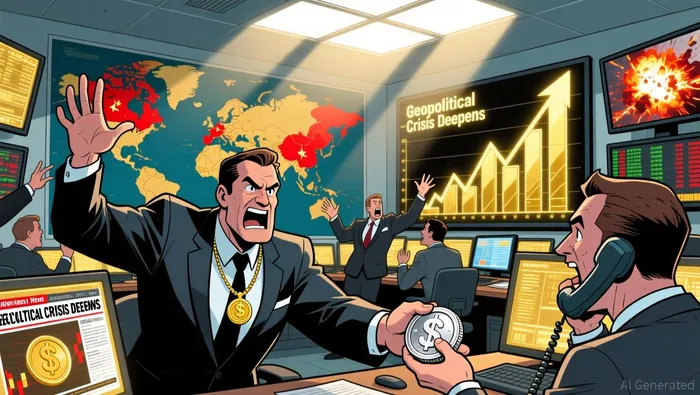 In 2025, gold prices surged over 70% year-to-date, driven by central bank diversification and de-dollarization trends. Silver, meanwhile, nearly doubled in value, benefiting from both industrial demand and its status as a safe-haven asset. The capture of Maduro alone triggered a 1.9% spike in gold prices to $4,411.14 per ounce, reflecting heightened risk premiums.
This trend is not isolated. Central banks in emerging markets have aggressively purchased gold, reinforcing its role as a strategic reserve. Silver's dual utility in renewable energy technologies-such as solar panels and electric vehicles-has further solidified its appeal. Platinum and palladium have also seen gains, driven by emissions-reduction policies and geopolitical uncertainty. The broader macroeconomic environment-characterized by inflation above central bank targets and a weak U.S. dollar-has amplified the case for precious metals as core portfolio components.
Strategic Investment Positioning
For investors, the Venezuela crisis highlights the need to balance exposure to oil and defensive commodities. While oil markets remain speculative, with long-term bearish pressures, precious metals offer a counterweight to geopolitical volatility. A diversified portfolio might include:
1. Oil sector exposure for potential upside if Venezuela's production recovers, though this requires a long-term horizon and tolerance for political risk.
2. Gold and silver allocations to hedge against both oil market volatility and broader geopolitical shocks.
3. Industrial metals like platinum and palladium to capitalize on green energy transitions and policy-driven demand.
The key is to align allocations with macroeconomic trends. For instance, U.S. interest rate cuts and dollar weakness in 2025 have bolstered precious metals, while oversupply concerns have capped oil price gains. Investors should also monitor OPEC+ dynamics and Venezuela's political trajectory, as these factors could alter the risk-reward profile of both asset classes.
Conclusion
Venezuela's oil market volatility and the geopolitical risks it embodies present a complex landscape for investors. While the country's vast reserves offer long-term potential, the path to recovery is fraught with challenges. Meanwhile, precious metals have emerged as indispensable tools for hedging against uncertainty, with gold and silver leading a broader commodities supercycle. As the U.S. and China vie for influence in South America, and global energy transitions accelerate, a strategic allocation to defensive commodities will remain critical for portfolios seeking resilience in an unpredictable world.







Comentarios
Aún no hay comentarios