
Venezuela's Oil Handover and U.S. Energy Strategy: Assessing the Economic and Geopolitical Implications for Energy Firms and Global Markets
The U.S. government's recent policy shift in Venezuela's oil sector marks a pivotal moment in its broader energy strategy, with far-reaching implications for U.S. energy firms and global oil markets. By conditioning compensation for expropriated assets on new investments in Venezuela's energy infrastructure, Washington is recalibrating its approach to a post-Nicolás Maduro era. This move, however, introduces complex risks and opportunities for international oil companies, reshaping the geopolitical and economic landscape of one of the world's most strategically significant hydrocarbon reserves.
A High-Stakes U.S. Policy Shift
According to a Reuters report, the U.S. has mandated that oil companies seeking to recover compensation for assets seized in Venezuela must first commit to new investments in the country's energy sector. This policy, outlined in a January 2026 update, effectively shifts the risk profile for energy investors, requiring them to fund infrastructure rehabilitation before securing any returns on past claims. For firms like ConocoPhillipsCOP-- and Exxon MobilXOM--, which hold long-standing claims for expropriated assets, this creates a dual challenge: financing costly rehabilitation projects while navigating Venezuela's politically unstable environment.
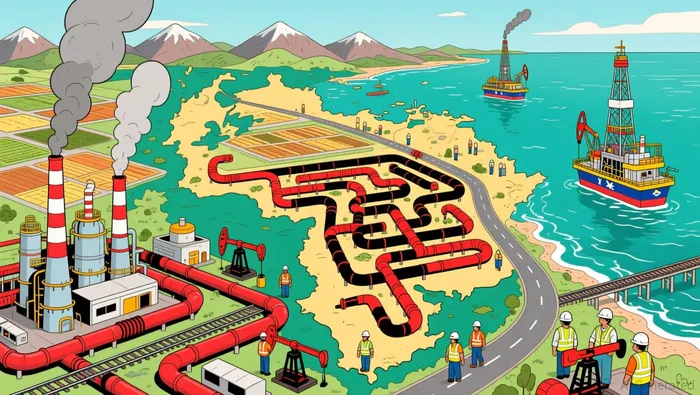
The U.S. strategy appears designed to incentivize large-scale capital inflows into Venezuela's oil sector, which has been crippled by years of underinvestment and U.S. sanctions. However, this approach also raises questions about the feasibility of such investments. As noted by experts, Venezuela's transition environment is marked by contested authority and regulatory instability, complicating long-term planning for foreign firms.
China's Growing Influence and the Reshaping of Global Oil Markets
While the U.S. seeks to reassert influence, China has emerged as a dominant player in Venezuela's oil sector. Data from Oilprice.com indicates that Chinese companies have leveraged production sharing contracts (CPPs) to bypass U.S. sanctions and begin operations in key fields. This shift has not only solidified China's role as Venezuela's primary oil export destination but also disrupted traditional U.S. Gulf Coast refiners, which previously benefited from discounted heavy crude imports.
The U.S. capture of Maduro has further accelerated this realignment. As Reuters highlights, ChevronCVX-- now operates under a limited maintenance license, while other international firms remain hesitant to re-enter the market. This vacuum has allowed Chinese "teapot" refiners to capitalize on deeply discounted barrels, though their advantage may wane as U.S. firms ramp up investments under the new policy framework.
Infrastructure Challenges and the Path to Recovery
Venezuela's oil sector faces monumental infrastructure challenges. According to a Heygotrade analysis, restoring production to meaningful levels will require years of investment, given the state of disrepair in facilities and the logistical complexities of refining heavy crude. A RBN Energy report underscores that even modest production gains-such as 200,000–300,000 barrels per day-could take one to three years to achieve, with long-term targets of 2.0 million barrels per day contingent on sustained political stability.
The scale of required investment is staggering. Adi-Analysis estimates that $10 billion in capital will be needed over the next one to two years, with total costs potentially reaching $40–$60 billion over five years. These figures highlight the magnitude of the challenge, particularly for firms already burdened by legacy claims and geopolitical risks.
Key Stakeholders and Strategic Opportunities
Despite the risks, several stakeholders are positioned to benefit from the evolving landscape. Chevron, with its existing joint ventures and export pathways, remains a critical player. Meanwhile, firms like TotalEnergies and EniE-- may enter through joint ventures as clarity on sanctions and legal frameworks emerges. Oilfield services companies are also poised to play a pivotal role in infrastructure rehabilitation, with opportunities for large EPC firms in pipeline and storage projects.
However, the success of these investments hinges on PDVSA's operational capacity and Venezuela's political trajectory. As JDSupra notes, governance uncertainty and security concerns remain critical risks that could derail progress.
Geopolitical Implications and Market Dynamics
The U.S. strategy to condition compensation on new investments reflects a broader effort to counter China's growing influence in Latin America's energy sector. By encouraging U.S. and European firms to re-engage, Washington aims to reassert its economic and strategic presence in a region where China has increasingly filled the void left by Western sanctions.
For global oil markets, the implications are twofold. On one hand, a revitalized Venezuelan oil sector could increase supply, easing pressure on global crude prices. On the other, the U.S. Gulf Coast stands to benefit from an influx of heavy crude, potentially outcompeting Chinese refiners as U.S. firms scale up operations.
Conclusion
Venezuela's oil handover represents a high-stakes gamble for U.S. energy firms and global markets. While the potential rewards-access to one of the world's largest oil reserves and a strategic counterbalance to China-are significant, the risks of political instability, infrastructure decay, and regulatory uncertainty cannot be overstated. Investors must weigh these factors carefully, recognizing that the path to recovery will require not only capital but also a long-term commitment to navigating Venezuela's complex geopolitical landscape.





Comentarios
Aún no hay comentarios