
Venezuela's Hidden Bitcoin Reserve and Its Strategic Implications for Global Crypto Markets
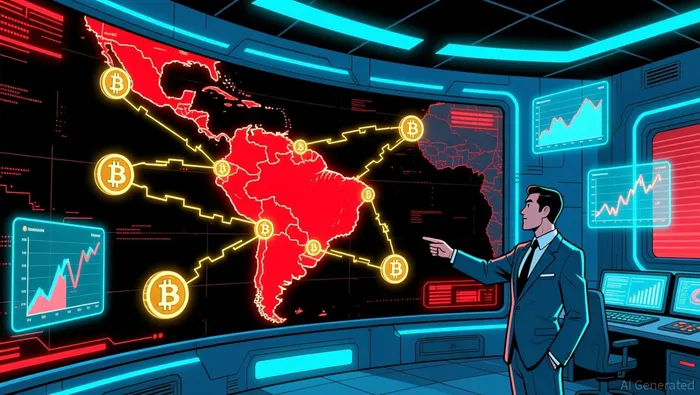
The world of geopolitics and cryptocurrency is colliding in ways few could have predicted. At the center of this storm is Venezuela, a nation long isolated by sanctions and economic turmoil, now rumored to hold a staggering BitcoinBTC-- reserve that could reshape global markets. Let's break this down.
The Rumor and Its Magnitude
Venezuela's alleged Bitcoin stash has become a hot topic in 2025, with speculative estimates ranging from 240 Bitcoin (worth ~$22 million) to a jaw-dropping 600,000 Bitcoin (~$60 billion) according to experts. These figures, however, are as much about political theater as they are about hard data. The lower estimate comes from blockchain analytics firm Bitcointreasuries.net, while the higher number is tied to unverified calculations involving gold sales and oil exports. The gap between these numbers isn't just a statistical debate-it's a window into the murky interplay of sanctions, digital assets, and state survival strategies.
Accumulation Methods: How Venezuela Could Have Built a Reserve
Venezuela's path to a Bitcoin reserve, if it exists, is rooted in its exclusion from traditional financial systems. Analysts suggest the country may have acquired Bitcoin through three primary avenues:
1. Gold-for-Bitcoin Swaps: In 2018, Venezuela sold gold reserves to China and Russia, with some speculation that proceeds were covertly converted into Bitcoin.
2. Oil Exports in Stablecoins: By accepting TetherUSDT-- (USDT) for oil exports, Venezuela could have bypassed U.S. sanctions and later exchanged stablecoins for Bitcoin.
3. Seizure of Domestic Miners: The government's crackdown on crypto miners in 2023-2024 may have yielded hardware and electricity discounts, enabling state-backed mining operations.
These methods align with Venezuela's history of leveraging digital assets for geopolitical flexibility. The failed 2018 Petro token was an early experiment in this playbook, but Bitcoin's decentralized nature offers a more robust tool for circumventing financial isolation.
Verification Challenges: The Fog of Pseudonymity
Here's the kicker: Bitcoin's decentralized ledger makes it nearly impossible to trace ownership with certainty. Major blockchain analytics firms have found no conclusive evidence of Venezuela's alleged 600,000 Bitcoin stash. Even the 240 Bitcoin estimate from Bitcointreasuries.net lacks on-chain proof of government control. This ambiguity is a double-edged sword. For investors, it means the market could react violently to even a whisper of confirmation or denial. For policymakers, it underscores the limitations of traditional financial surveillance in the crypto era.
Geopolitical Chess: U.S. Interests and Strategic Reserves
The U.S. has long viewed Venezuela as a strategic battleground. With President Donald Trump's recent proposal for a U.S. strategic Bitcoin reserve, the stakes have escalated. If Venezuela's Bitcoin is real, it could become a geopolitical jackpot. Imagine a scenario where U.S. sanctions force Maduro's government to liquidate its holdings-creating a flood of Bitcoin that could destabilize prices. Conversely, if the U.S. seeks to seize or partner with Venezuela's reserves, it could set a precedent for how nations treat digital assets as sovereign wealth.
Market Implications: A Double-Edged Sword
The potential sale or movement of Venezuela's Bitcoin would send shockwaves through crypto markets. A sudden dump of even 10,000 Bitcoin (worth ~$1 billion) could trigger a short-term selloff, while a controlled release might stabilize prices by increasing supply. However, the uncertainty itself is already a market driver. Speculation about Venezuela's reserves has already inflated volatility, with traders hedging bets on geopolitical outcomes rather than fundamental metrics.
Conclusion: Navigating the Uncertainty
Venezuela's Bitcoin narrative is less about verified facts and more about the power of possibility. For investors, the lesson is clear: geopolitical asset control is now a first-order consideration in crypto strategy. While the $60 billion figure is likely a myth, the mere potential for such a reserve highlights Bitcoin's role as a tool for nations to reclaim financial sovereignty. As the U.S. and Venezuela circle each other in this high-stakes game, one thing is certain-Bitcoin's value as a geopolitical asset is no longer theoretical.






Comentarios
Aún no hay comentarios