
Venezuela's Geopolitical Turmoil: Implications for Emerging Market Investments
The U.S. military operation that culminated in the arrest of Venezuelan President Nicolás Maduro in early 2026 has reshaped the geopolitical and economic landscape of Latin America, sending ripples through global emerging market investments. This intervention, framed as a move to stabilize Venezuela's oil sector and curb illicit networks, has introduced a complex mix of risks and opportunities for investors. The transition to Vice President Delcy Rodríguez as acting leader, under U.S. oversight, underscores the fragility of Venezuela's political structure and the long-term challenges of restoring economic stability.
Political Developments and Geopolitical Risks
The U.S. capture of Maduro and his wife, Cilia Flores, marked a dramatic escalation in Washington's engagement with Venezuela. While Secretary of State Marco Rubio emphasized that the U.S. would not assume day-to-day governance, the operation has entrenched U.S. influence over Venezuela's oil infrastructure and security apparatus. Rodríguez, a close Maduro ally, now holds power, signaling continuity with the Chavismo regime despite the regime's criminalization of opposition figures like María Corina Machado and Edmundo González. This fragmented political environment raises concerns about prolonged instability, with analysts warning that further U.S. military actions could destabilize the region.
The geopolitical implications extend beyond Venezuela. The U.S. intervention directly challenges the influence of China and Russia, which had long supported the Maduro regime through oil contracts and financial loans. With Venezuela's oil exports previously flowing predominantly to China, the shift toward U.S. control could realign regional trade dynamics, potentially triggering retaliatory measures from non-aligned powers. For investors, this recalibration introduces heightened geopolitical risk premiums, particularly in South American markets where U.S. and Chinese interests intersect. 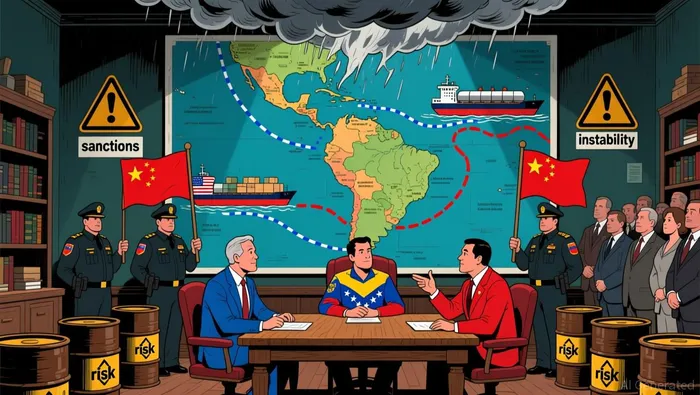
Economic Challenges and Oil Sector Recovery
Venezuela's economy remains in dire straits, with hyperinflation exceeding 270% annually and oil production crippled by years of underinvestment and sanctions. The U.S. strategy hinges on revitalizing the country's oil infrastructure, which requires an estimated $100 billion in capital to restore output to 1–2 million barrels per day-a process likely to take 5–10 years. While U.S. energy firms have expressed interest in participating, structural reforms and political stability are prerequisites for meaningful investment. The International Monetary Fund (IMF) has highlighted the need for a sovereign debt restructuring process involving bondholders, the World Bank, and China, though this is expected to be protracted and contentious.
The oil sector's recovery is critical not only for Venezuela but for global energy markets. A return to pre-sanctions production levels could exert downward pressure on oil prices, influencing inflation trajectories and central bank policies worldwide. However, short-term volatility remains a key risk, as geopolitical uncertainties and operational challenges delay output normalization.
Impact on Emerging Market Investment Flows
The U.S. intervention has prompted a reevaluation of risk in emerging markets, with financial institutions and international organizations closely monitoring its implications. The World Bank, while not directly engaged in Venezuela, notes that regional migration flows-driven by Venezuela's crisis-have already strained economies like Colombia and Peru, complicating investment in infrastructure and labor markets. Meanwhile, the IMF has underscored the importance of hedging against political and energy price risks, particularly in oil-linked emerging markets.
For portfolio strategies, the situation in Venezuela highlights the need for diversification and active risk management. Emerging market debt, currencies, and equities face heightened volatility, with distressed debt opportunities emerging in sectors like energy and state-owned enterprises. Investors are also advised to monitor gold prices and safe-haven assets, which may benefit from prolonged geopolitical uncertainty.
Regional and Global Implications
The U.S. operation has broader implications for Latin America, where regional alliances and trade balances could shift. The potential for further U.S. actions in neighboring countries, such as Colombia, raises concerns about a new era of geopolitical competition. Additionally, the migration crisis- projected to reach 8.4 million Venezuelan migrants by 2025-continues to strain host economies, with mixed effects on foreign direct investment in infrastructure and renewable energy.
From a global perspective, the intervention underscores the return of "spheres of influence" dynamics, reminiscent of Cold War-era geopolitics. This shift could exacerbate tensions between the U.S. and non-aligned nations, further complicating emerging market investment environments.
Conclusion
Venezuela's geopolitical turmoil presents a dual-edged scenario for emerging market investors. While the long-term potential for oil-driven growth and resource investment exists, the path to stability is fraught with political, economic, and geopolitical risks. Investors must adopt a disciplined, intelligence-driven approach, hedging against volatility while remaining attuned to structural opportunities in energy and infrastructure. As the U.S. navigates its role in Venezuela's transition, the broader implications for emerging markets will hinge on the balance between geopolitical strategy and economic pragmatism.







Comentarios
Aún no hay comentarios