
Venezuela's Energy Revival: Risks, Rewards, and the Role of Smaller Oil Producers
Venezuela's oil sector, long a symbol of geopolitical tension and economic mismanagement, is poised for a complex reawakening. With the U.S. government recalibrating its sanctions regime and Venezuela's political landscape shifting after the January 2026 capture of Nicolás Maduro, the country's vast but untapped oil reserves are attracting renewed attention. For independent energy firms, this represents a high-stakes opportunity: a chance to navigate a fractured market and capitalize on one of the world's largest hydrocarbon deposits while avoiding the cautionary hesitancy of major oil giants.
U.S. Policy Shifts: A Double-Edged Sword
The U.S. has maintained a stranglehold on Venezuela's oil sector since 2015, with sanctions targeting state-owned Petróleos de Venezuela, S.A. (PdVSA), and its partners. These measures, enforced under the International Emergency Economic Powers Act (IEEPA) and the Treasury Department's Office of Foreign Assets Control (OFAC), have included asset freezes, restrictions on dollar transactions, and the quarantine of oil tankers. However, recent policy shifts under the Trump administration signal a nuanced approach. In late 2025, the U.S. selectively rolled back sanctions to permit the transport and sale of Venezuelan crude under strict oversight, while authorizing the import of oilfield equipment to support production growth.
This duality-maintaining pressure while creating narrow pathways for sanctioned activity-has created a paradoxical environment. On one hand, U.S. actions like the January 2026 national emergency declaration to block Venezuela's oil revenue from judicial proceedings underscore a desire to retain leverage over the regime. On the other, the government's sale of captured crude at market prices, with proceeds held in U.S. accounts until Venezuela is deemed "ready" to receive them, offers a regulated entry point for compliant actors. For smaller firms, this represents a potential opening: a chance to engage in a market where larger players, wary of political and security risks, remain hesitant.
The Allure of Untapped Reserves
Venezuela's Orinoco Heavy Oil Belt holds an estimated 235 billion barrels of extra-heavy crude, accounting for roughly 17% of global reserves. Yet production remains a fraction of its historical peak, hovering around 400,000–500,000 barrels per day in 2025 compared to 3.5 million in the 1970s. This gap is not due to a lack of resources but to decades of underinvestment, infrastructure decay, and U.S. sanctions that have isolated Venezuela from global financial systems.
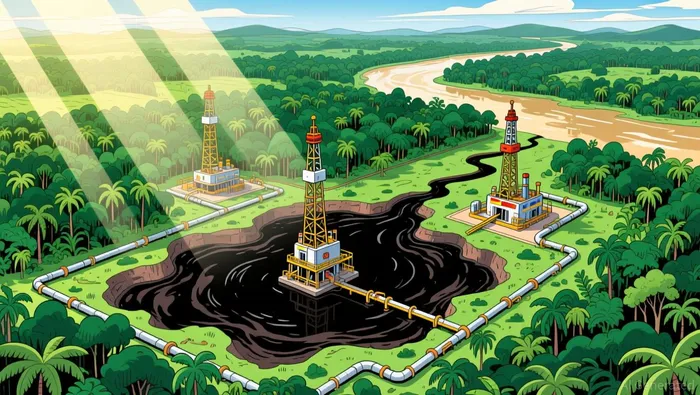
For independent firms, the rewards are clear. J.P. Morgan projects that with political stability and $100 billion in investment, Venezuela could restore production to 2.5 million barrels per day within a decade. Smaller players, unburdened by the bureaucratic inertia of major oil companies, may be better positioned to exploit this potential. However, the path is fraught with challenges. Heavy crude requires costly refining infrastructure, and Venezuela's oil sector lacks the technical expertise and capital to scale operations without foreign collaboration.
Navigating Sanctions: Compliance as a Competitive Edge
The U.S. sanctions framework, while restrictive, is not impenetrable. Chevron's continued operations in Venezuela-despite the sanctions-offer a blueprint for compliance-driven strategies. The company maintains joint ventures with PdVSA under limited OFAC licenses that permit maintenance and preservation activities but prohibit revenue generation. This model, which prioritizes asset protection over immediate profit, could be adapted by smaller firms seeking to establish a foothold without triggering secondary sanctions.
Additionally, the U.S. has begun issuing private sanctions waivers to international traders, allowing them to purchase and resell Venezuelan crude under conditions such as directing initial shipments to U.S. buyers. For nimble firms, these exceptions create a niche market: acting as intermediaries in a tightly controlled supply chain. However, success hinges on meticulous compliance. The Treasury Department's recent targeting of oil traders and tankers involved in sanctions evasion-such as the December 2025 sanctions on four firms and four tankers-demonstrates the agency's willingness to enforce rules rigorously.
Strategic Entry Points for Smaller Firms
Independent energy firms with the agility to navigate these complexities can exploit several entry points:
Infrastructure Partnerships: Collaborating with U.S. majors like Chevron or Exxon Mobil, which are already positioned to reclaim assets seized during Hugo Chávez's 2007 nationalization, could provide smaller firms access to Venezuela's oil infrastructure without direct exposure to sanctions risks. These partnerships could involve joint ventures focused on maintenance, technology transfer, or incremental production scaling.
Authorized Sales Channels: The U.S. government's controlled sale of Venezuelan crude offers a regulated market for compliant buyers. Smaller firms with refining capabilities or access to alternative markets (e.g., Asia or Europe) could bid for these oil shipments, leveraging their flexibility to absorb the logistical challenges of heavy crude processing.
Asset Recovery Arbitration: For firms with historical ties to Venezuela, pursuing arbitration claims against the Maduro regime-such as ConocoPhillips' $10 billion or Exxon Mobil's $2 billion in outstanding claims-could provide a long-term payoff. While politically sensitive, these efforts align with U.S. goals of holding the former regime accountable.
Risks and Realities
Despite these opportunities, the risks are substantial. Venezuela's political instability, high crime rates, and lack of rule of law remain significant deterrents. The U.S. State Department's "do not travel" warning for American citizens underscores the security challenges. Additionally, the Trump administration's emphasis on U.S. companies leading the country's energy revival could marginalize foreign entrants, particularly those from non-allied nations.
For smaller firms, the key to success lies in balancing ambition with pragmatism. This means prioritizing compliance, securing U.S. government approvals, and building partnerships that mitigate exposure to Venezuela's volatile environment. While the road to profitability is long, the potential rewards-access to one of the world's largest oil reserves-make it a gamble worth considering for those with the patience and expertise to navigate the minefield.
Conclusion
Venezuela's energy sector is at a crossroads. U.S. policy shifts have created a fragile window for independent firms to engage in a market that remains both tantalizing and treacherous. For nimble players, the path forward lies in leveraging compliance strategies, forming strategic partnerships, and capitalizing on the U.S. government's dual role as both a regulator and a facilitator. While the risks are undeniable, the scale of Venezuela's reserves and the potential for geopolitical alignment with U.S. interests make this a high-stakes arena where agility and foresight could yield outsized rewards.







Comentarios
Aún no hay comentarios