
Venezuela's Debt Resurgence: A High-Conviction Bet for 2026 and Beyond
The collapse of Venezuela's oil-driven economy has created one of the most extreme cases of sovereign distress in modern history. Yet, as geopolitical tectonics shift in late 2025 and early 2026, the country's $150–$170 billion in external debt-trading at 27–32 cents on the dollar-has become a focal point for investors seeking high-conviction opportunities in a volatile market. The U.S. capture of President Nicolás Maduro in January 2026 has not only reshaped the political landscape but also injected new dynamics into the distressed-debt arena, where the interplay of sanctions, court-supervised asset claims, and potential U.S. investment creates both risk and reward.
Geopolitical Shockwaves and Market Reactions
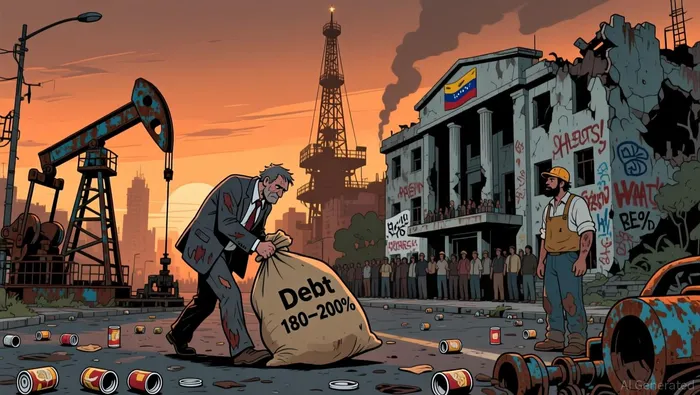
The U.S. intervention has triggered a sharp reevaluation of Venezuela's debt profile. According to a Reuters report, PDVSA bonds-previously in technical default-have rallied as markets speculate that American oil companies may eventually restore production in the world's largest oil reserve. This optimism, however, is tempered by the reality of Venezuela's economic collapse: a debt-to-GDP ratio of 180–200%, hyperinflation, and oil output that has plummeted to less than 500,000 barrels per day from over 3 million in 2016.
The U.S. takeover has also complicated the path to a sovereign restructuring. While some analysts argue that political change could unlock negotiations, U.S. sanctions remain a critical barrier. As stated by Allianz Global Investors, Washington has imposed additional tariffs on countries importing Venezuelan oil and blocked sanctioned tankers, further isolating the country from global markets. This has left Venezuela without access to IMF financing and reliant on bilateral creditors like China and Russia-whose own geopolitical tensions with the U.S. add another layer of uncertainty.
The Arithmetic of Restructuring
For distressed-debt investors, the key question is whether Venezuela's debt can be restructured in a way that offers meaningful returns. Citigroup analysts suggest a 50% principal haircut may be necessary to restore debt sustainability, with recovery values potentially reaching the mid-40s cents on the dollar under favorable scenarios. However, the path to such an outcome is fraught.
The Citgo refinery, secured by a PDVSA bond, remains a central asset in court-supervised recovery efforts. Yet the growing pool of court-registered claims-exceeding $19 billion-has created a "first-mover advantage" for early creditors, while later entrants face diminishing returns. This dynamic mirrors the 2005 Argentina default, where rapid legal action by U.S. hedge funds secured disproportionate recoveries. For Venezuela, the risk of a similar "vulture fund" scenario looms large, particularly as U.S. courts gain jurisdiction over assets like Citgo.
Oil, Sanctions, and the Long Game
The U.S. has signaled that American oil companies may eventually invest in Venezuela to revive production. However, as The Economic Times notes, infrastructure degradation and political instability will likely limit near-term output. This creates a paradox: while the U.S. seeks to stabilize global oil markets by increasing supply, its own sanctions have reduced Venezuela's exports to a trickle. The result is a market balancing act, where oil prices remain stable in the short term but face long-term volatility as geopolitical risks evolve.
For investors, the key is timing. A 2026 restructuring would require a coordinated effort between U.S. policymakers, international creditors, and Venezuela's new leadership. The absence of an IMF program-a critical tool for debt sustainability analyses-means any agreement would rely on ad hoc negotiations, increasing the likelihood of protracted legal battles.
Conclusion: A High-Risk, High-Reward Proposition
Venezuela's debt market is a microcosm of the broader geopolitical risks reshaping global finance. The U.S. capture of Maduro has created a window of opportunity for investors willing to navigate the complexities of sanctions, court claims, and oil-market volatility. Yet the path to recovery remains uncertain. A 50% haircut may be necessary, but the mid-44s recovery scenario hinges on a political and economic transition that is far from guaranteed.
For those with a high-risk tolerance and a long-term horizon, Venezuela's distressed debt offers a compelling case study in the intersection of geopolitics and finance. But as with any high-conviction bet, the rewards are only worth the risk if the investor can withstand the turbulence of a nation in transition.







Comentarios
Aún no hay comentarios