
Why VeChain's (VET) Price Struggles Below $0.016 and What It Means for Investors
Structural Weaknesses: A Perfect Storm of Technical and Operational Challenges
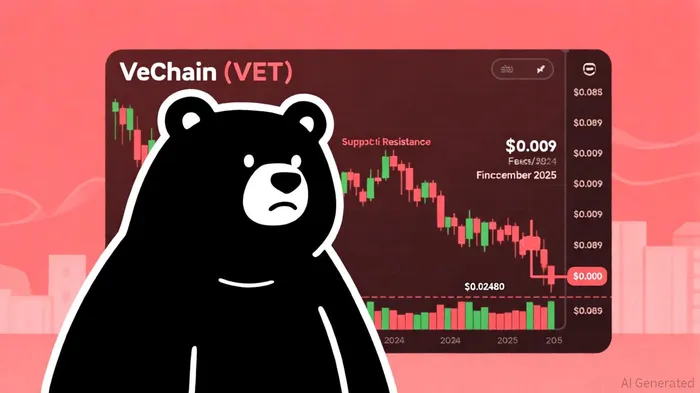
VeChain's price action in Q3 2025 has been emblematic of a deteriorating technical outlook. The token failed to hold key support levels, breaking down from an ascending trend line and falling to a low of $0.009 by October 2025 after peaking at $0.08 in December 2024, according to a CCN analysis. Momentum indicators like the Relative Strength Index (RSI) and Moving Average Convergence Divergence (MACD) remain below critical thresholds (50 for RSI and negative for MACD), signaling sustained bearish pressure, as that CCN analysis notes. While a short-term bounce is possible following a completed A-B-C corrective wave on the 2-hour chart, broader market conditions remain hostile, the CCN piece adds.
Structurally, VeChain's reliance on a Proof of Authority (PoA) consensus mechanism raises red flags. Unlike Proof of Work or Proof of Stake, PoA depends on a select group of validators approved by an "Independent Steering Committee," which critics argue centralizes control and undermines censorship resistance, according to a 99Bitcoins forecast. This design, while efficient for throughput, limits organic validator participation and could deter projects prioritizing decentralization.
Compounding these issues is VeChain's dual-token model, which separates utility (VET) and transaction fees (VTHO). While this system aims to stabilize gas costs, it introduces complexity for users and liquidity challenges. VTHO's derivation from VET requires users to convert tokens, a process that may confuse newcomers and hinder mass adoption, as that 99Bitcoins forecast also explains.
Market Sentiment: Analysts Split Between Hope and Caution
Analyst opinions on VET reflect a polarized landscape. On the bullish side, the Stargate upgrade and partnerships with Walmart China and BMW are cited as catalysts for long-term growth, potentially enhancing scalability and real-world utility, according to a Bitpanda forecast. The VeFounder Program, launched to empower Web3 developers, is also seen as a strategic move to bolster the ecosystem, per a LiveBitcoinNews piece.
However, bearish forecasts dominate. Regulatory uncertainties in the U.S., coupled with the PoA mechanism's centralization, are viewed as existential risks in the Bitpanda forecast. Additionally, profit-taking following the Stargate staking launch and broader market risk aversion have exacerbated downward pressure, according to a CoinMarketCap analysis. A neutral forecast anticipates VET trading between $0.04 and $0.06 by year-end, balancing growth potential against persistent volatility, the Bitpanda piece suggests.
Enterprise Focus: A Double-Edged Sword
VeChain's enterprise-centric strategy, while a strength in securing partnerships with brands like DHL and the UFC, may also limit its appeal. The platform's focus on supply chain and logistics solutions caters to a niche market, potentially excluding broader adoption by decentralized or community-driven projects, the 99Bitcoins forecast argued. This positioning contrasts with generalized smart contract platforms like EthereumETH-- or SolanaSOL--, which attract a wider array of applications.
Moreover, despite a 21% surge in trading volume to $81 million in Q3 2025 reported by LiveBitcoinNews, enterprise adoption remains limited. Competitors like AlgorandALGO-- and HederaHBAR-- are gaining traction with cross-chain DeFi projects, further intensifying competition, as noted in an Invezz roundup. VeChain's Interstellar development phase, aimed at achieving EVM parity and cross-chain integration, is a critical upgrade but requires time to materialize into tangible results.
Implications for Investors: Navigating a Bearish Environment
For investors, VET's current trajectory underscores the risks of structural vulnerabilities in a bearish market. The token's failure to break above the 20-week moving average ($0.025) has historically signaled missed rally opportunities, and Fibonacci resistance near $0.02480 remains a psychological barrier, as the CoinMarketCap analysis observes.
However, long-term optimismOP-- hinges on the success of the VeChain Renaissance initiative, which aims to overhaul tokenomics, gas fees, and interoperability, per the 99Bitcoins forecast. If executed effectively, this upgrade could reinvigorate demand and attract institutional interest. Investors must also monitor regulatory developments in the U.S., where uncertainty could either stifle or catalyze adoption.
Conclusion
VeChain's price struggles below $0.016 are a symptom of deeper structural issues-centralization, complex tokenomics, and limited enterprise adoption-compounded by bearish market sentiment. While short-term bounces are possible, the path to recovery depends on resolving these weaknesses and capitalizing on strategic upgrades. For now, investors should approach VET with caution, prioritizing risk management in an environment where fundamentals and sentiment remain misaligned.






Comentarios
Aún no hay comentarios