
VanEck's VSOL ETF: A Strategic Play on Solana's Institutional Adoption Momentum
Structural Advantages: Staking Meets Institutional Rigor
VSOL's core innovation lies in its ability to generate yield while maintaining regulatory compliance. By staking a portion of its SolanaSOL-- holdings with institutional-grade validators like OrangeFin, the fund earns staking rewards that accrue to the Trust's net asset value (NAV) rather than being distributed to investors. This design creates a compounding effect, as the NAV grows organically over time. For example, if Solana's price dips, the undistributed staking rewards act as a buffer, mitigating downside risk-a critical feature in a market where SOLSOL-- has seen over 26% declines in recent months.
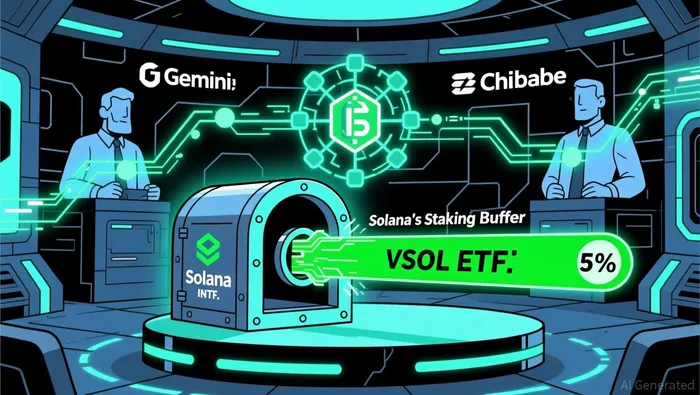
The fund's custodial strategy further reinforces its institutional appeal. Assets are safeguarded by Gemini Trust and Coinbase Custody, both of which offer regulated, insured storage. This contrasts sharply with many crypto-native funds that rely on less transparent custodians. Additionally, VSOL's 5% liquidity buffer-a reserve to offset Solana's 2-day unbonding delays-ensures the fund can meet redemptions without destabilizing its staked positions. These structural safeguards make VSOLVSOL-- a rare hybrid: a crypto ETF that balances yield generation with the liquidity and security demands of institutional investors.
Institutional Adoption: Solana's Infrastructure Play
Solana's institutional adoption in Q3-Q4 2025 has been nothing short of explosive. Partnerships with Visa, Stripe, and PayPal have repositioned the network as a production-grade financial infrastructure, while its 65,000 TPS throughput and low fees make it ideal for DeFi and stablecoin settlements according to industry analysis. The U.S. Treasury's regulatory clarity on staking rewards has further accelerated this trend, with firms like Upexi holding $397 million in SOL as a balance-sheet asset.
VSOL is uniquely positioned to capitalize on this momentum. Its 0.30% fee-waived for the first $1 billion in assets-undercuts Grayscale's 0.35% GSOL, making it a cost-efficient entry point for institutions according to market reports. Meanwhile, the fund's staking strategy, managed by ISO 27001-certified validators, aligns with the risk-averse preferences of institutional investors as industry data shows. This is no longer a "crypto experiment"-it's a financial infrastructure play with real-world use cases.
Performance in Volatility: Staking Yields as a Hedge
The October–November 2025 market correction tested the mettle of staking-integrated ETFs. While SOL plummeted from $268 to $135, VSOL and GSOL demonstrated resilience. Grayscale's GSOL, which distributes 77% of staking rewards to shareholders, attracted $541 million in assets by mid-November. Bitwise's BSOL, which fully compounds staking rewards into its NAV, saw even stronger inflows, surpassing $545 million according to market reports.
VSOL's structure-retaining staking rewards within the NAV-offers a unique advantage. Even as SOL's price fell, the fund's NAV grew from staking, creating a decoupling effect. For instance, while SOL's price decline eroded headline returns, the undistributed rewards provided a tailwind for long-term holders. This is a critical differentiator in a market where volatility is the new normal.
Strategic Implications for Investors
VSOL's success hinges on three pillars: yield generation, regulatory alignment, and institutional trust. By integrating staking into a traditional ETF wrapper, VanEck has created a product that appeals to both crypto-native and traditional investors. The fund's fee waivers and liquidity buffer further enhance its attractiveness in a market where capital preservation is paramount.
However, risks remain. Solana's price volatility could erode the benefits of staking yields if the market continues its downward trend. Additionally, the SEC's approval timeline for VSOL is still uncertain, though the fund's alignment with recent regulatory guidance suggests a favorable outcome according to industry analysis.
The Bottom Line
VanEck's VSOL ETF is more than a crypto product-it's a bridge between decentralized finance and institutional capital. In a market where yield is scarce and volatility is inevitable, its staking-integrated structure offers a compelling value proposition. For investors seeking exposure to Solana's institutional adoption without sacrificing liquidity or security, VSOL is a strategic play worth considering.





Comentarios
Aún no hay comentarios