
Valuation Realism in the AI Era: Is the Hype Overinflating Tech Stocks?
Nvidia's Earnings: A Tale of Two Narratives
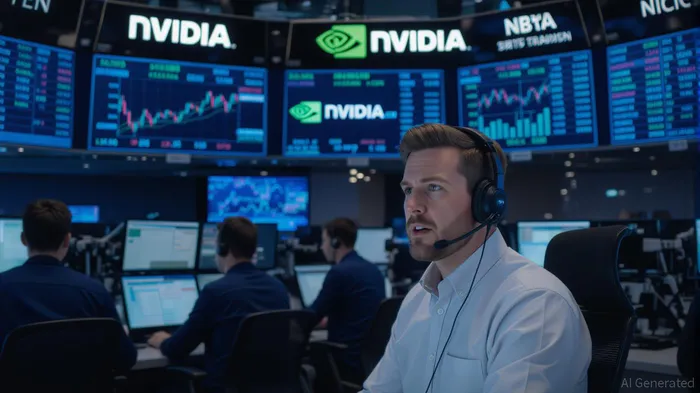 Nvidia's Q4 2025 results were nothing short of extraordinary. The company's data center revenue alone hit $51.2 billion in Q3 FY2026, driven by surging demand for its Blackwell AI supercomputers. Analysts praised the performance, with Evercore raising its price target to $352 (implying 95% upside) and Raymond James upgrading the stock to "strong-buy". Yet, even as the stock initially dipped 3% post-earnings due to valuation concerns, it stabilized at $179 within a week. This duality-strong fundamentals versus short-term skepticism-reflects the broader market's struggle to reconcile Nvidia's dominance with fears of overvaluation.
The company's forward P/E ratio of 30x as of October 2025 appears modest compared to the peak 472x P/E of Cisco during the dot-com era. However, critics argue that Nvidia's valuation is still precarious given its role as the "picks and shovels" provider for AI infrastructure. With institutional ownership at 65% and retail enthusiasm undimmed on platforms like WallStreetBets, the stock's trajectory remains a barometer for the sector's health.
The AI Sector's Fragile Valuation Premise
While Nvidia's performance is a bright spot, the broader AI sector is under siege. Pure-play AI software firms like C3.ai have seen their stock plummet over 26% in a month, with revenue declining 19% year-over-year. The company's consideration of a sale or private fundraising highlights the fragility of business models that lack consistent cash flow. Meanwhile, the AI sector's enterprise value-to-sales (EV/Sales) ratios have drawn comparisons to the dot-com bubble, with some startups valued at $400M–$1.2B per employee.
This exuberance is not without justification. The AI revolution is real, with large language models and generative AI tools already transforming industries. Yet, as one analyst noted, "Investors are demanding more concrete evidence of commercial success beyond the largest cloud and chip companies to justify current valuations." The challenge lies in distinguishing between scalable, profitable AI applications and speculative hype.
Historical Parallels and Divergences
The dot-com bubble of 2000 offers a cautionary tale. At its peak, the Nasdaq-100 traded at a forward P/E of 60x according to historical analysis, while many companies had no revenue. By contrast, today's AI leaders-Nvidia, Microsoft, and Apple-are established profit-generators. However, the current rally shares similarities with the past: explosive gains concentrated in a handful of names (the "Magnificent Seven") and infrastructure providers (Nvidia's 1,150% return since 2023).
A key divergence lies in the quality of underlying technology. Unlike the dot-com era's "vaporware," AI's foundational tools-such as large language models-have tangible applications. Yet, the sector's reliance on debt-fueled infrastructure spending raises concerns. Analysts project $1.5 trillion in cumulative data center and AI infrastructure debt by 2028, a figure that could strain sustainability if adoption slows.
The Bubble Debate: Hype vs. Reality
The AI bubble debate hinges on two questions: (1) Are valuations justified by fundamentals, and (2) Is the sector overconcentrated in a few names?
On the first question, Nvidia's revenue growth (up 62% YoY to $57 billion) and the AI sector's enterprise demand suggest realism. However, the EV/Sales ratios of AI startups and the lack of profitability for many generative AI firms according to analysis hint at overvaluation.
On the second, the Magnificent Seven now trade at a collective forward P/E of 38x according to financial analysis, exceeding the dot-com peak average of 30x for tech leaders. This concentration risks a sharp correction if sentiment shifts, as seen in the 2.2% drop in the Nasdaq Composite following Nvidia's earnings report according to market data.
Conclusion: A Balancing Act for Investors
The AI sector's valuation realism lies in its duality: a mix of transformative potential and speculative excess. For NvidiaNVDA--, the challenge is maintaining its growth trajectory while managing expectations. For the broader sector, the path forward requires proving that AI's promise can be monetized at scale.
Investors must navigate this landscape with caution. While the AI revolution is likely to deliver long-term value, the current rally's sustainability depends on whether the hype can be tempered by tangible results. As one fund manager put it, "The AI bubble isn't about the technology-it's about the pricing."





Comentarios
Aún no hay comentarios