
Valmont's (VMI) Q2 Earnings Beat and Strategic Momentum in Infrastructure and Agriculture: A Case for Long-Term Value
Valmont Industries (VMI) has long been a bellwether for industrial resilience, and its Q2 2025 earnings report reaffirmed its strategic agility in navigating macroeconomic headwinds. Despite a 2.8% operating margin—a sharp decline from 14.2% in the prior-year period—driven by $112.1 million in non-recurring charges, the company's operational execution, capital returns, and long-term positioning in infrastructure and agriculture merit a closer look for investors. The question remains: Does Valmont's strategic momentum justify a buy opportunity, even as short-term margin pressures persist?
Operational Execution and Margin Resilience
Valmont's Q2 results were a mixed bag. Net sales rose 1.0% year-over-year to $1.05 billion, with Infrastructure and Agriculture segments showing divergent trends. The Infrastructure segment, which accounts for 72.6% of revenue, faced headwinds in Solar and international markets but offset these with strong Utility and Telecommunications growth. Agriculture, meanwhile, delivered 2.7% revenue growth, driven by international expansion in the EMEA and Brazil regions.
The $112.1 million in charges—primarily goodwill and intangible impairments in the Solar and Access Systems businesses—were a drag on profitability. However, these one-time costs were part of a deliberate realignment strategy initiated by CEO Avner Applbaum. The company expects $22 million in annualized cost savings by 2026, with 28.1% higher operating cash flows in Q2 ($167.6 million) demonstrating underlying strength. Shareholders also benefited from $113.6 million in returns through buybacks and dividends, underscoring Valmont's commitment to capital efficiency.
Infrastructure: Navigating Solar Woes, Leveraging Core Strengths
The Infrastructure segment's $765.5 million in Q2 sales highlighted both challenges and opportunities. Solar sales plummeted due to overcapacity and falling prices in the U.S., but Utility and Telecommunications demand surged. This reflects broader industry trends: utilities are accelerating grid modernization, while telecom carriers are investing in 5G and fiber infrastructure.
Valmont's competitive edge lies in its vertically integrated supply chain and coatings expertise. Its ability to deliver durable, corrosion-resistant infrastructure components—a critical need in aging utility and telecom networks—positions it to capture market share. For instance, the company's Utility segment grew 5.9% in Q4 2024, driven by pricing discipline and product mix improvements.
Despite Solar's struggles, Valmont's realignment strategy is a calculated move. By exiting low-margin solar projects and streamlining operations, the company is redirecting resources to higher-margin areas like Utility and Telecommunications. This aligns with global infrastructure spending forecasts, which project $1.2 trillion in U.S. investments alone over the next decade.
Agriculture: Precision Tech and International Expansion
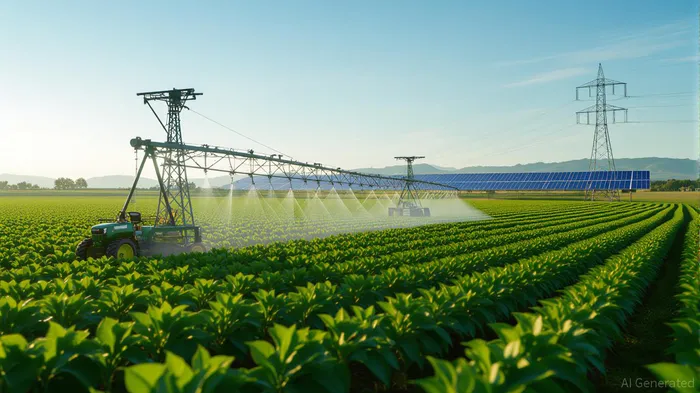
The Agriculture segment's 2.7% revenue growth was underpinned by international demand, particularly in Brazil and the EMEA region. While North American sales dipped due to lower storm-related replacement demand, Valmont's focus on precision agriculture technology—such as data-driven irrigation systems—has offset softness. Operating income margins improved to 12.5% of sales in Q2, aided by cost discipline in North America and higher-margin international projects.
The company's 2025 Sustainability Report underscores its alignment with ESG trends, a growing differentiator in agriculture. By optimizing water usage and reducing environmental impact, Valmont's irrigation solutions appeal to both farmers and regulators. For example, its center pivot systems now incorporate AI-driven analytics, enabling real-time adjustments to water and fertilizer application.
Competitive Landscape and Industry Tailwinds
Valmont faces competition from peers like FlowserveFLS-- (FLS) and TimkenTKR-- (TKR), but its diversified product portfolio and global footprint give it an edge. While Flowserve boasts a higher return on equity (19.56% vs. Valmont's 11.76%), Valmont's infrastructure sales ($765.5 million in Q2) and operating cash flow ($167.6 million) outperform its peers. Moreover, Valmont's strategic focus on international agriculture—where it has a 30%+ market share—provides a buffer against North American volatility.
Industry tailwinds further bolster Valmont's case. Global infrastructure spending is set to grow 6.5% annually through 2030, while precision agriculture adoption is projected to expand 12% annually. Valmont's recent $32 million in capital expenditures for capacity expansion and its 9.7% Q2 backlog increase signal readiness to scale.
Valuation and Investment Thesis
At first glance, Valmont's 18.55 price-to-earnings ratio (as of Q2 2025) appears elevated compared to its 10-year average of 16. However, this must be viewed through the lens of its long-term growth drivers. The company raised its 2025 adjusted EPS guidance to $17.50–$19.50, reflecting confidence in cost savings and margin expansion.
For investors, the key trade-off is short-term margin compression versus long-term structural growth. Valmont's realignment costs will weigh on 2025 earnings, but the $22 million in annualized savings by 2026 and its leadership in high-growth infrastructure and agriculture segments justify a bullish outlook. Additionally, its $1.0 dividend yield and $100 million in buybacks during Q2 signal management's conviction in its intrinsic value.
Conclusion: A Buy for the Patient Investor
Valmont's Q2 earnings may not dazzle at first glance, but the company's strategic clarity and operational discipline are compelling. The short-term margin hit from realignment is a necessary investment in long-term resilience. With infrastructure demand surging and agriculture markets expanding, Valmont is well-positioned to deliver compounding returns for patient investors. While volatility remains a risk—particularly in Solar—its core strengths in Utility, Telecommunications, and international agriculture make VMIVMI-- a compelling buy for those with a three- to five-year horizon.





Comentarios
Aún no hay comentarios