
Valley National Bancorp's Q3 2025 Earnings Outlook: Strategic Positioning in a Stabilizing Regional Banking Sector
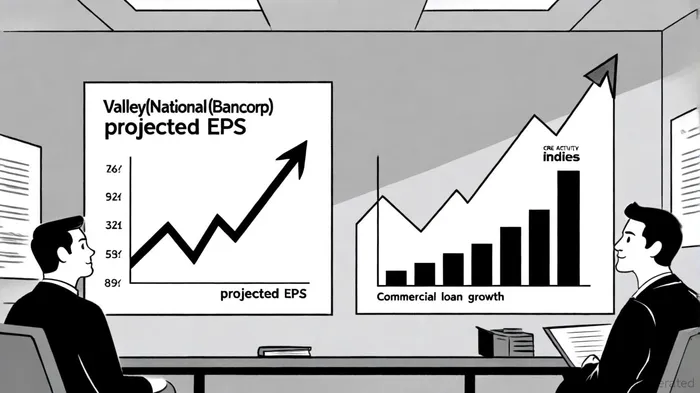
Regional banks are navigating a pivotal inflection point in 2025, as commercial real estate (CRE) stabilization and disciplined balance-sheet management begin to yield tangible results. For Valley National BancorpVLY-- (VLY), the third quarter of 2025 represents a critical juncture to demonstrate its strategic agility in a sector poised for cautious optimism. With earnings expected to reflect a blend of asset repricing tailwinds and commercial loan growth, Valley's performance will serve as a barometer for the broader regional banking landscape.
Earnings Expectations and Analyst Optimism
Analysts project Valley National BancorpVLY-- to report earnings per share (EPS) of $0.25 for Q3 2025, with a consensus range of $0.25–$0.27[1]. This aligns with the company's historical trajectory, including a 51% year-over-year EPS increase in prior forecasts[4]. Revenue is estimated to reach $511.64 million, reflecting a 9.3% year-over-year growth rate observed in Q2 2025[4]. These figures underscore Valley's ability to capitalize on its $63 billion asset base while navigating macroeconomic headwinds such as delayed Federal Reserve rate cuts[4].
The company's net interest margin (NIM) strategy—centered on disciplined deposit pricing and asset repricing—positions it to benefit from the current interest rate environment. As noted in Q2 2025 earnings calls, Valley has maintained a focus on optimizing NIM without sacrificing deposit growth, a critical differentiator in a sector where margin compression has historically been a drag[2].
Strategic Initiatives: Commercial Loan Growth and Sector Specialization
Valley's strategic emphasis on commercial and industrial (C&I) lending has yielded consistent results. Its C&I portfolio has grown at a 19% compound annual growth rate (CAGR) since 2017, with nearly 15% growth in the past 12 months[2]. This momentum is driven by targeted infrastructure investments in treasury solutions and credit appetite expansion, particularly in high-growth sectors like technology and healthcare[2]. Such specialization allows Valley to diversify risk while tapping into industries with resilient demand, even as broader CRE markets stabilize.
The regional banking sector as a whole is witnessing a shift in CRE dynamics. According to LightBox CRE Activity Index projections, CRE lending is expected to rise by 25% in 2025 as banks re-engage with the sector after years of deleveraging[1]. Valley's CEO, Ira Robbins, has signaled anticipation of stabilized CRE balances by year-end 2025, with modest growth projected for 2026[2]. This aligns with broader industry trends, including S&P Global Ratings' revised stable outlook for banks and a decline in nonaccrual CRE loans to 1.7% in 2024[4].
Sector Stabilization and Macroeconomic Tailwinds
The U.S. economic backdrop further supports regional banks' near-term resilience. With GDP growth projected at 2% over the next two years and unemployment stabilizing at 4.2%[4], demand for credit remains robust. For Valley, this environment amplifies the benefits of its low-cost deposit base and risk-managed lending approach. Analysts have upgraded long-term earnings expectations for Valley, citing its ability to balance growth with prudence[4].
However, challenges persist. Inflationary pressures and the delayed impact of Fed rate cuts could temper loan demand in the short term[4]. Valley's strategic focus on high-quality commercial borrowers and its avoidance of speculative CRE segments position it to weather such volatility better than peers with weaker balance sheets.
Conclusion: A Test of Resilience and Execution
Valley National Bancorp's Q3 2025 earnings, scheduled for release on October 23, 2025[3], will be a key test of its strategic positioning. With a 16.16% earnings growth forecast for 2026[4] and a sector-wide pivot toward stabilization, the company's ability to deliver on its C&I loan growth and NIM optimization goals will determine its trajectory in the coming year. Investors should closely watch the October 23 conference call, where CEO Ira Robbins will provide insights into Valley's progress in navigating the evolving regional banking landscape[3].
Historically, VLY's shares have shown a mild negative drift following earnings announcements, with an average decline of -2.3% by day 10 and a win rate not exceeding 48% in the first 30 days[4]. This suggests that while the company's strategic initiatives are promising, investors should be cautious about short-term post-earnings momentum.





Comentarios
Aún no hay comentarios